


 English
 Español
 русский
 عربى
 中文简体

Lin Qian — International Sales Manager
52-Inch Three-System Full-Function Shoe Upper Knitting Machine for High-Capacity Flyknit Production
Date:Oct 14, 2026
Content
- 1 Why Wide-Format Shoe Upper Knitting Matters
- 2 Three-System Single-Carriage Architecture
- 3 Precision Sinker System with Stepping Motor Control
- 4 Full-Function Knitting for Advanced Shoe Upper Designs
- 5 52-Inch Capacity for Large-Scale Production
- 6 1GB Intelligent Control System
- 7 2×8 Yarn Carrier Configuration
- 8 Stitch Density and Take-Down Control
- 9 Servo-Controlled Racking and Stable Drive Performance
- 10 Computer-Controlled Needle Selection
- 11 Protection and Production Safety Functions
- 12 Manufacturing Strengths and Engineering Capability
- 13 Advanced Production Process Considerations
- 14 Advantages Over Standard and Narrower Competitor Models
- 15 Applications for the GS-V352
- 16 Production Workflow Recommendations
- 17 Quality Control in Flyknit Upper Production
- 18 Business Value for Footwear Manufacturers
- 19 Q&A
- 19.1 What type of machine is the GS-V352?
- 19.2 What is the knitting width?
- 19.3 What is the maximum knitting speed?
- 19.4 What knitting functions are supported?
- 19.5 Why is the sinker system important?
- 19.6 How much design data can the control system store?
- 19.7 Does the machine support multi-color production?
- 19.8 Can the machine reduce sewing and cutting work?
- 19.9 What type of racking system does it use?
- 19.10 What power supply is required?
- 19.11 Who is the machine best suited for?
- 19.12 How does it compare with a standard 36-inch machine?
- 20 Conclusion
- 21 References
- 22 Product: GS-V352 52-Inch Three System Full-Function Shoe Upper Knitting Machine
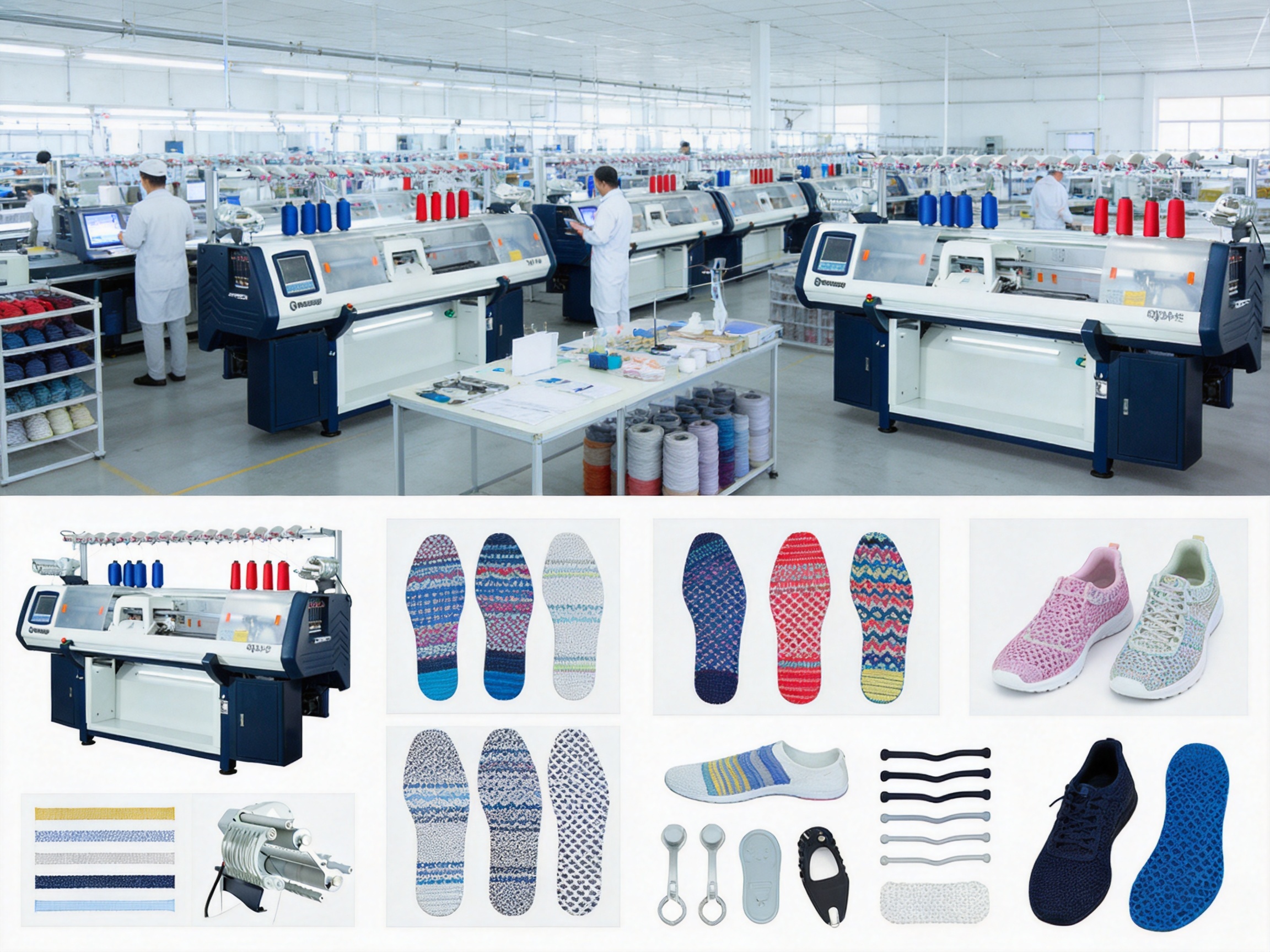
52-Inch Three-System Full-Function Shoe Upper Knitting Machine for High-Capacity Flyknit Production
The development of knitted footwear has changed the requirements placed on modern textile machinery. Shoe upper manufacturers must now produce lightweight, breathable, elastic, durable, and visually distinctive structures while maintaining high output and consistent quality. At the same time, customers increasingly expect shorter delivery cycles, more product variations, lower material waste, and greater flexibility in responding to changing footwear designs.
The GS-V352 52-Inch Three System Full-Function Shoe Upper Knitting Machine is designed to address these production challenges. It combines a wide 52-inch knitting format, a three-system single-carriage configuration, precision motor-controlled knitting elements, comprehensive shaping functions, multi-color yarn carrier capability, and a 1GB intelligent control system. Together, these features create a professional production platform for large-scale flyknit shoe uppers, sports goods, and other advanced knitted products.
Unlike a basic shoe upper knitting machine designed primarily for standard structures, the GS-V352 is intended for manufacturers that require both capacity and design freedom. It is suitable for businesses producing multiple footwear styles, complex upper patterns, three-dimensional structures, elastic zones, ventilation areas, and color-rich jacquard designs. Its wide working format also provides a practical path for increasing production capacity without relying only on additional machine units.
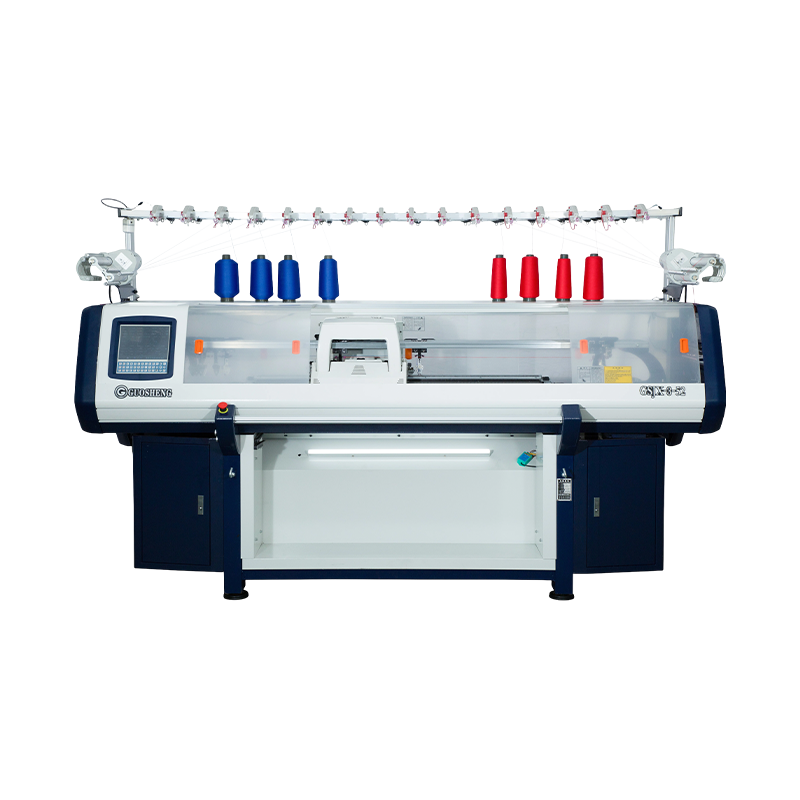
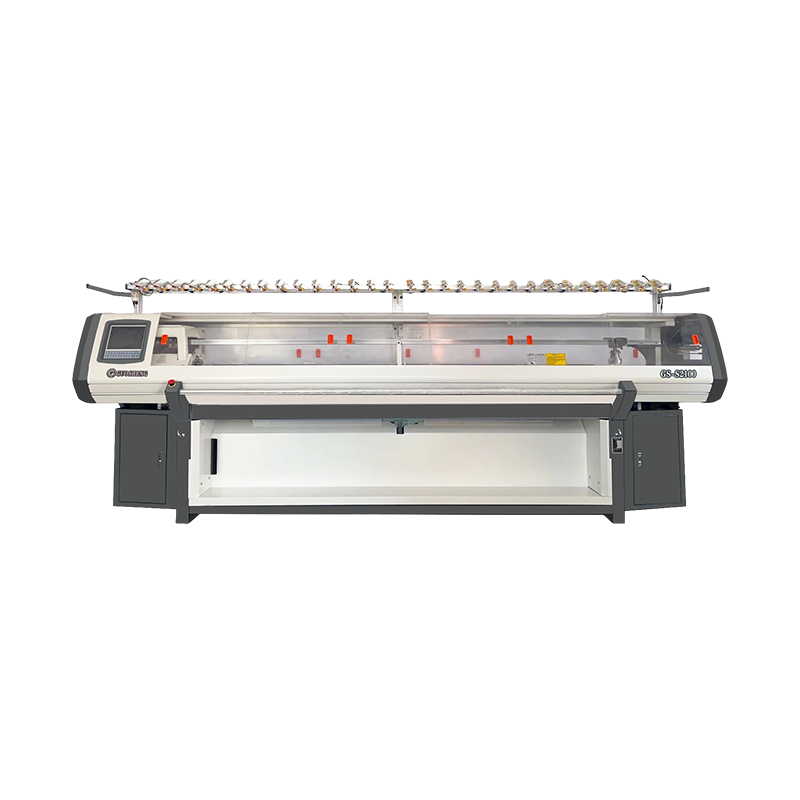
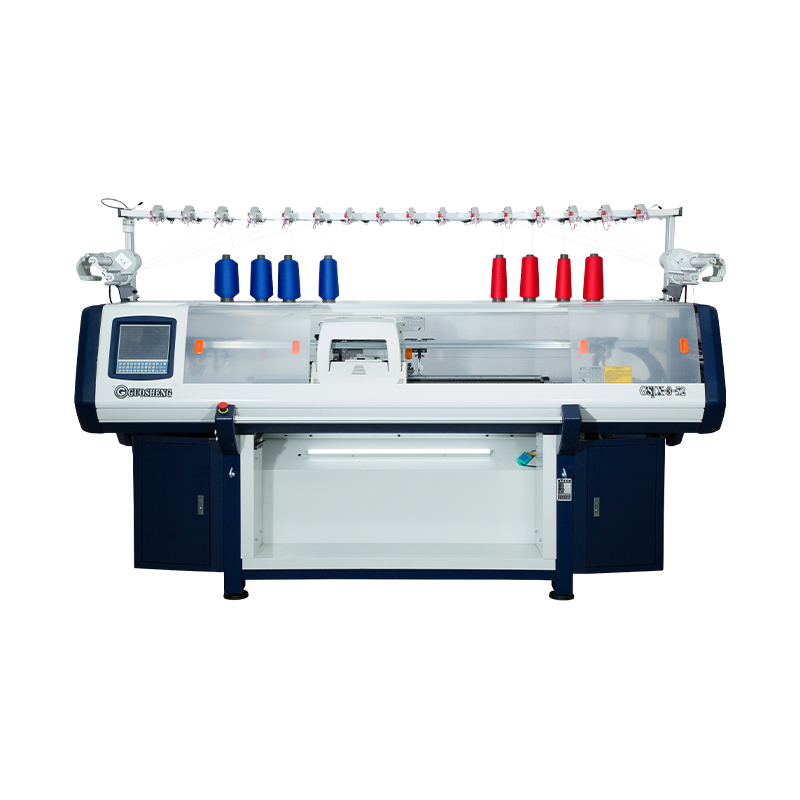
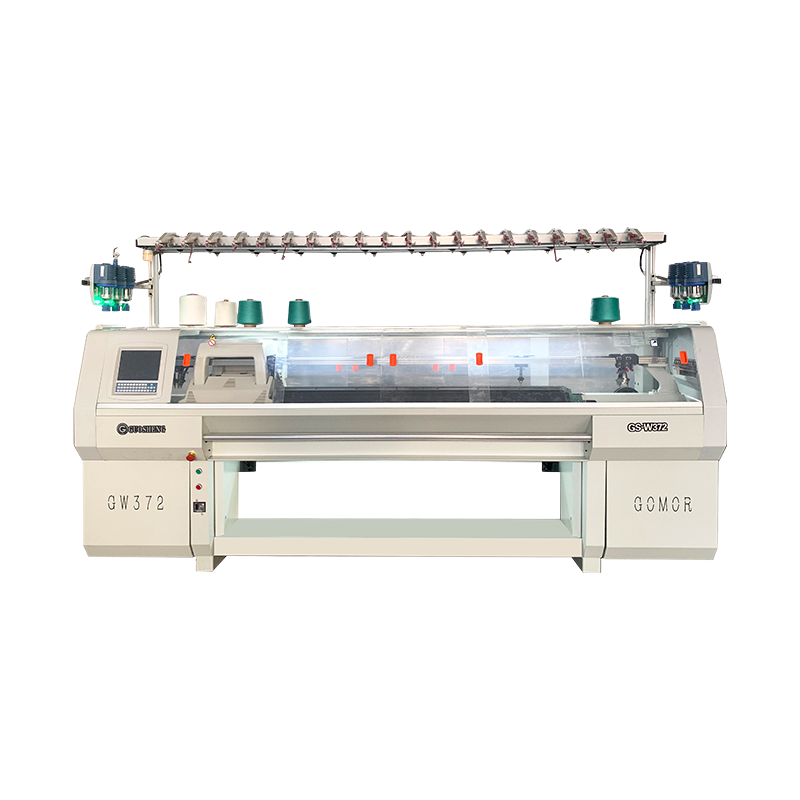
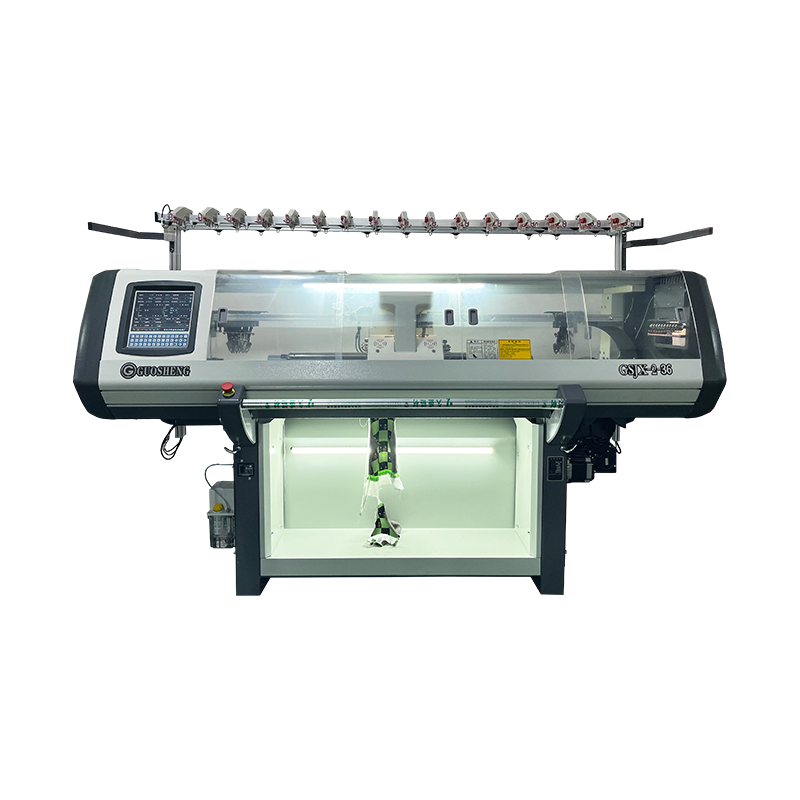
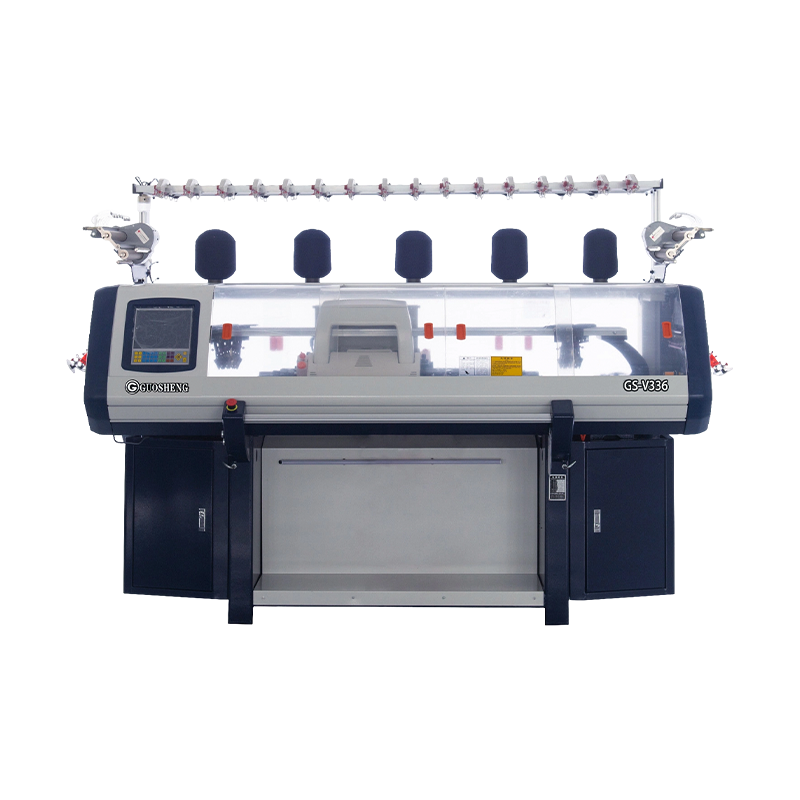
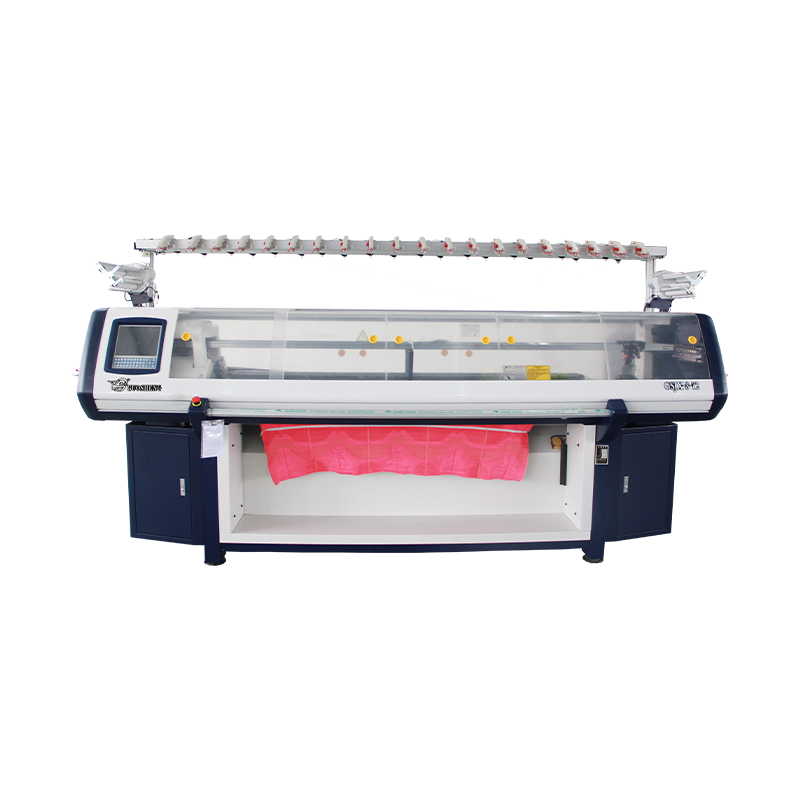
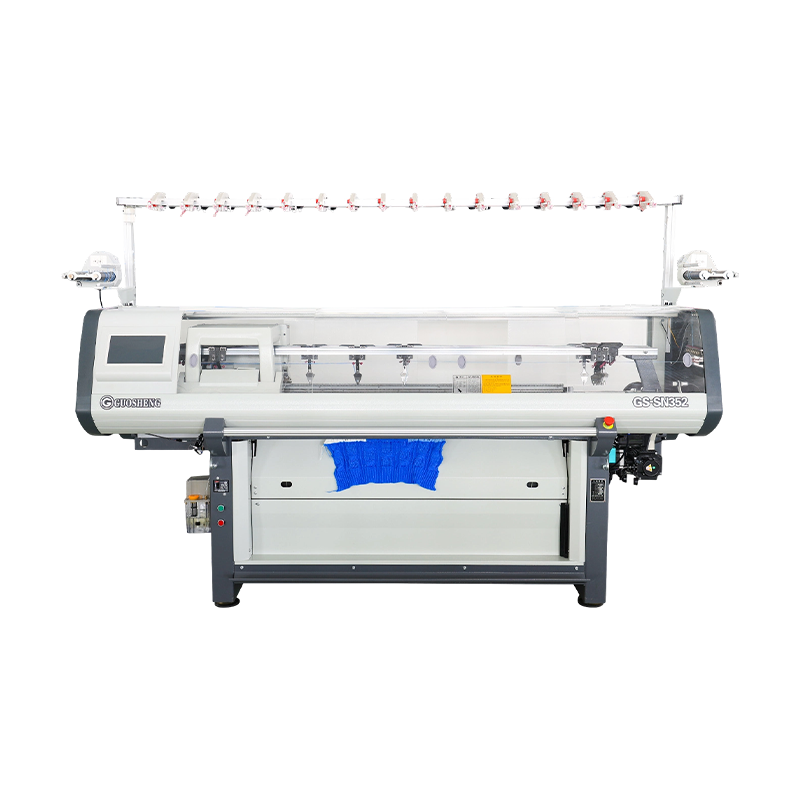
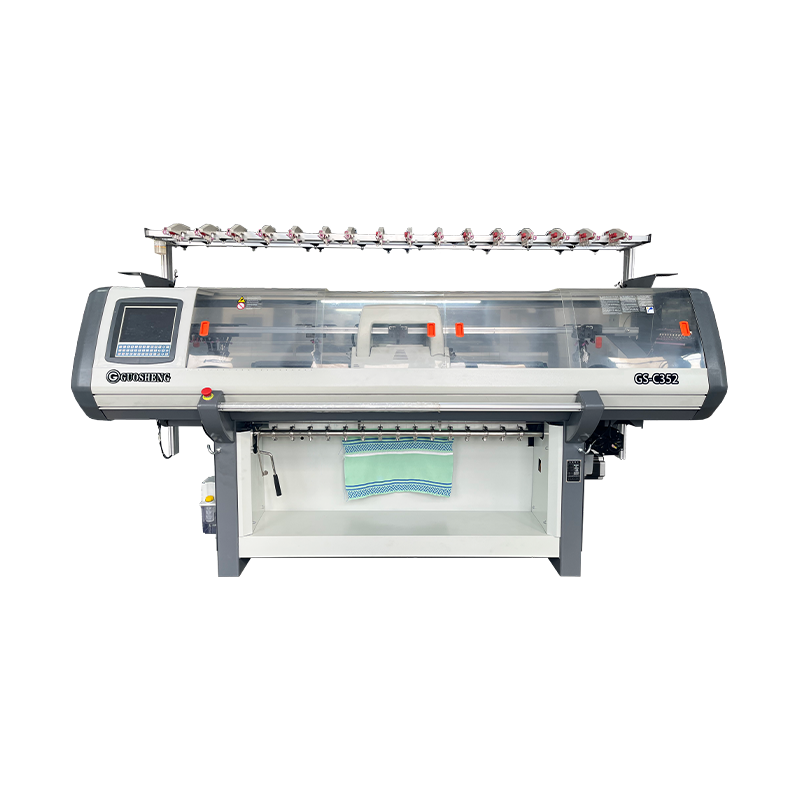
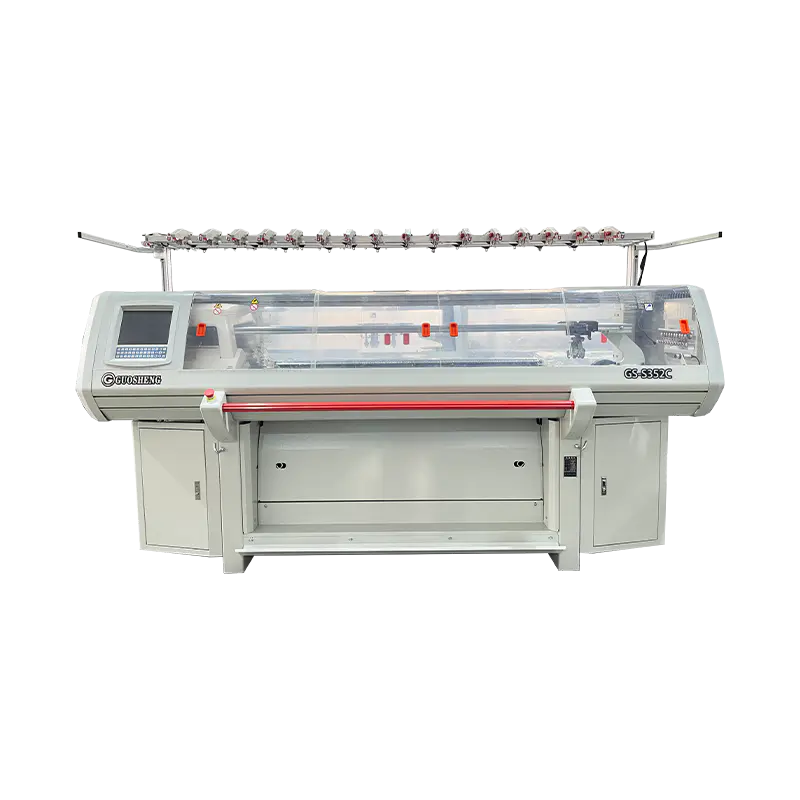
GS-V352 52-Inch Three System Full-Function Shoe Upper Knitting Machine
Why Wide-Format Shoe Upper Knitting Matters
Knitted shoe uppers are often manufactured from engineered yarn structures that combine several functional zones in one product. A single upper may include tightly knitted support areas, open ventilation mesh, elastic sections, reinforced edges, decorative patterns, and shaped transitions around the toe, heel, and collar. Producing these areas efficiently requires a machine capable of controlling yarn, stitch density, fabric take-down, sinker action, carriage movement, and shaping operations with high accuracy.
The working width of a machine has a direct influence on production planning. A standard-width machine may be effective for a limited range of upper sizes or simpler product formats, but a wider machine can offer greater layout flexibility. The GS-V352 provides a 52-inch knitting width, allowing manufacturers to arrange more production areas within a single working cycle or accommodate larger and wider product structures.
Compared with a conventional 36-inch format, the 52-inch width represents a substantial increase in available knitting space. This can help manufacturers produce more shoe upper components in parallel, depending on the pattern size, yarn specification, machine settings, and production layout. It can also support larger sports goods and wider engineered textile products that may be difficult to manage efficiently on a narrower platform.
Wide-format production can create several operational benefits. First, it allows production planners to organize patterns more efficiently. Second, it can reduce the number of machine units needed for a specific order volume. Third, it supports a broader product range, including larger shoe sizes and specialized sports applications. Finally, greater usable width can help manufacturers respond to high-volume orders without expanding floor space in direct proportion to output requirements.
It is important to note that actual output depends on the structure being knitted, yarn type, stitch density, pattern complexity, operator skill, and machine settings. Nevertheless, the 52-inch format gives the production department a larger technical foundation than standard-width equipment. This makes the GS-V352 particularly suitable for footwear manufacturers seeking scalable production capacity.
Three-System Single-Carriage Architecture
The GS-V352 uses a three-system single-carriage configuration. In flat knitting machinery, the system arrangement influences how many knitting actions can be performed during each carriage pass. A three-system design enables more operations within the same general carriage movement than a single-system configuration and can provide greater productivity than simpler machine architectures when producing compatible structures.
The three-system structure is especially valuable for shoe upper production because modern upper designs frequently combine several actions in one programmed sequence. Transfer, tuck, miss, jacquard, intarsia, and shaping operations may need to be coordinated within a single product. A machine with multiple systems can provide more opportunities to organize these actions efficiently while maintaining a continuous production rhythm.
The single-carriage design also supports coordinated movement across the wide working area. With a maximum knitting speed of 1.2 meters per second, the machine is engineered to maintain a stable production rhythm while processing wide-format upper patterns. Speed alone does not determine productivity; the machine must also maintain accurate yarn control, reliable needle selection, consistent stitch formation, and stable fabric take-down. The GS-V352 is designed around this combined requirement.
Compared with a basic single-system machine, the GS-V352 can offer a stronger balance between production speed and functional capability. Compared with equipment intended only for narrow or standard-width production, it provides greater working capacity for large-scale operations. The key competitive advantage is not simply the number of systems, but the way the three-system architecture works together with wide-format knitting, intelligent control, multiple yarn carriers, and advanced shaping functions.
For factories producing several upper styles, the three-system arrangement can also support more efficient programming of repeated production operations. Properly prepared programs may reduce unnecessary carriage movements and help improve overall machine utilization. This is particularly valuable when production schedules include complex designs that would require multiple stages or considerable manual intervention on less capable machinery.
Precision Sinker System with Stepping Motor Control
The sinker system plays an important role in fabric formation, yarn control, shaping, and stopping effects. In three-dimensional shoe upper production, the sinker must respond accurately to different fabric zones. A ventilation area, structural support zone, elastic section, and edge transition may each require different knitting behavior.
The GS-V352 uses a stepping motor-controlled sinker system. This design allows precision adjustment according to fabric characteristics and programmed knitting requirements. Rather than relying on a fixed or limited sinker setting, the system can be adjusted for different yarn materials, stitch structures, and shaping requirements.
Motorized sinker control is valuable because three-dimensional shoe upper fabric is not uniform across its entire surface. Some areas must remain open and breathable, while others must provide support or resistance to deformation. Some edges must be shaped accurately, and some transition zones must be stabilized to maintain the intended upper geometry. Fine sinker adjustment helps the machine manage these changes with greater control.
The system also supports different shaping and stopping effects. This can improve the formation of edges, openings, transitions, and other structural details. Consistent sinker behavior across the full 52-inch width is particularly important because wide-format knitting can magnify any inconsistency between the center and outer areas of the working field.
Compared with a machine using less adjustable sinker technology, the GS-V352 offers manufacturers greater process flexibility. Operators can optimize settings for different yarn compositions and fabric constructions instead of using one general adjustment for every product. This can improve fabric uniformity, reduce the risk of unstable formation, and support more accurate development of new upper designs.
Full-Function Knitting for Advanced Shoe Upper Designs
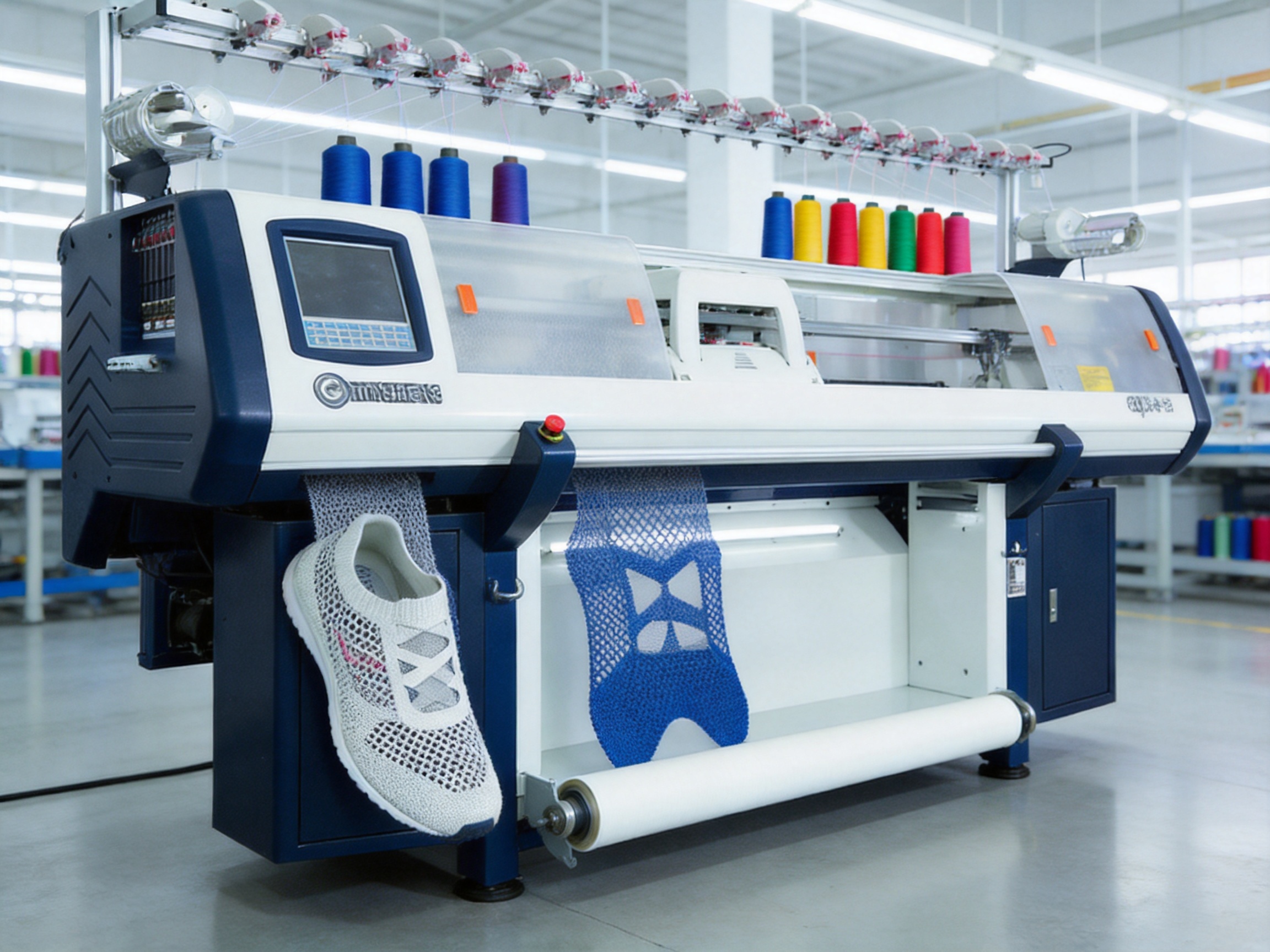
The GS-V352 supports transfer, tuck, miss, jacquard, intarsia, hide shaping, and apparent shaping. These functions give designers and production engineers a broad set of tools for developing functional and decorative upper structures.
Transfer Knitting
Transfer knitting allows loops to move between needles. This function can be used to create changes in width, decorative structures, shaped areas, and complex fabric transitions. In shoe uppers, transfer operations may contribute to localized shaping, structural reinforcement, or design details that would be difficult to achieve with basic knit-and-miss programming alone.
Tuck Knitting
Tuck structures can increase fabric thickness, add texture, improve local stability, or create visual patterns. A footwear designer may use tuck knitting in support zones or decorative sections where additional structure is required. Carefully controlled tuck operations can help balance flexibility and reinforcement within the same knitted upper.
Miss Knitting
Miss knitting provides another method for controlling surface appearance, openness, and yarn interaction. It can support the development of mesh effects, visual lines, and programmed pattern details. When integrated with other functions, miss knitting helps create complex upper surfaces without requiring separate finishing operations.
Jacquard Knitting
Jacquard capability is essential for multi-color and pattern-rich footwear designs. Athletic shoes increasingly use brand graphics, geometric motifs, contrasting panels, and color transitions as part of their product identity. The GS-V352 supports jacquard production across its wide knitting area, helping manufacturers create visually distinctive uppers with integrated color patterns.
Intarsia Knitting
Intarsia allows different yarn colors to be placed in specific areas while limiting unnecessary yarn float across the design. This is useful for clean color blocks, logos, contrasting panels, and carefully defined graphic elements. Intarsia can also help improve the appearance and wear behavior of selected upper areas when the yarn arrangement is properly engineered.
Hide and Apparent Shaping
Support for hide and apparent shaping is one of the GS-V352’s important full-function advantages. These functions allow upper edges and three-dimensional areas to be formed more precisely during the knitting process. The result can be a product with more accurate contours and less dependence on downstream cutting and sewing.
Reducing post-knitting operations can provide several benefits. It may lower labor requirements, shorten the production route, reduce material waste, and improve consistency between batches. It can also help preserve the intended shape of the designed upper. For manufacturers producing high-value or technically complex flyknit products, integrated shaping is a major advantage over equipment limited to simpler knitted panels.
52-Inch Capacity for Large-Scale Production
The wide working format is one of the clearest differences between the GS-V352 and standard-width shoe upper knitting machines. At 52 inches, the machine is designed for production environments where output capacity, layout efficiency, and product flexibility are critical.
Manufacturers may use the wider format in different ways. Some may arrange multiple smaller upper components side by side. Others may use the available width for larger shoe sizes, sports goods, protective products, or specialized technical textiles. The best arrangement depends on the pattern dimensions and production requirements, but the additional space gives the factory more choices.
A wider machine can also help consolidate production. When one machine can complete a greater number of compatible pieces within a working cycle, the factory may be able to reduce the number of machines assigned to a particular order. This does not eliminate the need for production planning, but it can improve the utilization of floor space, operators, power, and auxiliary resources.
In a competitive footwear supply chain, capacity must be evaluated together with flexibility. A high-output machine that can only produce a narrow range of designs may not provide sufficient value when orders change frequently. The GS-V352 combines wide capacity with full-function knitting, allowing the same equipment to support standard upper production as well as more complex and customized designs.
The machine may therefore be suitable for manufacturers serving sports footwear brands, private-label customers, contract production programs, and development-oriented businesses. Its wide format can contribute to production scale, while its programmable capabilities help support the increasing variety of modern knitted footwear.
1GB Intelligent Control System
Modern computerized knitting equipment must manage more than mechanical movement. It must store design files, coordinate machine functions, display operating information, support parameter adjustments, and help operators respond to changing production requirements. The GS-V352 includes a 1GB control system memory, representing a significant increase over conventional 256MB storage capacity.
Complex three-dimensional shoe upper programs can require substantial memory because they may contain many structural instructions, color changes, shaping operations, stitch variations, and machine-control parameters. A larger memory capacity allows factories to store more design files directly in the machine system.
The practical advantage is improved multi-style flexibility. Operators can retain numerous upper patterns instead of frequently deleting and transferring files. This can simplify product changeovers and reduce the time required to locate and load a specific design. It is particularly useful for factories that produce many colors, sizes, customer specifications, or seasonal models.
The control system uses an LCD display and USB input. The monitoring menu can show operating parameters, allowing operators to review machine status and make adjustments while the machine is running. Real-time parameter access can help production personnel respond to changes in yarn behavior, fabric formation, stitch density, take-down requirements, or other operating conditions.
The visual design system is intended to be easy to understand and upgrade. A user-oriented interface can reduce training difficulty, especially when operators must manage several product programs. Multi-language support, including Chinese and English, also makes the system more suitable for international manufacturing environments.
Another important feature is power-off memory. If an unexpected interruption occurs, the machine can retain production information at the power-off moment. This helps protect design data and production progress. Although power-off memory cannot eliminate every consequence of an interruption, it provides an important safeguard for production continuity and reduces the risk of losing valuable program information.
2×8 Yarn Carrier Configuration
The GS-V352 is equipped with a 2×8 yarn carrier arrangement mounted on both sides of four guide rails. This configuration supports yarn changes at any needle position, creating the flexibility needed for multi-color and multi-structure flyknit production.
Modern shoe uppers often use multiple yarns in one design. Different yarns may be selected for appearance, elasticity, softness, strength, abrasion resistance, ventilation, or support. In color-rich jacquard designs, the ability to change yarn positions accurately is essential for producing clean patterns and minimizing unnecessary limitations in layout.
With 2×8 yarn carriers on each side, the machine provides a substantial carrier resource for complex patterns. The carrier arrangement supports the development of color contrasts, localized structural zones, and repeated pattern elements across the wide knitting area. It can also reduce the need to compromise on design placement simply because a yarn carrier cannot reach a required position.
Compared with simpler carrier arrangements, the GS-V352 provides greater flexibility for footwear manufacturers that produce multiple colors or complex upper graphics. The value of this system becomes particularly clear when combined with jacquard, intarsia, transfer, and shaping functions. These features work together to support integrated upper production rather than treating color, structure, and shape as separate processes.
Stitch Density and Take-Down Control
Consistent fabric quality depends heavily on the relationship between stitch formation and fabric take-down. If stitch density is not properly controlled, the finished fabric may show differences in thickness, elasticity, openness, or dimensional stability. In a shoe upper, such differences can influence comfort, fit, appearance, and performance.
The GS-V352 uses stepping motor control for stitch density and provides 32 selectable stitch sections. The adjustable range is supported by subdivision technology from 0 to 650. This gives operators and pattern engineers a detailed control framework for adjusting the tightness and formation of different product areas.
Different regions of a shoe upper may require different stitch settings. A toe area may need a specific degree of flexibility, while a heel or side-support zone may require a denser construction. A ventilation mesh may require openness, while a logo or edge structure may need greater definition. Section-based stitch control helps the machine produce these variations within one programmed product.
The take-down roller is also controlled by a stepping motor and provides 32 selectable levels, with an adjustable area from 0 to 100. Accurate take-down control helps regulate fabric tension as the knitted structure is formed. Proper tension management is important for maintaining uniform dimensions and minimizing unwanted deformation.
Stitch and take-down control should be optimized together. If the stitch density is changed without considering fabric pull, the result may not match the intended structure. The GS-V352’s programmable systems allow manufacturers to coordinate these parameters for different yarns, patterns, and production conditions.
Servo-Controlled Racking and Stable Drive Performance
Racking is an important movement in flat knitting because it enables the needle bed relationship to shift during pattern formation and shaping. The GS-V352 uses an AC servo motor to control racking within a two-inch range and includes a fine-adjustment function.
Servo control provides accurate positioning and repeatability. Fine adjustment is especially valuable for developing engineered upper structures where small positional differences can affect the alignment of stitches, shaping lines, and visual patterns. Accurate racking can also support transfer operations and complex dimensional transitions.
The machine uses a synchronous belt drive and AC servo system. This combination is designed to provide smooth and stable movement during production. Stable drive performance helps reduce unnecessary vibration and supports consistent carriage operation across the wide knitting format.
A dependable drive system is important because the machine may operate for long production cycles and process demanding programs with frequent changes in speed, direction, and function. Mechanical stability contributes to product consistency and can also help reduce stress on key moving components when the equipment is properly operated and maintained.
Computer-Controlled Needle Selection
The needle selection system is controlled by computer and uses an electric magnet needle selection mechanism. Accurate needle selection is central to computerized knitting because every pattern depends on the correct activation and deactivation of individual needles.
For shoe upper production, needle selection must support a wide range of structures, including mesh zones, support panels, decorative patterns, shaped edges, and multi-color sections. A high-efficiency needle selection system helps translate digital pattern instructions into repeatable physical fabric formation.
Computer control also allows manufacturers to modify and store product programs. This supports product development, sampling, customer customization, and repeat orders. Once an approved design program has been created and verified, it can be retained for future production, subject to appropriate quality-control procedures and machine settings.
Protection and Production Safety Functions
Unplanned machine interruptions can affect delivery schedules, fabric quality, yarn consumption, and equipment utilization. The GS-V352 includes a protection system that automatically generates alarms for several abnormal conditions.
These conditions include yarn breakage, float yarn, rewinding faults, end-of-knitting signals, racking failure, needle breakage, and programming errors. Detecting these conditions promptly allows operators to investigate the cause before a larger quantity of defective fabric is produced.
Yarn breakage and float yarn detection are particularly important in complex upper structures. If an issue is not identified quickly, it may create visible defects across a large section of the product. Racking and needle-related alarms also help protect against continued operation under unsuitable conditions.
Protection functions do not replace operator attention or preventive maintenance. Instead, they provide an additional layer of monitoring. Operators should still inspect yarn paths, needle beds, carriers, sinkers, take-down components, drive systems, and electrical connections according to the manufacturer’s procedures.
Early alarm response can help reduce waste and improve equipment availability. It can also support a more disciplined production environment because operators receive direct feedback when the machine detects a condition outside the programmed or expected operating range.
Manufacturing Strengths and Engineering Capability
The GS-V352 is produced by Guosheng Wonderful Intelligent Technology (Changshu) Co., Ltd., a specialized manufacturer focused on the research, development, manufacturing, and global supply of computerized knitting machinery. The company is located in Changshu, Jiangsu Province, an important textile machinery manufacturing region in China.
Manufacturing in a mature textile machinery cluster provides access to an established industrial ecosystem. This environment can support specialized component sourcing, engineering cooperation, manufacturing expertise, technical labor, and supply-chain coordination. For a computerized knitting machine, these capabilities are important because product performance depends on the integration of mechanical structures, electrical systems, control software, precision components, and production assembly.
The company’s product portfolio includes computerized flat knitting machines, collar knitting machines, and flyknit shoe upper knitting machines. This range gives the manufacturer experience across several knitted product categories. Knowledge gained from sweater, collar, accessory, and footwear applications can contribute to broader understanding of stitch formation, yarn behavior, shaping, fabric tension, and production control.
The GS-V352 reflects an engineering approach that combines mechanical precision with intelligent control. The stepping motor-controlled stitch system, motorized sinker system, servo-controlled racking, synchronous belt drive, computer needle selection, programmable take-down, and high-capacity memory are not isolated features. They form an integrated production platform in which mechanical actions and digital instructions work together.
The company also focuses on practical production requirements. Textile manufacturers need more than a list of technical functions. They require stable operation, understandable controls, repeatable quality, flexible pattern programming, manageable maintenance, and reliable support for different product types. The GS-V352 has been developed around these operational priorities.
For international customers, multilingual control support and USB-based design input can simplify communication between machine users, pattern departments, and technical teams. The ability to store many files and adjust parameters during operation also supports factories that must respond quickly to different markets and customer programs.
Advanced Production Process Considerations
Producing a high-performance computerized knitting machine requires careful coordination at multiple stages. The design must begin with clear performance objectives, including working width, knitting speed, system arrangement, control precision, machine protection, and product application. These objectives must then be translated into mechanical and electronic systems that operate together reliably.
Mechanical Integration
Mechanical integration involves the needle bed, carriage, sinker system, yarn carrier rails, take-down roller, racking mechanism, drive components, and supporting frame. Each component must be positioned and adjusted accurately. In a wide-format machine, alignment becomes especially important because small deviations may become more noticeable across the full working width.
The wide 52-inch structure requires stable support and consistent movement. The synchronous belt drive and servo system are designed to provide controlled carriage motion, while the racking mechanism must maintain accurate positioning during programmed operations. The sinker system must also respond consistently across the machine’s working area.
Electronic and Control Integration
The electronic system must coordinate needle selection, carriage movement, stitch density, take-down, racking, sinker behavior, yarn carrier operations, alarm functions, and power-off memory. This requires reliable communication between control hardware, sensors, motors, and software.
A 1GB memory system gives the machine sufficient storage capacity for large and numerous design files. However, memory capacity is most valuable when combined with a clear interface and stable file-management process. The LCD display and USB input are intended to make pattern transfer and parameter monitoring more practical for everyday factory use.
Testing and Adjustment
Before a machine enters production, its mechanical and electronic systems must be tested and adjusted. Testing may include carriage movement, needle selection, yarn carrier positioning, stitch control, take-down operation, racking accuracy, sinker action, alarm response, and power interruption recovery.
Trial knitting is also important. A machine must demonstrate not only that its components move correctly, but that it can produce fabric with the expected quality. Test programs may include different stitch densities, yarn materials, colors, shaping operations, and fabric structures. These trials help verify the coordination between the digital program and physical knitting process.
For footwear applications, testing should reflect the demands of actual upper production. This may include open mesh zones, dense support areas, elastic sections, jacquard patterns, intarsia blocks, shaped edges, and three-dimensional transitions. Such testing helps ensure that the equipment is suitable for practical production rather than only basic demonstration patterns.
Advantages Over Standard and Narrower Competitor Models
The GS-V352 should be evaluated against the needs of a production operation rather than by one specification alone. Its advantages become most apparent when compared with standard-width, lower-system, or limited-function shoe upper machines.
First, the 52-inch knitting width provides greater capacity and layout flexibility than a typical 36-inch model. This can support more parallel production, larger product formats, and better utilization of factory resources.
Second, the three-system single-carriage architecture offers more knitting actions per carriage pass than a basic single-system design. This can improve productivity when producing compatible patterns and may reduce the number of separate operations required for complex structures.
Third, the stepping motor-controlled sinker system provides more precise adjustment for different fabric characteristics than a less flexible sinker arrangement. This is valuable for three-dimensional upper formation and mixed structural zones.
Fourth, support for hide and apparent shaping gives the machine capabilities that may not be available on standard shoe upper equipment. These functions can reduce cutting and sewing requirements while helping create cleaner and more accurate upper contours.
Fifth, the 1GB control memory is substantially more suitable for multi-style operations than conventional lower-capacity systems. Factories producing numerous upper patterns can store more design files and reduce the frequency of file management interruptions.
Sixth, the 2×8 yarn carrier configuration provides strong support for multi-color jacquard and intarsia production. Designers have more freedom to position yarn changes and develop color-rich upper patterns across the wide working area.
Seventh, the combination of servo racking, motorized stitch density, programmable take-down, and computer needle selection provides a more comprehensive control structure than basic machines that rely on fewer adjustable parameters.
These advantages do not mean that every factory requires the largest or most function-rich machine. A smaller model may be suitable for limited production, simple designs, or lower investment requirements. The GS-V352 is most appropriate when the manufacturer values wide capacity, product variety, advanced shaping, and long-term production flexibility.
Applications for the GS-V352
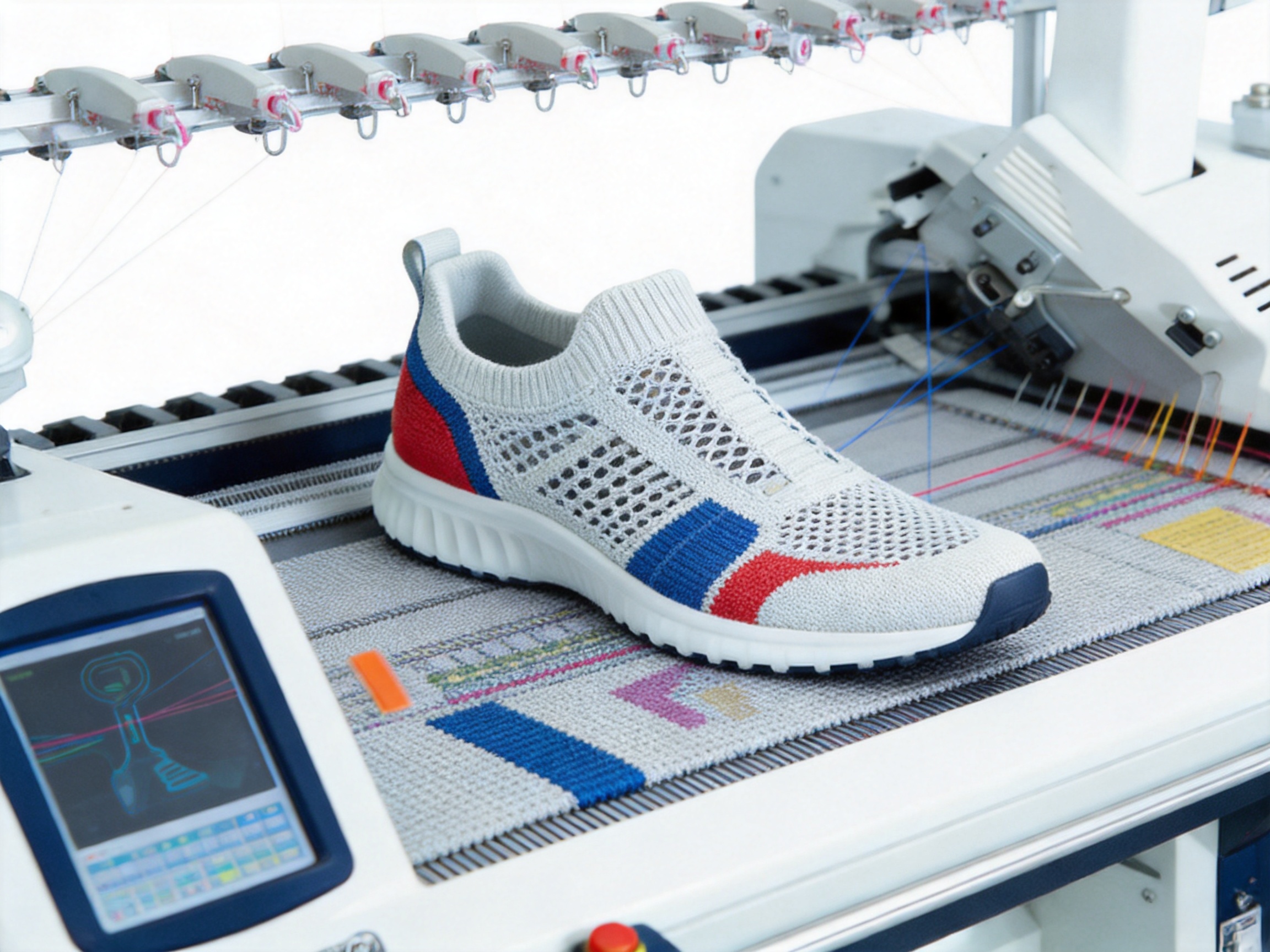
The primary application of the GS-V352 is knitted shoe upper production. It is suitable for sports shoes, casual footwear, running shoes, lifestyle footwear, and other products that use engineered knitted upper structures.
The machine can also support sports goods and functional knitwear. Its wide format may be useful for protective products, elastic technical panels, sports accessories, and other textile components requiring programmed structures and controlled shaping.
Potential application areas include breathable mesh uppers, supportive athletic uppers, multicolor fashion footwear, performance shoe components, seamless or reduced-seam upper structures, and customized product programs. Actual suitability depends on yarn selection, pattern development, finishing requirements, and customer specifications.
Manufacturers may also use the machine for sampling and product development. The large memory capacity allows multiple trial files to be retained, while the full-function system gives designers more freedom to evaluate different stitch structures. This can accelerate the transition from concept design to approved production pattern.
Production Workflow Recommendations
To achieve the best results, manufacturers should establish a disciplined workflow from design preparation through final inspection. The first step is to define the performance requirements of the shoe upper, including flexibility, breathability, support, stretch, abrasion resistance, appearance, and dimensional stability.
Pattern engineers should then select appropriate stitch structures and determine where transfer, tuck, miss, jacquard, intarsia, hide shaping, and apparent shaping will be used. These functions should be planned in relation to the physical requirements of each upper zone rather than used only for decorative purposes.
Yarn selection is equally important. Different yarns may require different stitch density, take-down, sinker, and carrier settings. Trial production should be used to verify how each yarn behaves under the intended machine parameters.
Operators should monitor the LCD display and review operating parameters during production. If a change in fabric behavior is detected, adjustments should be made carefully and recorded for future reference. Maintaining accurate records can improve repeatability when the same design is produced again.
Preventive maintenance should include inspection and cleaning of the needle bed, sinker area, yarn carriers, guide rails, take-down roller, drive system, electrical connections, and other relevant components. A clean and properly adjusted machine is more likely to produce stable fabric and reduce unexpected interruptions.
Quality Control in Flyknit Upper Production
Quality control should begin with incoming yarn inspection. Yarn count, composition, elasticity, color, surface condition, and winding quality can all affect the final upper. Inconsistent yarn may lead to variations in stitch formation or appearance even when the machine is operating correctly.
During knitting, inspectors should check fabric width, stitch uniformity, pattern alignment, color placement, mesh openness, edge formation, shaping accuracy, and visible defects. The protection system can provide alarms, but visual and dimensional inspection remain necessary.
After knitting, the upper should be assessed for its intended functional properties. Depending on the product, this may include stretch recovery, breathability, tensile behavior, abrasion resistance, seam or bonding compatibility, and dimensional stability after finishing.
Because the GS-V352 can produce complex structures, quality standards should be defined for each functional zone. A ventilation area should not be evaluated by the same criteria as a reinforced heel area. Establishing zone-specific standards helps ensure that the design performs as intended.
Business Value for Footwear Manufacturers
The value of a shoe upper knitting machine extends beyond its purchase price. Manufacturers should consider production capacity, labor requirements, pattern flexibility, material utilization, product quality, changeover efficiency, and the ability to accept future orders.
The GS-V352 can contribute to business value through its wide knitting format and three-system architecture. More production space and more knitting actions may help increase output, while integrated shaping can reduce downstream operations. The full-function configuration can also support a broader range of customer requirements.
High memory capacity may reduce the time associated with switching between multiple product programs. This is useful for factories that produce many styles in relatively small or medium batches. Faster changeovers can improve machine utilization and help manufacturers respond to market demand.
Reduced cutting and sewing requirements may also lower labor consumption and material waste. The actual savings depend on the product design and production method, but integrated knitting has the potential to simplify the overall manufacturing route.
Most importantly, the machine can help manufacturers move from basic upper production toward more advanced engineered footwear. This supports product differentiation, which is increasingly important in a market where appearance, comfort, performance, sustainability, and rapid design changes influence purchasing decisions.
Q&A
What type of machine is the GS-V352?
The GS-V352 is a 52-inch three-system single-carriage full-function shoe upper knitting machine. It is designed primarily for flyknit shoe uppers, sports goods, and other advanced knitted products.
What is the knitting width?
The machine has a 52-inch knitting width. This wide format can support more parallel production, larger product structures, and greater layout flexibility than standard-width machines.
What is the maximum knitting speed?
The maximum listed knitting speed is 1.2 meters per second. Actual production speed depends on pattern complexity, yarn characteristics, stitch density, shaping requirements, and operating conditions.
What knitting functions are supported?
The machine supports transfer, tuck, miss, jacquard, intarsia, hide shaping, and apparent shaping. These functions provide flexibility for decorative, structural, and three-dimensional shoe upper designs.
Why is the sinker system important?
The sinker system helps control yarn and fabric formation. The GS-V352 uses stepping motor control, allowing precision adjustment for different yarns, fabric structures, shaping effects, and three-dimensional upper zones.
How much design data can the control system store?
The control system includes 1GB of memory. This allows factories to store a large number of design files, including complex upper programs, without constantly removing older files.
Does the machine support multi-color production?
Yes. The 2×8 yarn carrier configuration, together with jacquard and intarsia functions, supports multi-color and pattern-rich flyknit upper production.
Can the machine reduce sewing and cutting work?
Its hide shaping and apparent shaping functions can help create more accurate upper contours during knitting. Depending on the product design, this may reduce downstream cutting and sewing requirements.
What type of racking system does it use?
The machine uses an AC servo motor-controlled racking system with a two-inch range and fine-adjustment capability.
What power supply is required?
The listed power supply is 220 volts, single-phase. The machine also includes a power-off memory function to help retain production information during unexpected interruptions.
Who is the machine best suited for?
The GS-V352 is best suited for footwear manufacturers, contract knitting factories, sports product producers, and technical textile businesses that require wide-format capacity, complex functions, multi-style flexibility, and programmable production control.
How does it compare with a standard 36-inch machine?
The GS-V352 provides a wider 52-inch working format, a three-system configuration, more comprehensive shaping functions, a larger memory capacity, and a more flexible yarn carrier arrangement. These features may support higher capacity and a broader range of products, although actual performance depends on the production program and operating conditions.
Conclusion
The GS-V352 52-Inch Three System Full-Function Shoe Upper Knitting Machine is designed for manufacturers that need more than basic knitted upper production. Its wide format provides greater capacity and layout flexibility, while its three-system single-carriage architecture supports efficient multi-action knitting. The stepping motor-controlled sinker system, programmable stitch density, adjustable take-down, servo racking, and computer needle selection provide the precision required for modern engineered footwear.
Its full range of transfer, tuck, miss, jacquard, intarsia, hide shaping, and apparent shaping functions allows manufacturers to create complex upper structures with integrated color, ventilation, elasticity, support, and three-dimensional form. The 1GB control system and 2×8 yarn carrier configuration further strengthen its ability to manage large design files and multi-color production.
Manufactured by Guosheng Wonderful Intelligent Technology (Changshu) Co., Ltd., the machine reflects the integration of mechanical engineering, computerized control, textile application knowledge, and practical production requirements. Its design is intended to support stable operation, flexible pattern development, scalable capacity, and consistent knitted quality.
For footwear manufacturers seeking to expand production while improving design freedom and reducing dependence on downstream operations, the GS-V352 offers a comprehensive platform. It is particularly suitable for businesses targeting high-volume flyknit production, sports footwear, multi-style manufacturing, and advanced technical knitted products.
References
1. Product technical specification sheet for the GS-V352 three-system full-function shoe upper knitting machine.
2. Internal product information concerning computerized flat knitting machinery and flyknit upper production.
3. General engineering principles for computerized flat knitting, stitch-density control, take-down regulation, and servo positioning.
4. Textile manufacturing practices for engineered knitted footwear uppers and three-dimensional fabric formation.
5. Technical guidance on jacquard, intarsia, transfer, tuck, miss, and shaping functions in computerized knitting production.
6. Manufacturer background information concerning computerized knitting machinery research, development, manufacturing, and international supply.
Product: GS-V352 52-Inch Three System Full-Function Shoe Upper Knitting Machine

Ready to Begin?
Product Categories
- Sweater Knitting Machine (Economic SE)
- Sweater Knitting Machine (Full Function S)
- Collar Knitting Machine (Economic CE)(Fabric)
- Collar Knitting Machine (Full-Function C)
- Blanket Knitting Machine(Fabric)
- Shoe Upper Knitting Machine
- Ready To Wear Sweater Knitting Machine
- Ready To Wear Glove Knitting Machine
- Ready To Wear Hat Knitting Machine
- Knee Pad Knitting Machine
- Metal Mesh Knitting Machine
Contact Information
-
 Email: gs@guoshengchina.cn
-
 Phone: +86-0512-52690511
-
 Address: No. 18, Hupu Pujiang Road, Bixi New District, Changshu City, Jiangsu Province, China
QR Code
