


 English
 Español
 русский
 عربى
 中文简体

Nwachukwu Meilin — Regional Sales Executive
Why an 80-Inch Double-Carriage Collar Knitting Machine Changes Large-Format Production
Date:Nov 05, 2026
Content
- 1 Large-Format Production Without a Single-Product Limitation
- 2 Product Advantages Compared With Conventional Narrower Equipment
- 3 Engineering Design for Stable Wide-Width Knitting
- 4 Consistent Fabric Handling Across 80 Inches
- 5 Automatic Cast-On and Faster Changeovers
- 6 Pattern Flexibility Through Computerized Needle Selection
- 7 Intelligent Control for Production Management
- 8 Protection Systems for Safer and More Reliable Production
- 9 Manufacturing Strengths Behind the Equipment
- 10 Applications in Different Manufacturing Environments
- 11 Operational and Commercial Benefits
- 12 Recommended Evaluation Points Before Purchase
- 13 Technical Specification Table
- 14 Frequently Asked Questions
- 14.1 What makes the GS-CE280H different from a conventional collar knitting machine?
- 14.2 Can the machine produce full rolls of ribbed fabric?
- 14.3 What types of products can be made?
- 14.4 What is the benefit of the 80-inch knitting bed?
- 14.5 How does automatic cast-on improve production?
- 14.6 Which gauges are available?
- 14.7 Does the machine support jacquard production?
- 14.8 How is fabric tension controlled?
- 14.9 What protection functions are included?
- 14.10 Is the machine suitable for small-batch customized production?
- 14.11 What should a buyer confirm before placing an order?
- 15 Conclusion
- 16 References
- 17 Product: GS-CE280H 80-Inch Single System Double Carriage Collar Knitting Machine
In modern knitwear manufacturing, flexibility is becoming as important as speed. Garment factories, textile trim suppliers, sportswear producers, and knitted accessory manufacturers are under continuous pressure to produce more product variations, respond faster to changing orders, reduce labor requirements, and maintain stable quality across long production runs. A machine designed for only one product width or one production method can limit factory utilization, particularly when demand changes between narrow collar components, extra-wide ribbed structures, and roll-format knitted fabric.
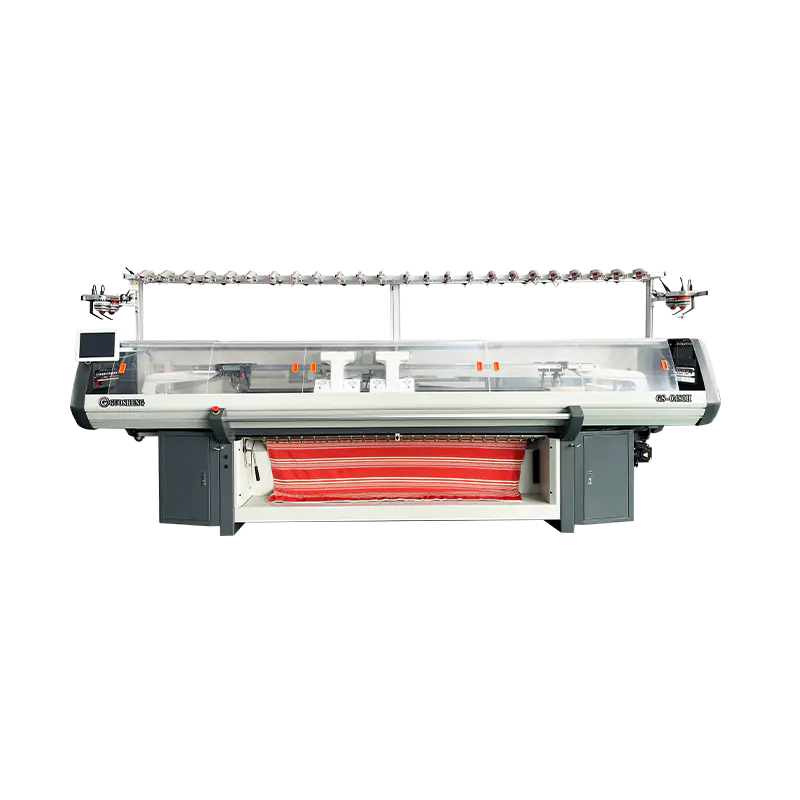
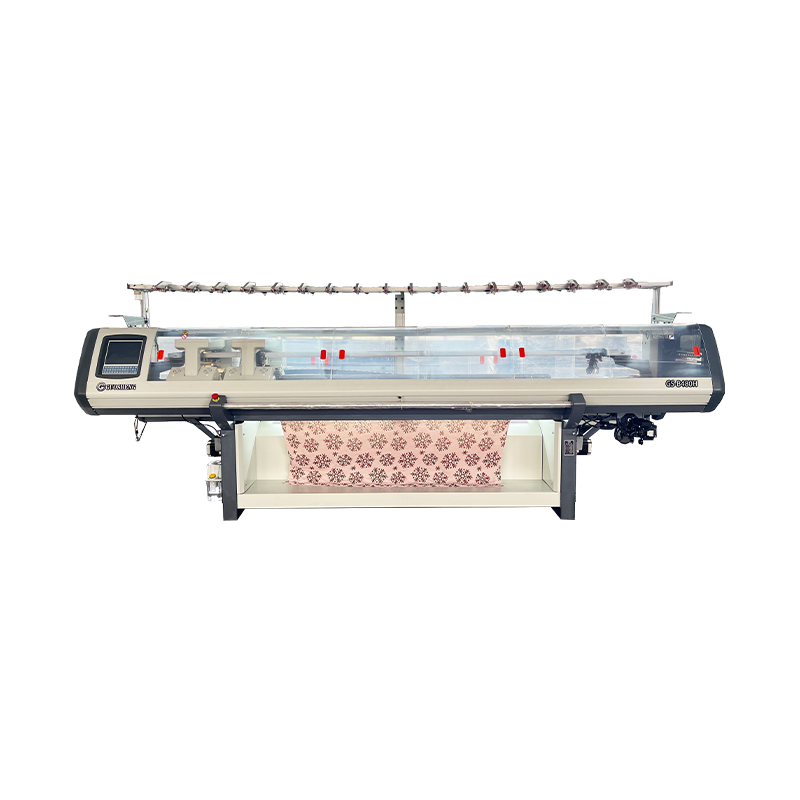
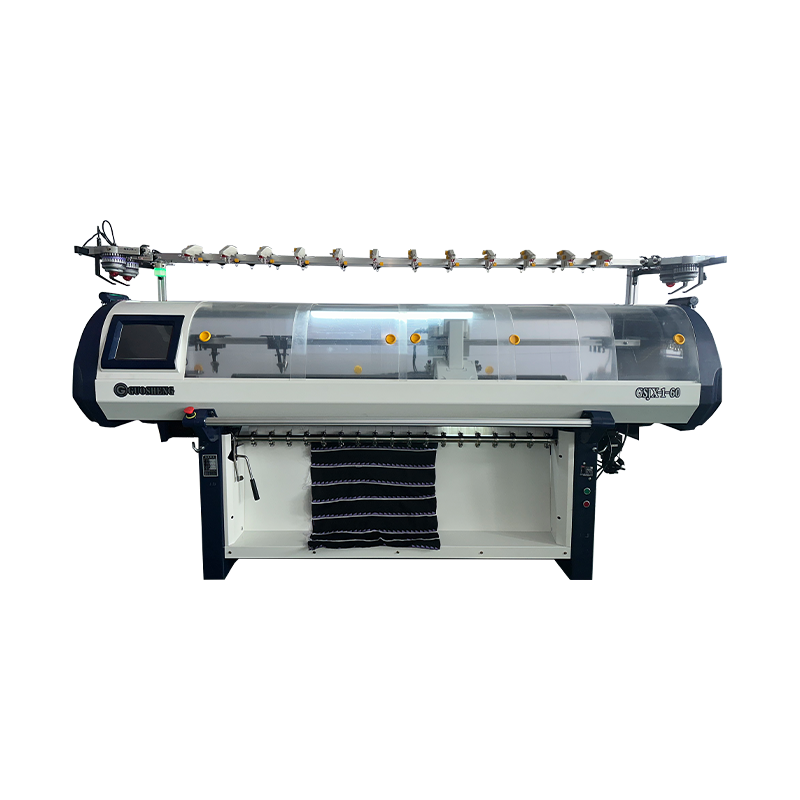
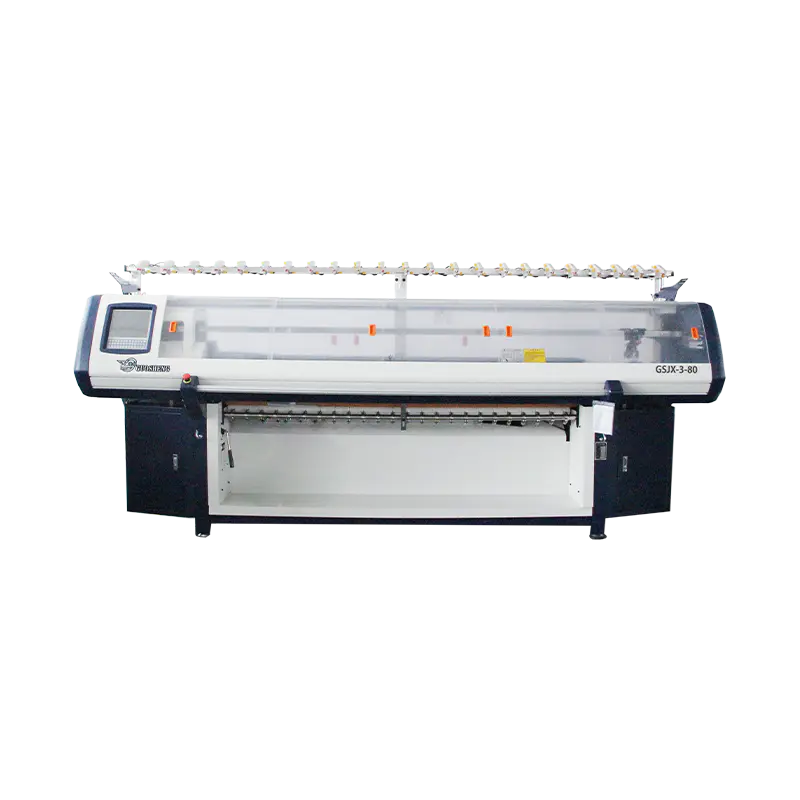
The GS-CE280H 80-Inch Single System Double Carriage Collar Knitting Machine is designed to address this challenge. It combines an extra-wide 80-inch knitting bed with a single-system double-carriage configuration. The two carriages can be merged for wide-format production or separated for simultaneous production in different zones of the needle bed. As a result, one machine can support multiple production strategies instead of being restricted to a single collar size or a single fabric format.
This dual-purpose concept gives the GS-CE280H a strong commercial advantage. In one operating mode, it can produce extra-wide ribbed collars, broad neckbands, oversized garment components, and wide-format knitted fabrics. In another mode, it can manufacture two narrower pieces at the same time, or operate as a productive platform for full rolls and multiple pieces of ribbed fabric. The machine therefore helps manufacturers balance specialized production with general-purpose capacity.
Developed by Guosheng Wonderful Intelligent Technology (Changshu) Co., Ltd., the machine reflects the company’s focus on computerized knitting machinery, practical textile engineering, intelligent control, and long-term production reliability. Its design combines a high-precision needle bed, motorized cam technology, computerized needle selection, automatic cast-on, multi-stage jacquard capability, and a comprehensive protection system.
For manufacturers evaluating large-format collar knitting equipment, the GS-CE280H is not simply a wider machine. It is a flexible production system intended to improve utilization, reduce changeover effort, expand product capability, and provide stable operation over extended shifts.
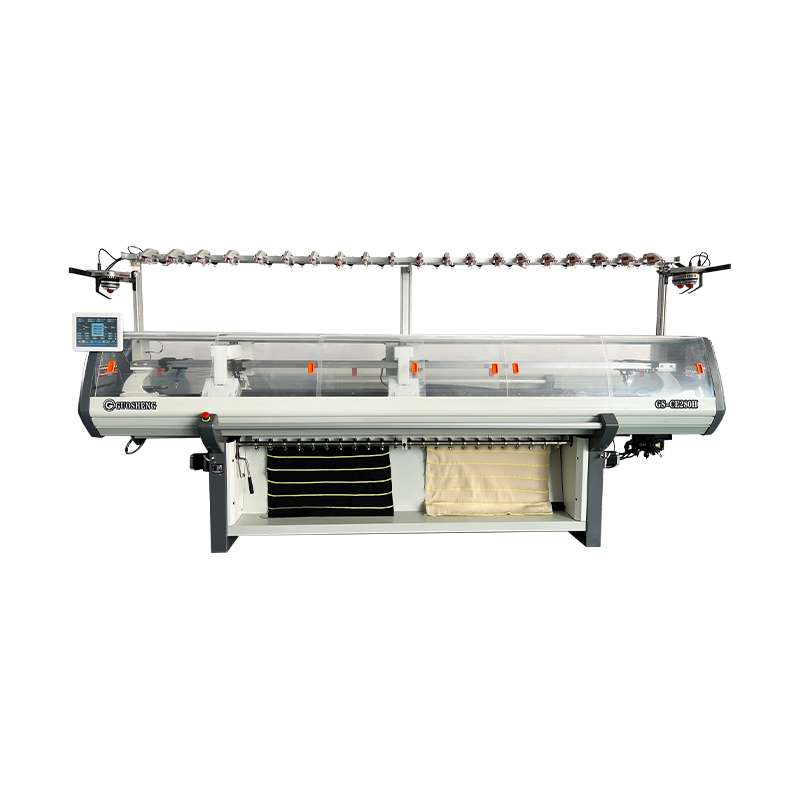
GS-CE280H 80-Inch Single System Double Carriage Collar Knitting Machine
Large-Format Production Without a Single-Product Limitation
The central strength of the GS-CE280H is its ability to combine extra-wide production with multi-piece output. Many knitting machines are optimized for a defined range of product sizes. A narrow machine may work efficiently for standard collars, but it cannot easily handle wide fabric or oversized components. A wide machine may provide capacity, but if it can only produce one large piece at a time, it may be inefficient when orders involve smaller products.
The 80-inch knitting width changes this balance. It provides sufficient working space for large-format ribbed structures while also allowing the machine to be used for multiple narrower pieces. This means that the same equipment can serve different departments, customers, and order types. A factory may use merged mode when an order requires a wide neckband or broad ribbed panel, then switch to separated mode when a high-volume order requires standard-width collar pieces.
This capability is especially valuable for manufacturers serving multiple markets. Garment brands may request different collar dimensions, sportswear producers may need wider or more elasticized components, and textile customers may purchase rib fabric by the roll. Instead of purchasing separate machines for every product category, a manufacturer can use one 80-inch platform to cover a broader commercial range.
The machine is also suitable for production planning where order volumes change throughout the year. During a period of high demand for wide components, the carriages can work together across the full bed. When the market shifts toward standard products, the carriages can work independently in separate zones. This helps reduce idle capacity and makes the equipment more adaptable to seasonal or project-based production.
Two Operating Modes in One Machine
In merged mode, the two carriages operate in coordination across the full knitting width. This arrangement supports large-format ribbed collars, oversized neckbands, wide garment trims, and broad-format knitted fabric. The combined working area is particularly useful when a product cannot be divided into separate narrow sections without creating additional joining or handling work.
In separated mode, the two carriages operate independently in different sections of the needle bed. This enables the simultaneous production of two narrower fabric pieces or collar components. The practical benefit is higher output from a single machine footprint. Rather than allowing the unused section of an extra-wide bed to remain inactive, the operator can use the available space for another product or for a second piece of the same design.
The ability to merge or separate the carriages also offers an advantage during order changes. A factory does not need to dedicate the entire machine to one production format for its entire service life. The operating method can be selected according to the size, quantity, and technical requirements of each order.
Product Advantages Compared With Conventional Narrower Equipment
When compared with conventional narrower collar knitting machines, the GS-CE280H provides several important advantages. The first is production width. An 80-inch bed gives the machine access to applications that are difficult or impossible for narrower models. These include broad ribbed fabrics, extra-wide collar components, large sportswear trims, and fabric production across a substantial continuous width.
The second advantage is production flexibility. A conventional single-width machine may require additional equipment when the product range expands. The GS-CE280H can cover both wide-format and multiple-piece production. This can reduce the need for separate investments and simplify factory layout, operator training, and maintenance planning.
The third advantage is utilization. A wide machine may normally appear excessive for smaller products, but the separated double-carriage configuration helps overcome this concern. When large-format orders are unavailable, the machine can be used for two narrower production zones. This provides a practical way to maintain output and improve equipment utilization.
The fourth advantage is the combination of width and automated control. A large knitting bed must maintain consistent stitch formation, traction, and yarn movement over a long working distance. The GS-CE280H uses computer-controlled functions, motorized stitch adjustment, servo-driven racking, programmed take-down, and automatic protection to support consistent production across the full width.
The fifth advantage is reduced manual preparation. The high-position roller enables automatic cast-on without requiring the operator to cover the fabric manually before starting a new product. On a machine with an 80-inch format, this can significantly reduce preparation time and physical effort. The wider the working area, the greater the potential benefit of eliminating manual fabric covering.
A Broader Product Portfolio From One Equipment Investment
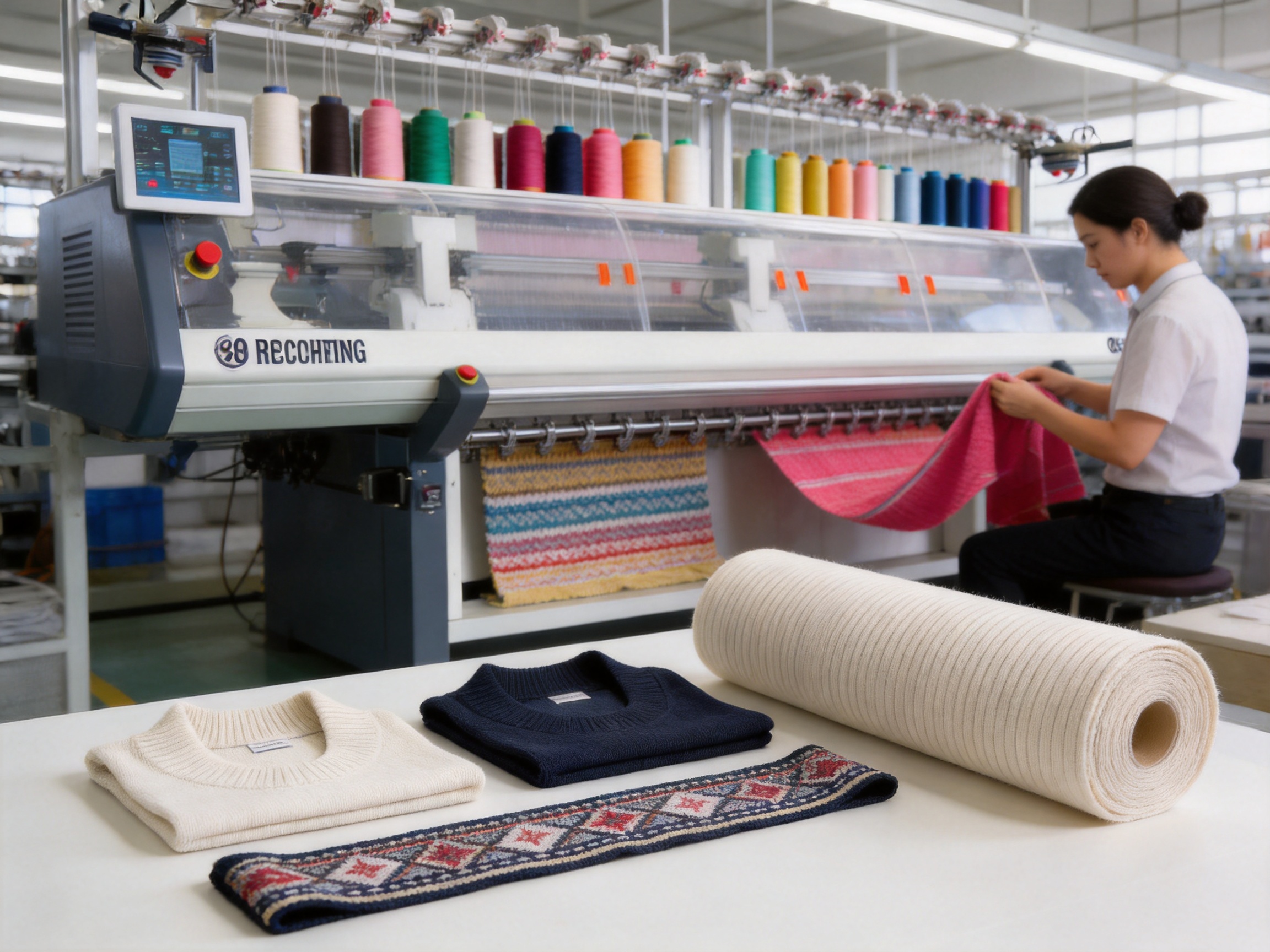
Manufacturers can use the GS-CE280H for a range of products, including extra-wide ribbed collars, oversized neckbands, sportswear trims, ribbed garment panels, broad-format knitted fabric, full rolls of rib fabric, and multiple standard-width collar pieces. The machine’s flat, transfer, tuck, and jacquard functions further expand the possible structures and designs.
Plain single-color rib structures can be produced for basic garment applications, while transfer and tuck functions support more complex surface effects and structural variations. Jacquard capability allows the production of multi-color patterns and decorative elements. This variety enables manufacturers to respond to customers that require both basic volume products and customized designs.
For companies that supply garment components to several brands, product diversity is a major competitive factor. Customers often prefer suppliers capable of handling different specifications without moving every order between separate production sites. A flexible wide-format machine can therefore contribute not only to production efficiency but also to customer retention and order acquisition.
Engineering Design for Stable Wide-Width Knitting
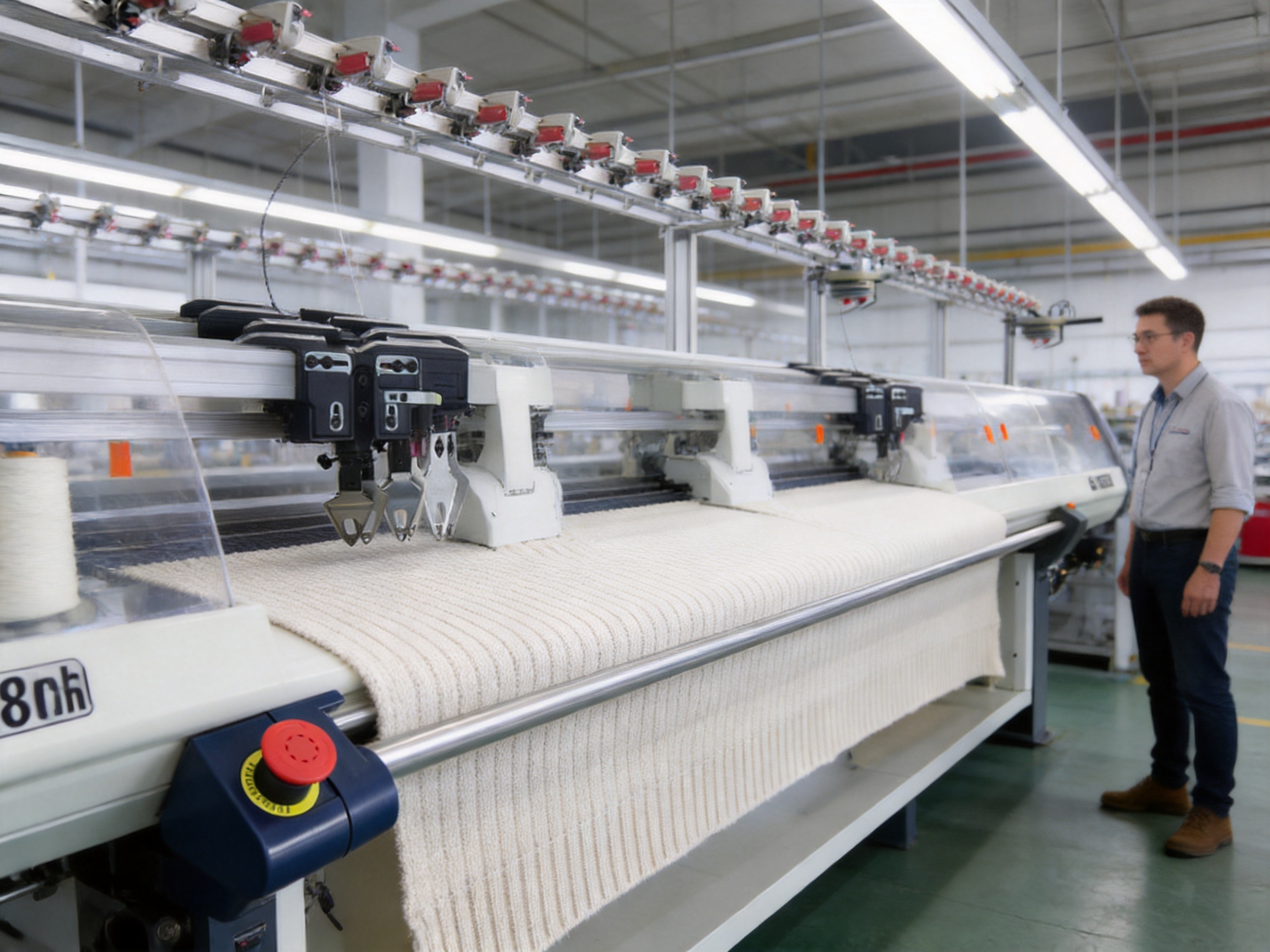
Wide-format knitting places greater demands on mechanical stability than narrow-format production. The machine must manage yarn movement, carriage travel, stitch formation, racking, and fabric take-down over a large working area. Any inconsistency in one section of the bed can result in differences in appearance, width, density, or tension. The GS-CE280H addresses these requirements through a group of coordinated mechanical and electronic systems.
Small-Head Fully Motorized Cam System
The machine uses a compact small-head fully motorized cam system. This design is intended to combine high operating stability with strong speed performance. The maximum knitting speed is 1.5 meters per second, allowing the machine to maintain productive output even when handling demanding wide-format applications.
A motorized cam system provides precise control over the actuation of knitting functions. Instead of relying primarily on manual mechanical adjustments, the system can respond to programmed instructions and production requirements. This supports faster changes between operating conditions and helps reduce adjustment-related downtime.
The compact design of the knitting head is also useful for carriage movement. A smaller head can help manage the working area efficiently and reduce unnecessary mechanical mass. In a machine with two carriages and an 80-inch bed, controlled carriage movement is important for maintaining smooth operation and avoiding excessive vibration or uneven performance.
High speed alone does not determine productivity. A machine must maintain stable loop formation, reliable yarn feeding, and consistent fabric take-down while operating at speed. The motorized cam system is therefore part of a broader engineering approach that combines speed with control and repeatability.
High-Precision Insert Needle Bed
The needle bed is the foundation of knitting quality. The GS-CE280H uses a high-precision insert needle bed with insert needles and notched sinkers. The stated design emphasizes high hardness, accurate precision, tight density, and long-term wear resistance.
A flat and accurately manufactured needle bed supports consistent needle movement and uniform loop formation. This is particularly important across an 80-inch width, where small variations can become visible in the finished fabric. A durable needle bed also helps the machine maintain performance during extended production and repeated product cycles.
Wear resistance is essential because the needle bed and associated knitting elements experience continuous movement and mechanical contact. Materials engineered for long service life can help reduce premature replacement, maintain dimensional accuracy, and support predictable maintenance planning.
For manufacturers, needle bed quality affects more than machine durability. It contributes to the appearance, hand feel, density, and dimensional consistency of the knitted product. A stable foundation is therefore necessary for both basic rib structures and more complex transfer, tuck, and jacquard designs.
Consistent Fabric Handling Across 80 Inches
Wide knitting requires accurate fabric handling after the loops are formed. If the fabric is pulled unevenly, one side may become tighter than the other, edges may curl, or the finished material may show dimensional differences across its width. These problems can create waste, complicate cutting and sewing, and reduce the value of the finished product.
Upper-Lower Composite Traction System
The GS-CE280H uses an upper-lower composite traction system. The upper and lower traction components work together to apply smooth and even tension across the fabric. This coordinated pulling action is important for controlling edge behavior, preventing distortion, and maintaining a uniform finished width.
The lower roller is thickened to provide enhanced traction force. Its wear-resistant roller cover is designed to support long-term use under continuous production conditions. The combination of traction force and roller durability helps the machine handle broad-format knitted fabric with greater consistency.
Even traction is particularly important when producing full rolls of rib fabric. Roll production requires stable dimensions over a long length, and variations in take-down tension can accumulate over time. A composite traction system helps reduce such variation and supports more predictable downstream processing.
For collar components, consistent traction also improves repeatability between pieces. Garment manufacturers need collars that match in width, elasticity, and appearance. Stable fabric handling helps suppliers provide components that are easier to assemble and more consistent from one production batch to the next.
Programmed Take-Down Control
The take-down roller is controlled by programmed instructions and a stepping motor. It provides 128 selectable tension levels within an adjustment range of 0 to 100. This allows operators to adapt fabric pulling conditions to the structure, yarn, width, and production requirements of the product.
Different knitted structures may require different take-down conditions. A plain rib structure, a transfer design, a tuck pattern, and a jacquard fabric can respond differently to tension. Programmed control makes it possible to adjust the take-down behavior more precisely than a simple fixed setting.
Electronic control also supports repeatability. Once a suitable parameter group has been established for a product, it can be used again for subsequent production. This can reduce the dependence on individual operator judgment and help standardize output across different shifts.
Automatic Cast-On and Faster Changeovers
Changeover time has a direct effect on production cost. A machine may have excellent nominal speed, but if operators spend substantial time preparing the fabric, covering the knitting area, or making manual adjustments between orders, actual output will be lower than expected.
The high-position roller on the GS-CE280H supports automatic cast-on without manual fabric covering. This means that the operator can begin a new product without performing a time-consuming covering operation across the wide knitting bed. The advantage is particularly meaningful for an 80-inch machine, where manual preparation would require more time and effort than on a narrow model.
Automatic cast-on helps manufacturers respond more quickly to order changes and design changes. It can also reduce physical workload for operators, allowing them to focus on programming, yarn preparation, quality inspection, and production monitoring.
Faster changeovers are valuable for both high-volume and small-batch manufacturing. In high-volume production, shorter preparation time increases available running hours. In small-batch production, it makes customized orders more economically practical because setup time represents a smaller portion of the total order cost.
Improved changeover efficiency also supports just-in-time production. Factories can schedule different collar sizes, colors, and structures more responsively instead of producing excessive inventory simply to avoid frequent setup operations.
Pattern Flexibility Through Computerized Needle Selection
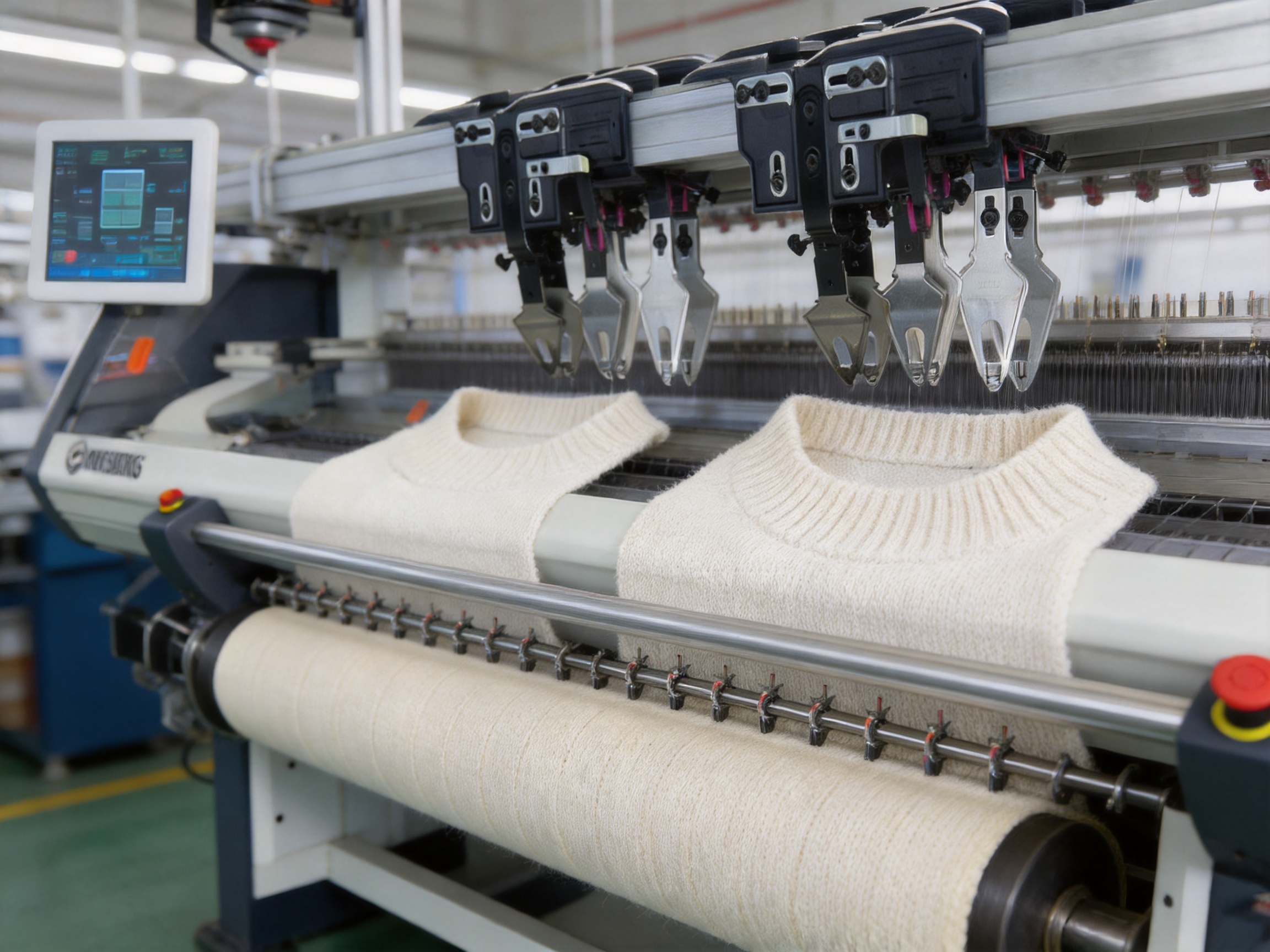
The GS-CE280H is equipped with a computer-controlled electromagnetic needle selection mechanism that supports multi-stage needle selection jacquard functionality. The available knitting functions include flat, transfer, tuck, and jacquard.
Flat knitting provides the foundation for standard ribbed structures and basic fabric production. Transfer functions allow loops to be moved between needle positions, supporting shaping, openwork effects, and structural changes. Tuck functions create additional texture and volume by holding selected loops. Jacquard functions enable the production of multi-color patterns and more complex visual effects.
This combination gives manufacturers the ability to produce products ranging from simple single-color collars to more decorative and customized designs. A supplier can therefore serve customers in basic garment production, fashion knitwear, sportswear, workwear, and other markets that require differentiated textile components.
2 × 8 Yarn Carrier Configuration
The yarn carrier system includes 2 × 8 yarn carriers mounted on both sides of four guide rails. The carriers can shift to any needle position across the knitting width. This arrangement supports yarn changes throughout the 80-inch working area and provides flexibility for multi-color jacquard production.
Color changes in wide-format knitting must be controlled accurately. If yarn carriers cannot reach the required positions smoothly, the machine may be restricted in pattern layout or color placement. The broad carrier configuration helps provide the movement range needed for complex designs across the full bed.
The system is also useful when multiple products are made in separated mode. Different zones may require different colors, yarns, or pattern instructions. Flexible carrier positioning helps the machine accommodate such variations without limiting production to a single uniform arrangement.
For manufacturers, this means that the 80-inch width can be used not only for large plain fabric but also for more valuable patterned products. The machine’s wide format and pattern capability can therefore work together to support higher-value applications.
Intelligent Control for Production Management
The control system uses an LCD display and USB input, with 256 MB of system memory for storing design files. The interface displays operating parameters and allows them to be adjusted while the machine is running. Multi-language support includes Chinese and English, with additional language versions available according to system configuration.
A visual control interface can make machine operation easier to understand, especially when production involves multiple knitting functions and a large number of parameters. Operators can monitor the machine, review settings, and make adjustments without relying exclusively on manual mechanical intervention.
Real-time parameter adjustment is valuable during product development and quality correction. If a fabric requires a change in stitch density, take-down tension, or another operating condition, the adjustment can be made while monitoring the result. This can shorten the time required to optimize a new design.
USB-based design input also supports practical file management. Design files can be transferred to the machine, stored, and selected as needed. The 256 MB memory capacity provides room for a considerable library of production programs, helping manufacturers manage multiple customers, products, colors, and seasonal designs.
Stitch Density Control
Stitch density is controlled by a stepping motor. The system provides 128 selectable levels, with subdivision technology supporting a stated adjustment scope from 0 to 650. Precise density control helps manufacturers adapt the knitted structure to different yarns, designs, and end uses.
Stitch density affects fabric weight, thickness, elasticity, appearance, and hand feel. A collar for a lightweight garment may require different settings from a heavy sportswear neckband or a roll of structural rib fabric. Electronic control makes such differences easier to manage and reproduce.
Servo-Controlled Racking
Racking is driven by an AC servo motor and provides a 2-inch range with fine-tuning capability. Servo control supports smooth and accurate movement, which is important for transfer structures, pattern alignment, and repeatable design execution.
Racking accuracy becomes increasingly important when producing complex patterns or when several knitting operations must remain synchronized. Stable servo movement helps reduce irregularity and supports consistent results across repeated production cycles.
Protection Systems for Safer and More Reliable Production
Automatic protection is essential in a computerized knitting machine because many production faults can affect both the fabric and the equipment. The GS-CE280H is designed to issue an alarm and stop automatically when it detects conditions such as yarn breakage, float yarn, rewinding faults, end of knitting, racking failure, needle breakage, needle collision, safety door events, or programming errors.
Stopping quickly after a fault can prevent a small issue from becoming a larger defect. For example, continuing to knit after a yarn break may create a section of incomplete fabric, while a needle problem may damage adjacent components if the machine continues operating. Automatic detection gives the operator an opportunity to correct the issue before restarting production.
Protection systems also support operator safety. Safety door detection helps prevent operation when access conditions are not secure. Clear alarms can guide maintenance and production personnel toward the source of a problem, reducing unnecessary troubleshooting time.
The power-off memory function helps protect production data during unexpected interruptions. Since knitted products may depend on detailed pattern and parameter settings, preserving information after a power failure can reduce the risk of losing programming work or restarting from an incorrect condition.
The machine operates on 220-volt single-phase power, which can simplify installation in facilities using compatible electrical infrastructure. Before installation, manufacturers should confirm local voltage, frequency, grounding, and electrical safety requirements.
Manufacturing Strengths Behind the Equipment
The performance of a knitting machine depends not only on its design concept but also on how accurately it is manufactured, assembled, tested, and supported. Guosheng Wonderful Intelligent Technology (Changshu) Co., Ltd. focuses on the research, development, manufacturing, and global supply of computerized knitting machinery. Its product range includes computerized flat knitting machines, collar knitting machines, and flyknit shoe upper knitting machines.
The company is located in Changshu, Jiangsu Province, a region with a strong textile machinery manufacturing ecosystem. Access to an established industrial cluster can support collaboration with component suppliers, engineering resources, technical labor, and textile production customers. This environment is useful for developing machinery that responds to practical factory requirements rather than only laboratory conditions.
Integrated Mechanical and Electronic Development
Modern knitting machinery requires close coordination between mechanical precision and electronic control. The needle bed, carriage, cam, yarn carrier, take-down roller, racking system, sensors, control software, and protection functions must work together. A weakness in one area can reduce the value of the entire machine.
The GS-CE280H reflects this integrated approach. Its wide-format mechanical platform is supported by computerized needle selection, stepping-motor stitch control, servo-driven racking, programmed take-down, LCD monitoring, USB design input, and automatic fault protection. These systems are not independent features; they contribute to a coordinated production process.
Such integration also supports future improvement. When machine structure and control architecture are designed as part of one system, manufacturers can optimize operating parameters, upgrade software functions, and refine production performance more efficiently.
Production-Oriented Engineering
Guosheng’s stated focus is on stable machine operation, flexible knitting structures, efficient production capability, and consistent knitting quality. These priorities align with the practical needs of textile manufacturers. A machine must be capable of producing saleable fabric repeatedly, not simply demonstrating a high specification under ideal conditions.
The GS-CE280H includes design decisions that address daily production concerns: automatic cast-on to reduce setup work, a wear-resistant needle bed for service life, composite traction for wide fabric control, a motorized cam for stable speed, and protection functions for fault response. Together, these features indicate a product-oriented engineering philosophy centered on total operating value.
The company’s portfolio across flat knitting, collar knitting, and shoe upper knitting also gives it exposure to different textile applications. Such application experience can help inform the development of machines for garments, accessories, footwear components, and other knitted products.
Applications in Different Manufacturing Environments
Garment Collar and Neckband Production
The primary application of the GS-CE280H is the production of ribbed collars and neckbands. In merged mode, the 80-inch bed supports extra-wide collars and oversized neck components. In separated mode, it can produce multiple narrower collar pieces, improving productivity for standard garment orders.
The available flat, transfer, tuck, and jacquard functions allow manufacturers to produce basic collars as well as patterned and textured variations. The ability to adjust stitch density and take-down tension helps accommodate differences in yarn and garment specification.
Sportswear and Functional Knitwear
Sportswear and functional garments often use ribbed components that must combine elasticity, recovery, comfort, and visual design. Wider formats may be needed for oversized silhouettes, performance garments, hooded products, and specialized textile structures.
The machine’s extra-wide capacity, pattern flexibility, and controlled traction make it suitable for suppliers serving this market. Multi-color jacquard capability can also support brand patterns, contrasting sections, and decorative technical designs.
Ribbed Fabric and Full-Roll Production
In separated or appropriately programmed production, the GS-CE280H can serve as a ribbed fabric platform capable of producing full rolls or multiple pieces of fabric. This broadens its role beyond component production and enables textile manufacturers to supply material to downstream garment factories.
Full-roll production requires dependable take-down, stable stitch density, and consistent yarn feeding over extended periods. The machine’s traction system, programmed roller control, and computerized monitoring are designed to support this type of operation.
Customized and Multi-Color Products
Manufacturers serving fashion brands and private-label customers often need short runs, frequent design changes, and multi-color effects. The computerized design system, memory storage, multi-stage needle selection, and flexible yarn carrier arrangement help support such orders.
The ability to move between plain, textured, and jacquard structures can help a factory create a more differentiated product offering. This may improve the value of each machine hour and reduce reliance on basic commodity production.
Operational and Commercial Benefits
The economic value of the GS-CE280H comes from the relationship between capacity, flexibility, labor efficiency, and product quality. A machine with a wide working area can produce more material per operating cycle, but its full value is achieved when that capacity remains useful across different order types.
The mergeable and separable carriage structure helps maintain this usefulness. Manufacturers can use the machine for large orders, small orders, standard collars, oversized components, full rolls, or multi-piece output. This reduces the risk that the machine will remain underused when the product mix changes.
Automatic cast-on reduces non-productive preparation. Computerized control reduces the need for repeated manual adjustment. Fault protection can reduce damage and waste. Stable traction and a precision needle bed support more consistent quality. Together, these factors may improve the total cost of ownership beyond the initial purchase price.
For factories planning expansion, the GS-CE280H may also reduce the number of separate machine types required. Fewer machine categories can simplify spare-part management, training, maintenance planning, and production scheduling. The exact financial benefit will depend on order volume, yarn type, product structure, operator skill, and local operating conditions.
Recommended Evaluation Points Before Purchase
Manufacturers should evaluate the machine according to their actual product requirements. The 80-inch width is most valuable when the factory has demand for wide components, rib fabric, or simultaneous multi-piece production. Buyers should review their current and expected order mix before selecting the machine.
Gauge selection is another important factor. The GS-CE280H is available in 12G, 14G, 16G, 18G, and 20G configurations. Gauge affects the type of yarn, fabric fineness, surface appearance, density, and end-use suitability. The correct gauge should be selected according to target products and customer specifications.
Manufacturers should also confirm electrical compatibility, floor space, material handling arrangements, yarn preparation, ventilation, operator access, and maintenance capabilities. Wide-format equipment requires sufficient space for loading, inspection, fabric collection, and safe movement around the machine.
Before commercial production, it is advisable to test representative yarns, structures, widths, colors, and patterns. Trial production can help determine suitable stitch density, take-down settings, carriage mode, yarn carrier positions, and production speed.
Training is equally important. Operators should understand design input, parameter adjustment, automatic cast-on, carriage operation, protection alarms, cleaning, lubrication, and routine inspection. Proper training helps the factory benefit from the machine’s flexibility while reducing avoidable operating errors.
Technical Specification Table
| Item | Specification |
|---|---|
| Model | GS-CE280H |
| Machine Type | Single-system double-carriage collar knitting machine |
| Gauge Options | 12G, 14G, 16G, 18G, 20G |
| Knitting Width | 80 inches |
| Maximum Knitting Speed | 1.5 meters per second |
| Knitting Functions | Flat, transfer, tuck, and jacquard |
| Carriage Configuration | Mergeable or separable double carriage |
| Stitch Density | Stepping-motor controlled; 128 selectable levels; adjustment scope from 0 to 650 |
| Racking | AC servo motor controlled; 2-inch range with fine adjustment |
| Yarn Carrier | 2 × 8 yarn carriers on both sides of four guide rails |
| Take-Down Roller | Stepping-motor controlled; 128 tension levels; adjustable range from 0 to 100 |
| Control Interface | LCD display with USB input |
| System Memory | 256 MB |
| Language Support | Chinese, English, and other available language versions |
| Protection Functions | Alarm and automatic stopping for selected yarn, knitting, needle, racking, safety, and programming faults |
| Power Supply | 220V, single-phase, with power-off memory function |
Frequently Asked Questions
What makes the GS-CE280H different from a conventional collar knitting machine?
Its main distinction is the combination of an 80-inch knitting width and a mergeable or separable double-carriage configuration. It can produce wide-format products in merged mode and two narrower products or fabric sections in separated mode. This provides greater flexibility than a machine limited to one width or one production arrangement.
Can the machine produce full rolls of ribbed fabric?
Yes. The machine is designed to support full-roll and multi-piece ribbed fabric production, particularly when operated in a suitable separated or programmed production mode. Actual roll dimensions and output depend on gauge, yarn, structure, settings, and production requirements.
What types of products can be made?
Applications include extra-wide ribbed collars, neckbands, sportswear trims, broad-format ribbed fabric, full rolls, multiple standard-width collar pieces, plain structures, transfer designs, tuck structures, and multi-color jacquard products.
What is the benefit of the 80-inch knitting bed?
The 80-inch bed provides space for extra-wide components and broad-format fabric. It also allows manufacturers to arrange multiple narrower pieces across the working area, helping improve equipment utilization when the order does not require one large product.
How does automatic cast-on improve production?
The high-position roller allows automatic cast-on without manual fabric covering. This reduces preparation time and operator workload, particularly during wide-format changeovers where manual covering would be more time-consuming.
Which gauges are available?
The machine is available in 12G, 14G, 16G, 18G, and 20G configurations. The appropriate gauge should be selected according to yarn, fabric structure, product thickness, appearance, elasticity, and customer requirements.
Does the machine support jacquard production?
Yes. Its computerized multi-stage needle selection system supports jacquard knitting, while the 2 × 8 yarn carrier arrangement provides yarn-changing flexibility across the wide knitting area.
How is fabric tension controlled?
The machine uses an upper-lower composite traction system and a programmed take-down roller. The stepping-motor-controlled take-down system provides 128 selectable tension levels across an adjustable range from 0 to 100.
What protection functions are included?
The system can alarm and stop automatically when it detects conditions such as yarn breakage, float yarn, rewinding faults, end of knitting, racking failure, needle breakage, needle collision, safety door events, or programming errors.
Is the machine suitable for small-batch customized production?
Its computerized design system, stored program capacity, automatic cast-on, adjustable parameters, and jacquard functions make it suitable for varied and customized production. Actual efficiency will depend on the complexity and quantity of each order.
What should a buyer confirm before placing an order?
Buyers should confirm the required gauge, yarn types, product dimensions, production mode, electrical supply, installation space, operator training, maintenance support, and sample testing requirements. Representative product trials are recommended before final production planning.
Conclusion
The GS-CE280H 80-Inch Single System Double Carriage Collar Knitting Machine is designed for manufacturers that need more than a conventional narrow collar machine can provide. Its extra-wide knitting bed supports broad-format products, while the mergeable and separable double-carriage system allows the same equipment to produce wide pieces, two narrower pieces, or ribbed fabric in different production arrangements.
Its commercial advantages are strengthened by a maximum knitting speed of 1.5 meters per second, a small-head fully motorized cam, a high-precision insert needle bed, an upper-lower composite traction system, automatic cast-on, computerized needle selection, multi-stage jacquard capability, flexible yarn carriers, programmed take-down, servo-controlled racking, and comprehensive fault protection.
These features are supported by Guosheng Wonderful Intelligent Technology (Changshu) Co., Ltd.’s focus on computerized knitting machinery and practical textile manufacturing solutions. The company’s engineering approach combines mechanical durability, electronic control, production flexibility, and application-oriented design.
For garment component suppliers, sportswear manufacturers, rib fabric producers, and textile factories seeking to expand their product range, the GS-CE280H offers a way to increase the usefulness of one machine investment. Its value lies not only in its 80-inch width, but also in the ability to switch between production modes, handle varied structures, reduce manual preparation, and maintain controlled operation across demanding wide-format applications.
References
1. Product specification and technical information for the GS-CE280H 80-Inch Single System Double Carriage Collar Knitting Machine.
2. Manufacturer-provided information on computerized flat knitting machines, collar knitting machines, and knitted textile production equipment.
3. General principles of computerized flat knitting, including needle selection, stitch density control, racking, yarn carrier movement, and fabric take-down.
4. General textile machinery engineering practices concerning wide-format fabric handling, automatic cast-on, servo control, machine protection, and production repeatability.
Product: GS-CE280H 80-Inch Single System Double Carriage Collar Knitting Machine


Ready to Begin?
Product Categories
- Sweater Knitting Machine (Economic SE)
- Sweater Knitting Machine (Full Function S)
- Collar Knitting Machine (Economic CE)(Fabric)
- Collar Knitting Machine (Full-Function C)
- Blanket Knitting Machine(Fabric)
- Shoe Upper Knitting Machine
- Ready To Wear Sweater Knitting Machine
- Ready To Wear Glove Knitting Machine
- Ready To Wear Hat Knitting Machine
- Knee Pad Knitting Machine
- Metal Mesh Knitting Machine
Contact Information
-
 Email: gs@guoshengchina.cn
-
 Phone: +86-0512-52690511
-
 Address: No. 18, Hupu Pujiang Road, Bixi New District, Changshu City, Jiangsu Province, China
QR Code
