


 English
 Español
 русский
 عربى
 中文简体

Lin Yuxi — International Product Sales Manager
52-Inch Three-System No-Waste-Yarn Bottom-Up Sweater Knitting Machine: A Complete Guide to High-Efficiency Intelligent Production
Date:Oct 04, 2026
Content
- 1 1. The Production Challenges Facing Modern Knitwear Factories
- 2 2. Product Overview and Core Positioning
- 3 3. Three-System Single-Carriage Architecture
- 4 4. Steel-Wire No-Waste-Yarn Comb and Material Economy
- 5 5. Six-Motor Independent Scissor-and-Clamp System
- 6 6. Broad Gauge Coverage and Product Flexibility
- 7 7. Comprehensive Knitting Functions
- 8 8. Stitch Density and Take-Down Control
- 9 9. Yarn Carrier Arrangement and Sinker Assistance
- 10 10. Intelligent Control System and Operator Convenience
- 11 11. Comprehensive Protection and Fault Monitoring
- 12 12. Advanced Manufacturing Strengths of the Supplier
- 13 13. Comparison with Conventional Knitting Workflows
- 14 14. Suitable Applications
- 15 15. Operating and Maintenance Considerations
- 16 16. Key Technical Specifications
- 17 17. Purchasing Considerations for Manufacturers
- 18 18. Frequently Asked Questions
- 18.1 Q1: What is the main advantage of the GS-S352Z?
- 18.2 Q2: How does the no-waste-yarn comb reduce production costs?
- 18.3 Q3: What does the three-system configuration mean?
- 18.4 Q4: Which products can be made with this machine?
- 18.5 Q5: What gauge options are available?
- 18.6 Q6: Does the machine support jacquard and intarsia?
- 18.7 Q7: How many scissors and clamps does the machine have?
- 18.8 Q8: Can the machine adjust stitch density during production?
- 18.9 Q9: What is the purpose of the take-down roller?
- 18.10 Q10: What protection functions are included?
- 18.11 Q11: Does the control system support design storage?
- 18.12 Q12: What power supply does the machine use?
- 18.13 Q13: Is the machine suitable for factories with limited labor availability?
- 18.14 Q14: What makes the machine competitive compared with conventional models?
- 18.15 Q15: What should a factory prepare before installation?
- 19 19. Conclusion
- 20 References
- 21 Product: GS-S352Z 52-Inch Three System No-Waste-Yarn Bottom-Up Sweater Knitting Machine
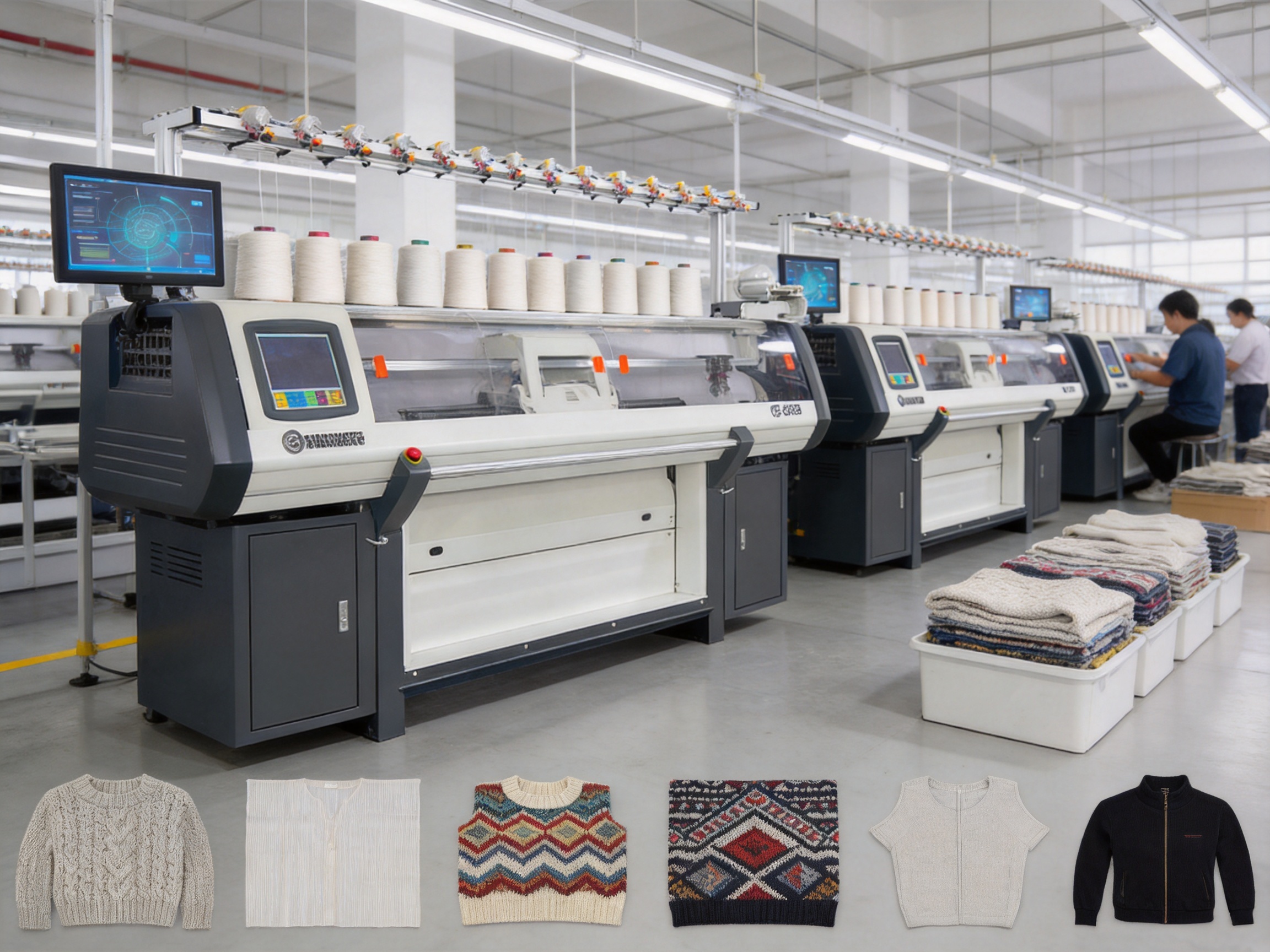
The modern knitwear industry is under constant pressure to increase productivity, reduce material consumption, shorten delivery times, and maintain consistent quality across large production orders. At the same time, manufacturers must respond to increasingly diverse product requirements, including fine-gauge fashion garments, chunky sweaters, multi-color jacquard designs, intarsia patterns, shaped panels, sportswear, and functional knitwear. These challenges require more than a conventional knitting machine. They require a coordinated production platform that combines high output, accurate control, efficient yarn use, flexible pattern capabilities, and reduced dependence on manual labor.
The GS-S352Z 52-inch three-system no-waste-yarn bottom-up sweater knitting machine has been developed for this demanding manufacturing environment. It combines a three-system single-carriage structure with a steel-wire no-waste-yarn comb, a six-motor independent scissor-and-clamp system, computerized needle selection, programmable stitch and take-down control, and broad gauge coverage. This combination gives factories a practical solution for producing complete or semi-complete knitted components with greater efficiency and less waste.
Unlike a conventional machine that uses waste yarn during the cast-on process, this model can lift the comb and begin knitting directly. When combined with the automatic scissor-and-clamp arrangement, it can support the automatic release of individual fabric pieces without requiring operators to remove waste yarn manually between pieces. The result is a more economical workflow in which yarn savings, labor savings, and production continuity reinforce one another.
The machine is designed for factories that need a balance between industrial productivity and product flexibility. It can support a wide selection of gauges, from heavier knit constructions through fine 16-gauge fabrics. Its functions include transfer, tuck, miss, jacquard, intarsia, hidden shaping, and apparent shaping. These capabilities allow manufacturers to produce a broad range of sweater panels, shaped garment sections, fashion structures, sportswear components, and other knitted products on a single equipment platform.
1. The Production Challenges Facing Modern Knitwear Factories
Knitting manufacturers operate in a market where the cost of yarn, electricity, labor, maintenance, and production space continues to influence the profitability of every order. A machine that appears productive in isolation may not provide the best overall result if it creates excessive waste, requires frequent manual intervention, or cannot adapt quickly to different garment styles.
Waste yarn is one example of a small process cost that becomes significant at scale. On a high-volume production line, every piece may require waste yarn at the beginning of the knitting cycle. Operators may then need to remove or separate the waste section before the next process. The material cost of this yarn is only one part of the problem. The additional handling time, the accumulation of waste, and the interruption of the production rhythm can affect the total cost of every garment.
Another challenge is the need to produce different constructions on the same machine. A factory may receive orders for a thick winter sweater, a fine-gauge fashion pullover, a multi-color sportswear panel, and a shaped collar or cuff component within the same production period. Equipment that is limited to one gauge or a narrow selection of knitting functions may force the manufacturer to divide production among several machines or outsource specific operations.
Labor availability is also an important consideration. Manual removal of finished fabric, manual yarn separation, and repeated adjustment of production parameters consume valuable operator time. These tasks can create inconsistencies between shifts and increase the risk of handling errors. Automated functions do not eliminate the need for skilled operators, but they allow operators to focus on supervision, quality control, design preparation, and production management instead of repetitive manual work.
The GS-S352Z addresses these challenges through an integrated design. Its three-system knitting architecture supports high effective output, while its no-waste-yarn comb reduces material consumption at the cast-on stage. Its independent scissors and clamps support automatic fabric separation, and its computerized control system provides real-time access to operating parameters. This combination is particularly valuable for factories pursuing lean production and more predictable manufacturing costs.
2. Product Overview and Core Positioning
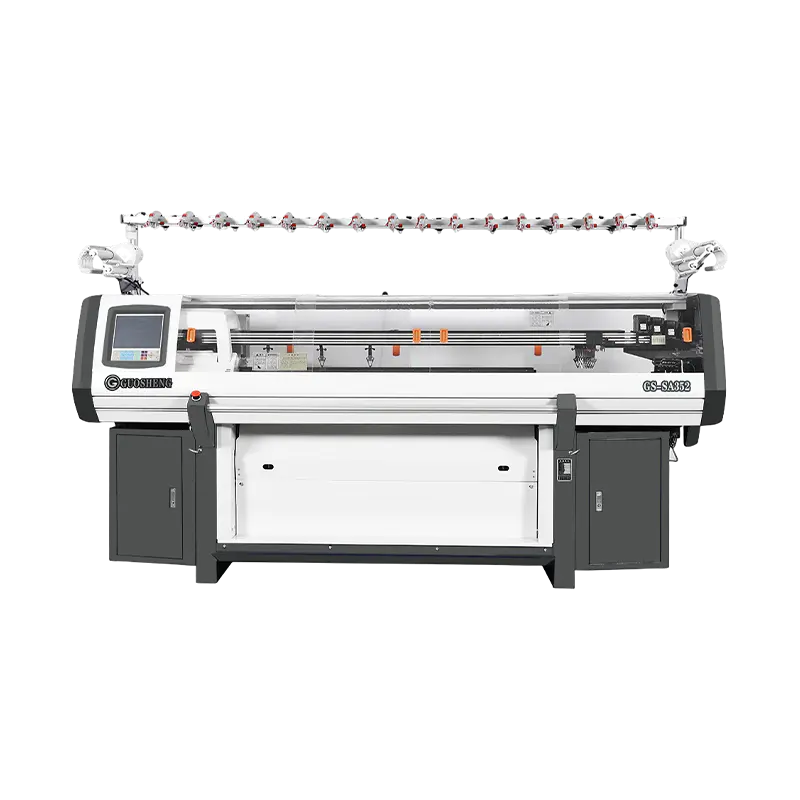
The GS-S352Z is a 52-inch, three-system, full-function S-series computerized flat knitting machine designed for bottom-up sweater knitting and related knitted products. Its standard knitting width is suitable for many mainstream garment dimensions, while its wide gauge selection makes the platform adaptable to both heavy and fine knitted fabrics.
The machine uses a three-system single carriage. Each system can contribute to the knitting process during a carriage pass, allowing more knitting actions to be completed within a given production cycle than on many comparable double-system machines. The carriage is driven by a synchronous belt and controlled by an AC servo system. This arrangement supports stable movement, accurate positioning, and a maximum knitting speed of 1.4 meters per second under suitable operating conditions.
The defining feature of the product is the steel-wire no-waste-yarn comb. The comb is designed to lift and allow knitting to begin without first producing a conventional waste-yarn section. In a high-volume environment, this can reduce yarn consumption on every individual piece. When the function is coordinated with the scissors and clamps, the machine can also support automatic dropping of separate pieces, reducing the need for manual removal and preparation.
The scissor-and-clamp system contains two scissors and four clamps. Each component is individually controlled by its own motor, creating a total of six dedicated motors. The components are positioned on both sides of the needle bed and can be programmed to operate synchronously or independently. This gives the machine greater control over yarn handling, piece separation, and production sequences for different garment structures.
In practical terms, the machine is positioned as a material-saving, labor-reducing, and productivity-focused solution. It is suitable for manufacturers that want to improve the efficiency of sweater production without sacrificing the pattern flexibility required by contemporary apparel orders.
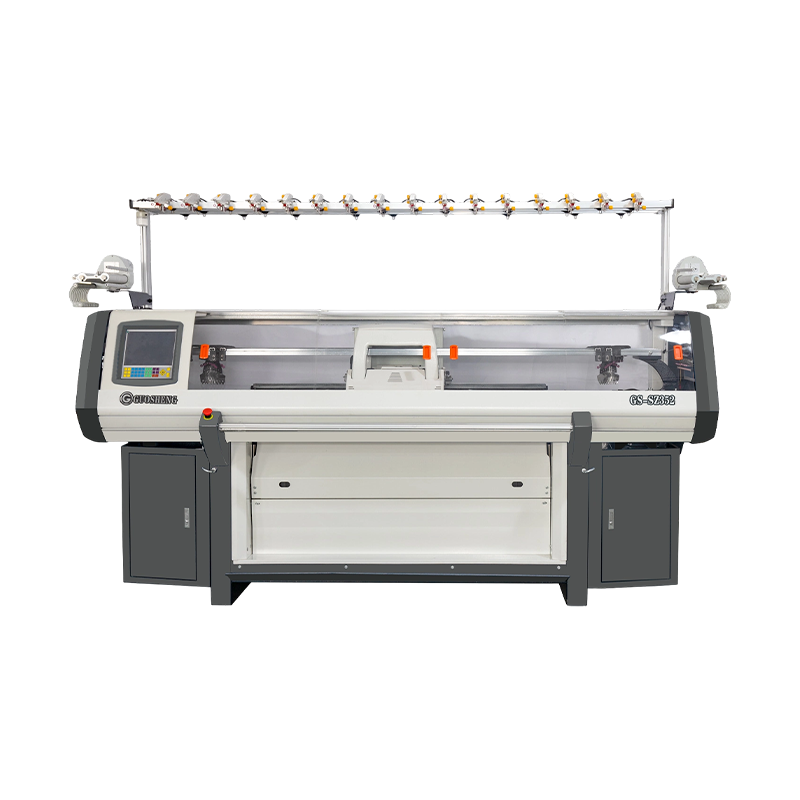
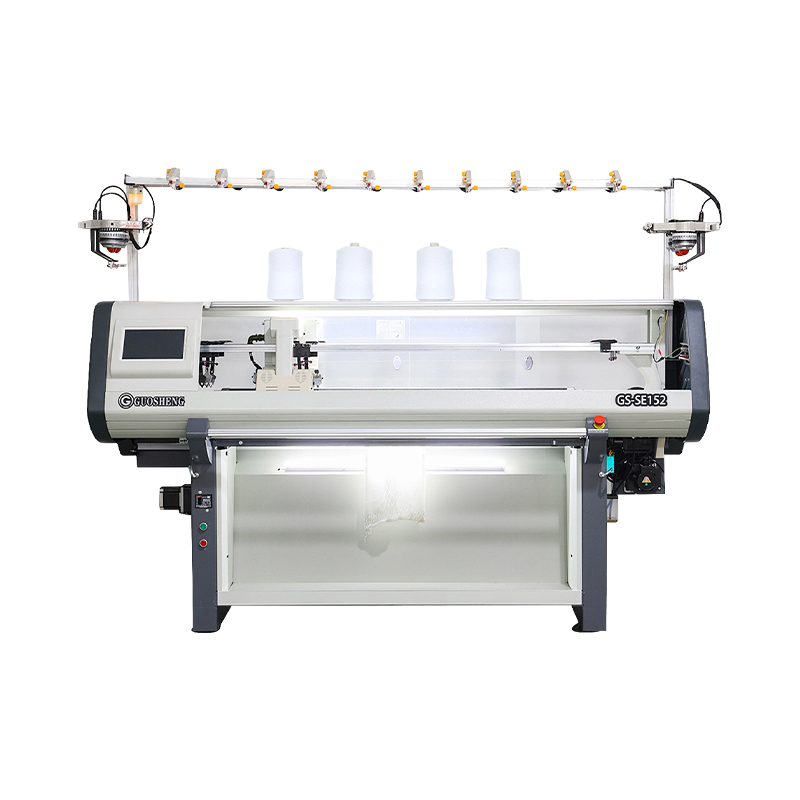
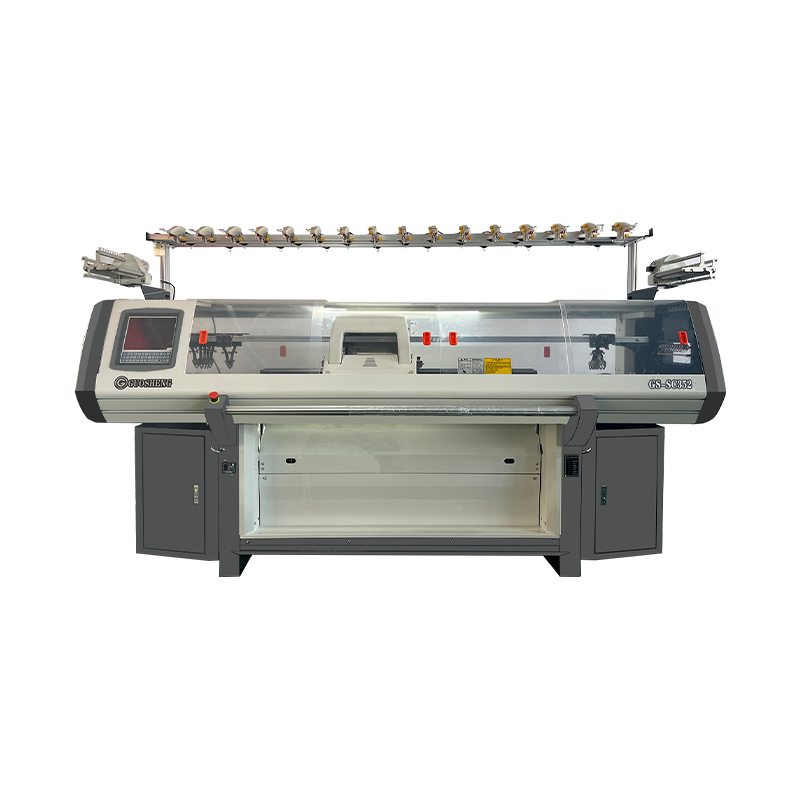
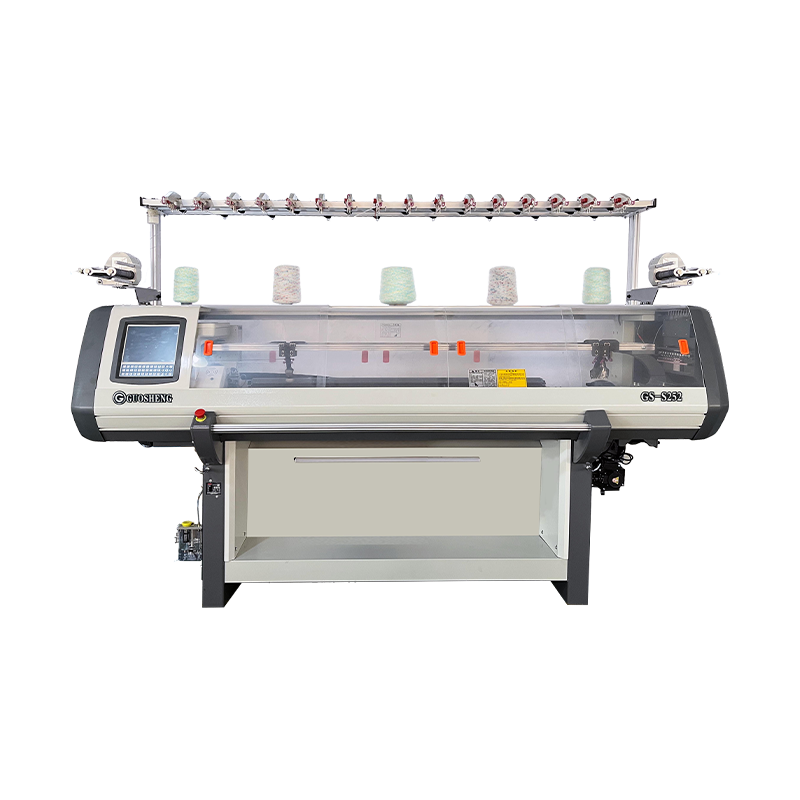
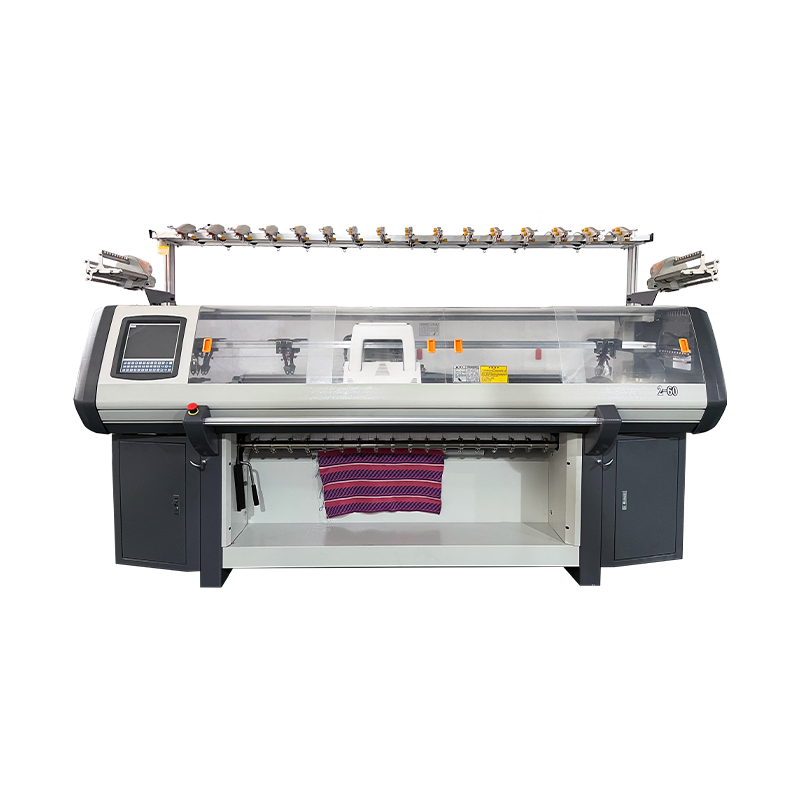
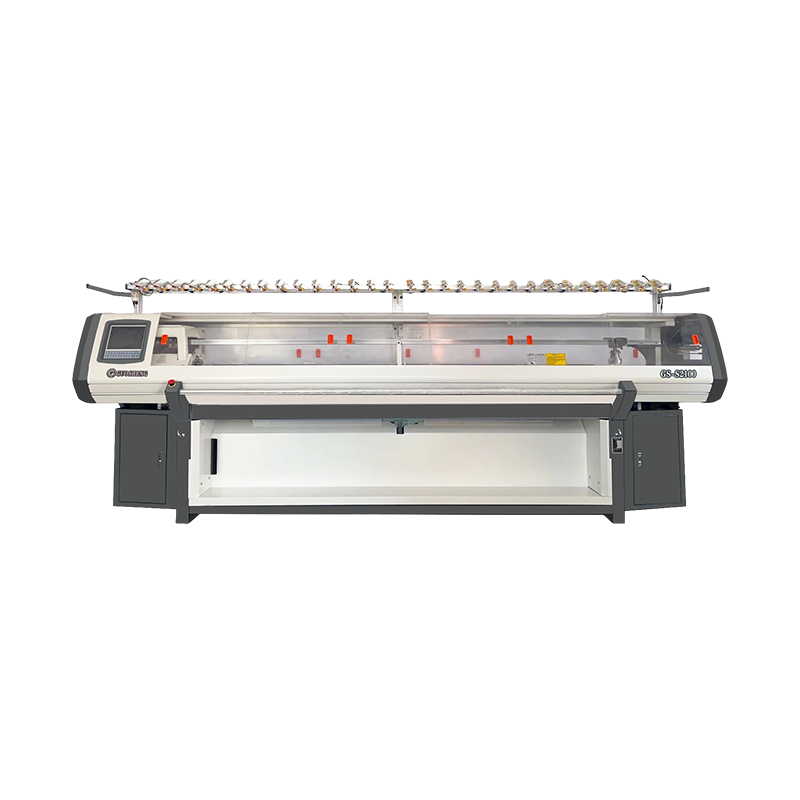
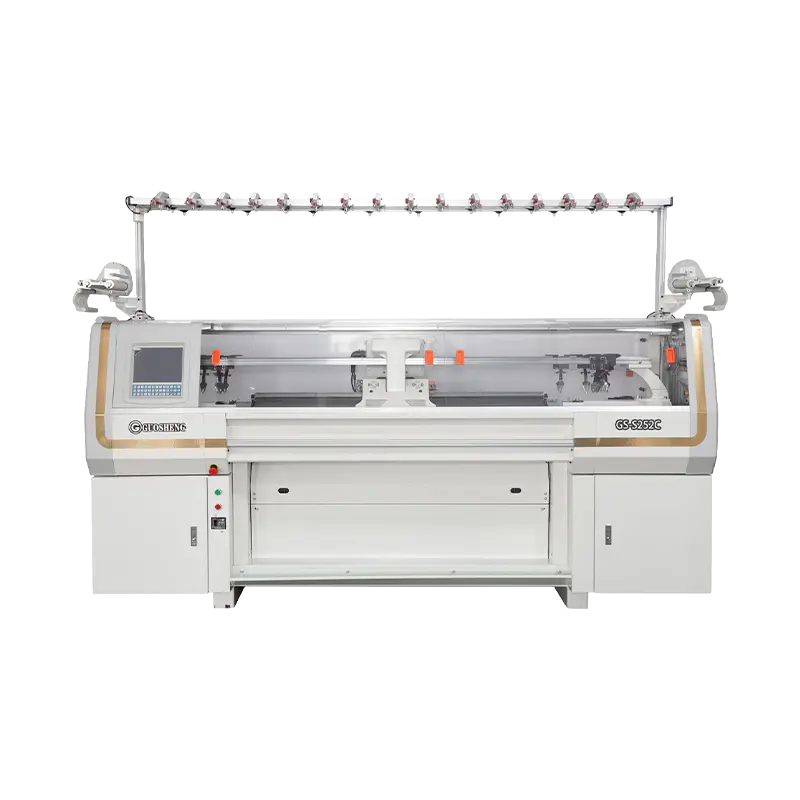
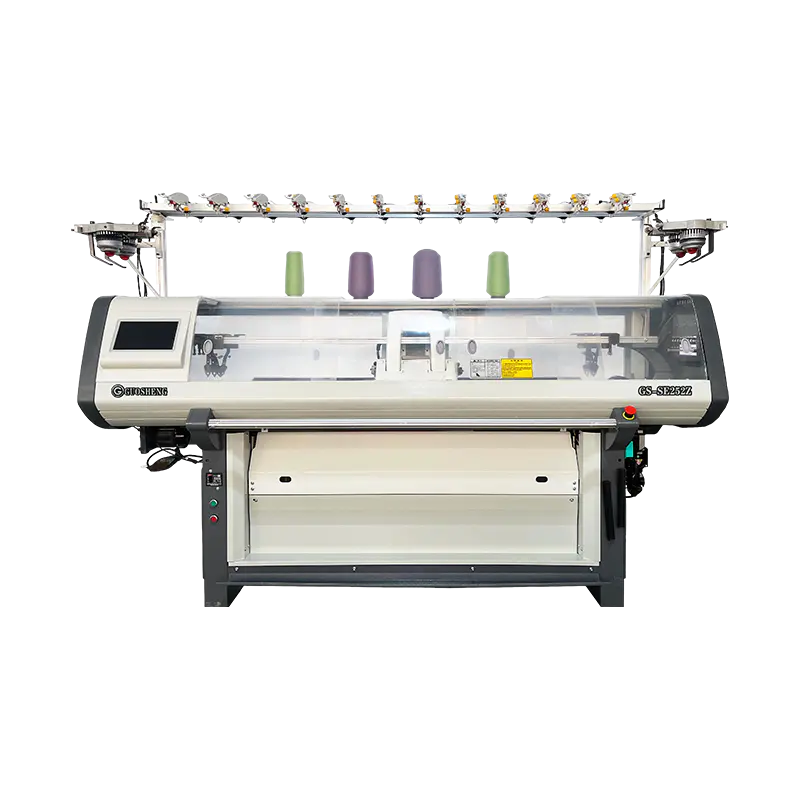
GS-S352Z 52-Inch Three System No-Waste-Yarn Bottom-Up Sweater Knitting Machine
3. Three-System Single-Carriage Architecture
The three-system single-carriage design is central to the productivity advantages of the GS-S352Z. A knitting system represents the functional capability available during the movement of the carriage. By integrating three systems into one carriage, the machine can perform more knitting actions in a single pass than a comparable two-system configuration.
This does not mean that every fabric will automatically be produced at three times the speed of a one-system machine. Actual output depends on the design, stitch structure, knitting width, gauge, yarn type, carriage settings, shaping requirements, and production conditions. However, the three-system arrangement provides a higher effective production capacity for many styles because more operations can be completed during each carriage movement.
For factories producing large quantities of standard or frequently repeated styles, the productivity benefit can be substantial. More knitting actions per carriage pass may reduce the number of passes required for a garment panel or fabric section. Fewer passes can lower machine running time per piece, improve equipment utilization, and help manufacturers meet delivery schedules more comfortably.
The single-carriage arrangement also supports a relatively organized mechanical structure. The synchronous belt drive transfers movement efficiently, while the AC servo motor provides controlled acceleration, deceleration, and positioning. Smooth carriage movement is important because sudden mechanical changes can affect fabric formation, noise levels, component wear, and the stability of high-speed operation.
Compared with a conventional system that relies heavily on mechanical adjustments, the electronically controlled carriage allows production parameters to be managed more precisely. Operators can adjust machine behavior according to the requirements of the design and yarn. This is especially useful when a factory changes between different fabric structures during the same working day.
Productivity Benefits for Large-Volume Orders
High-volume production rewards machines that can maintain a stable rhythm over long operating periods. The GS-S352Z supports this objective through its three-system arrangement, high maximum speed, computerized operation, and automatic fabric-handling functions. The combination is more important than any single specification. A fast carriage alone does not guarantee high output if operators must frequently stop the machine to remove waste yarn or separate finished pieces.
By reducing these interruptions, the no-waste-yarn comb and automatic scissor-and-clamp system help the machine convert its knitting capacity into more usable production time. This is a major distinction between nominal speed and effective factory output. Effective output includes the time spent on knitting, handling, adjustment, piece separation, and operator intervention.
4. Steel-Wire No-Waste-Yarn Comb and Material Economy
The steel-wire no-waste-yarn comb is the most distinctive innovation of this model. In a conventional cast-on process, waste yarn may be used to establish the initial structure before the actual garment fabric is knitted. This waste section must later be removed, separated, or discarded. Although the quantity used on one piece may appear small, the cumulative consumption can become considerable when thousands of pieces are produced.
The no-waste-yarn comb allows the comb to lift and supports direct knitting without the conventional waste-yarn stage. This reduces the amount of yarn consumed before the useful fabric begins. It also simplifies the process after knitting because the operator does not need to spend the same amount of time removing waste yarn from every piece.
The direct material saving is one of the clearest economic benefits. Yarn is a major cost element in sweater production, and premium fibers or specialty yarns can be particularly expensive. Reducing unnecessary consumption can therefore improve the material yield of every production order. The saving is not limited to yarn cost; lower waste also supports a cleaner production environment and more efficient inventory management.
The second benefit is process simplification. Waste-yarn operations create an additional step between knitting and subsequent garment assembly or finishing. Removing this step can help reduce handling, shorten the route from knitting to the next operation, and lower the chance of a worker accidentally damaging the useful fabric while separating the waste section.
The third benefit is production consistency. Automated comb lifting provides a repeatable starting process. When the machine is correctly programmed and maintained, the beginning of each piece can be produced according to the same operating sequence. This supports more consistent production across different operators and shifts.
The no-waste-yarn design is particularly valuable when used together with automatic scissors and clamps. The comb reduces waste at the beginning of knitting, while the scissors and clamps support controlled yarn handling and piece separation at the end or during transitions. These functions work as a system rather than as isolated features.
Compared with a compound-needle variant in the same general product family, the GS-S352Z places greater emphasis on eliminating waste yarn. This makes it especially suitable for factories where raw material economy is a primary purchasing criterion. Manufacturers should still evaluate yarn type, fabric design, operator training, and production settings before calculating exact savings, but the machine is structurally designed to support a lower-waste workflow.
5. Six-Motor Independent Scissor-and-Clamp System
The machine is equipped with two scissors and four clamps, and each unit is independently driven by a dedicated motor. The six-motor arrangement provides a high level of control over yarn cutting, clamping, and fabric-handling operations.
Many production processes require different yarn-handling actions depending on the design. A basic panel, a shaped garment section, a multi-color pattern, and an intarsia structure may each require different timing and coordination. If all cutting and clamping actions are controlled as one mechanical group, the available production options can be limited. Independent motor control allows each component to respond to the program as required.
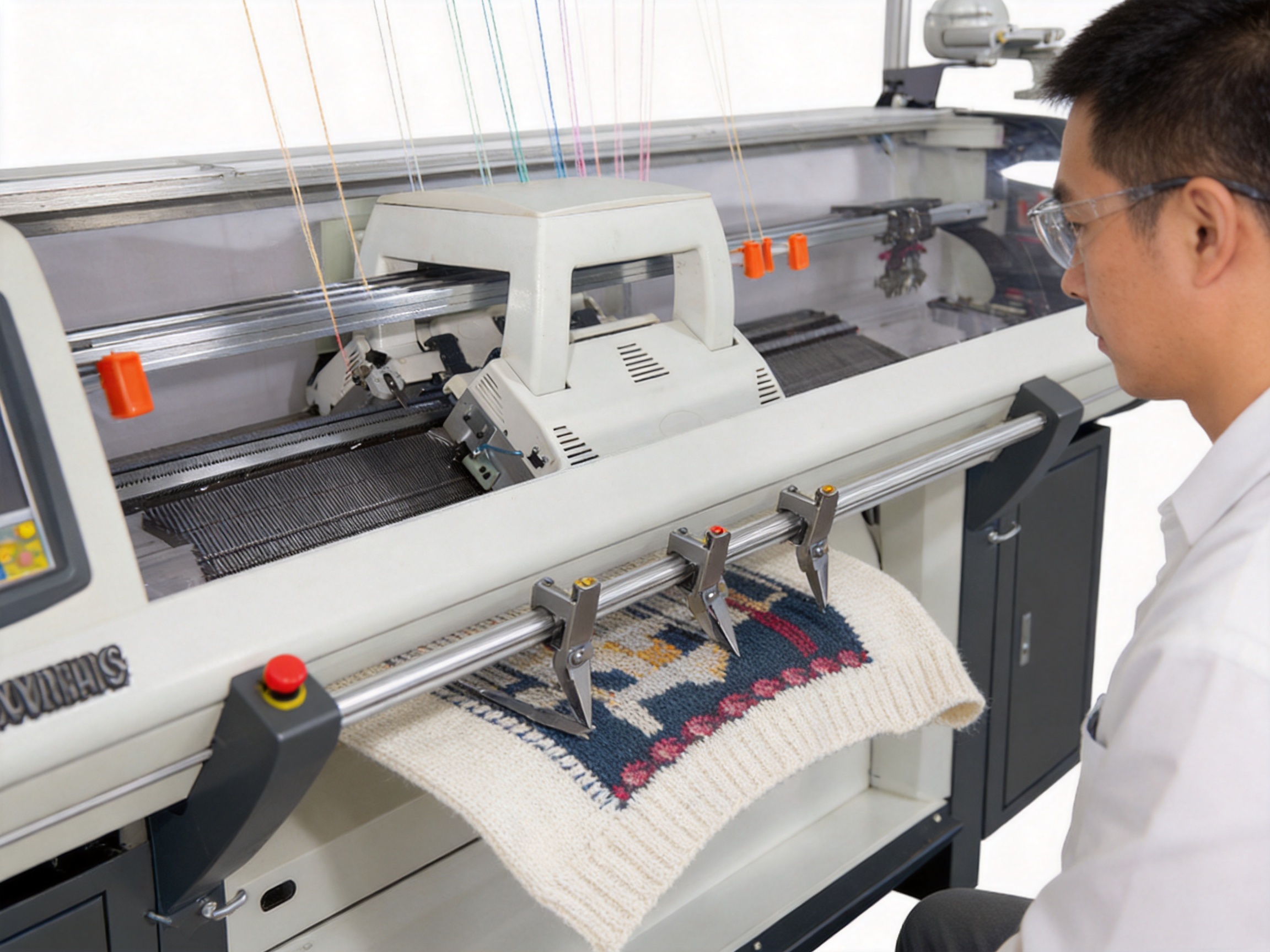
The two scissors can perform controlled cutting operations at appropriate stages of the knitting cycle, while the four clamps help hold or manage yarns in coordination with the knitting sequence. The units are located on both sides of the needle bed, providing balanced access to the yarn-handling area and supporting different production directions.
The system can operate synchronously when a coordinated action is required, or independently when the design calls for separate timing. This flexibility is useful for patterns involving color changes, separate yarn paths, shaped edges, and individual piece drop-off. The machine can therefore adapt its yarn-handling sequence to the structure being produced rather than relying on a single fixed procedure.
Automatic piece dropping is another important advantage. When a knitted component is completed, the machine can coordinate the scissor-and-clamp system to release the piece according to the programmed sequence. This can reduce the need for an operator to reach into the working area after every piece, improving productivity and supporting a more continuous workflow.
From a manufacturing perspective, the six-motor arrangement reflects an emphasis on controlled automation. It is not simply a device for cutting yarn. It is part of a coordinated material-management system that helps reduce waste, support repeatable operation, and lower the amount of manual intervention required during continuous production.
6. Broad Gauge Coverage and Product Flexibility
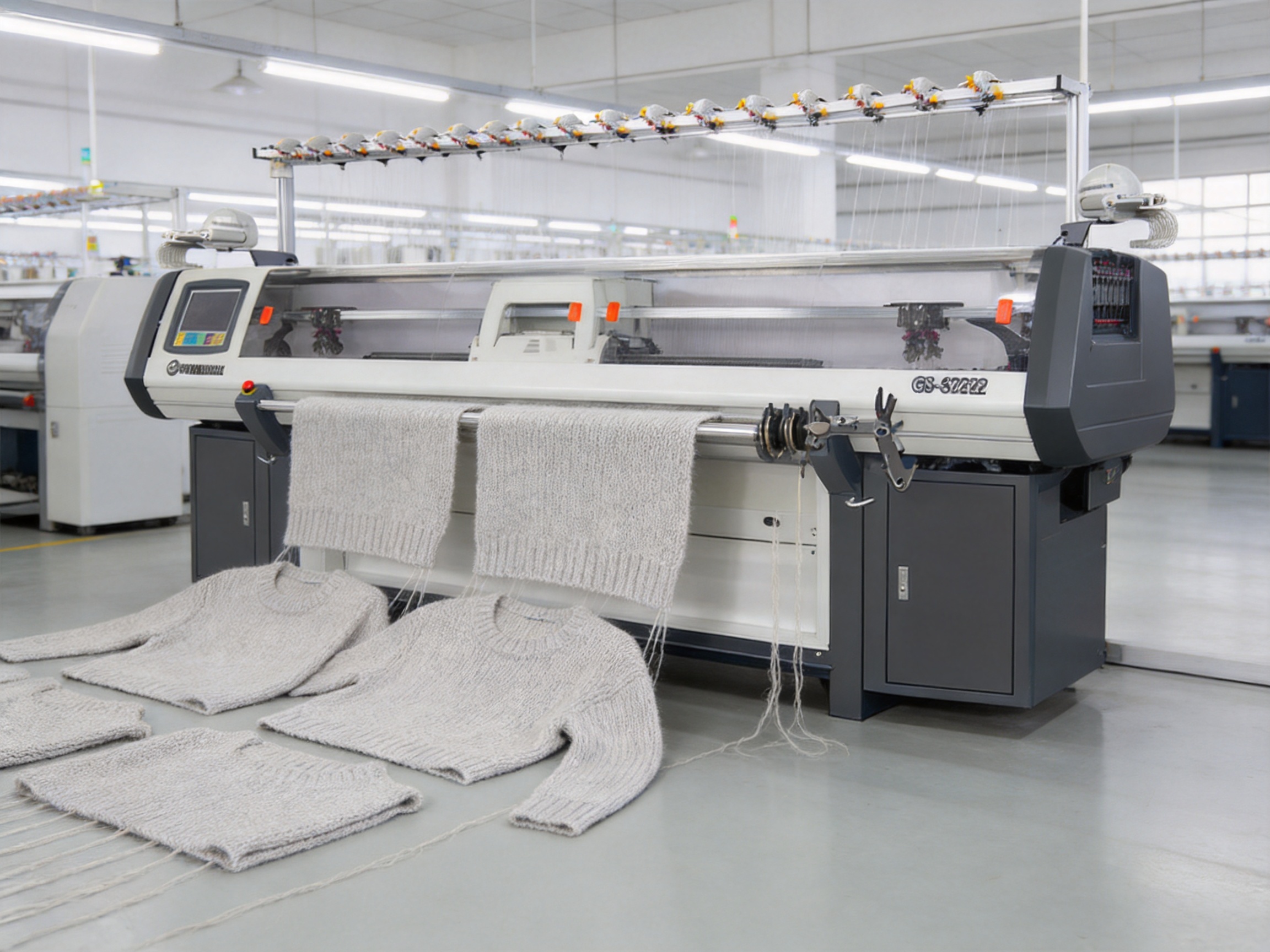
The GS-S352Z offers twelve gauge options: 3-5-7G, 5G, 6G, 7G, 8G, 9G, 10G, 12G, 13G, 14G, 15G, and 16G. This range covers a broad spectrum of knitwear requirements, from heavy and textured constructions to fine, lightweight fashion fabrics.
Lower gauges are commonly associated with thicker yarns and heavier fabric structures. They may be suitable for winter sweaters, chunky fashion garments, textured panels, and products requiring a pronounced knitted appearance. Higher gauges support finer yarns and more compact stitch formations, which can be used for lightweight pullovers, refined fashion garments, fine accessories, and smooth sportswear components.
The availability of multiple gauges gives a factory greater flexibility when planning its product portfolio. Instead of investing only in equipment designed for one narrow class of product, a manufacturer can select the gauge configuration that matches its target orders. This can help improve equipment utilization over the course of a season, especially for factories serving multiple brands or markets.
Gauge flexibility also supports product development. Designers can test different fabric weights, stitch densities, and surface effects without changing the entire production concept. The same general machine platform can therefore contribute to sampling, small-batch production, and larger commercial orders, provided the selected gauge and yarn are appropriate for the intended design.
The 52-inch knitting width is suitable for many standard sweater and garment-panel dimensions. It provides sufficient working width for a broad selection of apparel applications while maintaining a practical format for factory installation and operation. Actual product dimensions depend on the gauge, design, stitch structure, shaping method, and required finishing allowance.
7. Comprehensive Knitting Functions
A modern computerized flat knitting machine must do more than produce a basic plain structure. Fashion and functional knitwear increasingly depend on pattern variety, shaped construction, and integrated design details. The GS-S352Z supports transfer, tuck, miss, jacquard, intarsia, hidden shaping, and apparent shaping.
Transfer
Transfer operations move loops from one needle position to another. They are essential for shaping, decorative structures, openwork effects, rib transitions, and the development of three-dimensional fabric surfaces. Accurate transfer control can reduce manual intervention and support more precise construction of shaped garments.
Tuck and Miss
Tuck stitches retain a loop on a needle while a new yarn movement is introduced, creating texture, thickness, and pattern variation. Miss stitches omit a knitting action at selected positions and can contribute to decorative effects, surface contrast, and controlled pattern development. These functions expand the number of fabric structures that can be produced without changing to a separate machine.
Jacquard
Jacquard knitting allows multiple colors or pattern areas to be formed according to a programmed design. The machine’s yarn carrier arrangement and computerized needle selection support complex color patterns and repeated motifs. Jacquard capability is important for fashion sweaters, logos, sportswear designs, promotional garments, and decorative knit panels.
Intarsia
Intarsia creates distinct areas of color without carrying unused yarn across the back of the fabric in the same way as certain jacquard structures. It is suitable for geometric patterns, pictorial motifs, color blocks, and high-contrast designs. Because intarsia requires careful yarn control, the combination of multiple carriers, independent clamps, and programmable operation is particularly useful.
Hidden and Apparent Shaping
Shaping functions allow the machine to create garment components that more closely follow the intended three-dimensional form. Hidden shaping can be incorporated within the structure, while apparent shaping produces visible changes in the outline or surface. These capabilities support fully fashioned production and can reduce the amount of cutting and sewing required after knitting.
The ability to combine these functions gives manufacturers greater freedom in developing sweaters, sportswear, accessories, and functional knitted products. It also improves the commercial value of the machine because a single platform can serve different product lines instead of being restricted to one basic fabric construction.
8. Stitch Density and Take-Down Control
Fabric quality depends heavily on the stability of stitch formation and fabric tension. Even a highly productive machine must maintain consistent loop size, fabric weight, and dimensional behavior if the finished product is to meet customer expectations. The GS-S352Z uses stepping-motor control for stitch density and take-down operation.
The stitch system provides 128 selectable sections, with an adjustable range from 0 to 650 through subdivision technology. This enables operators and programmers to make fine adjustments to stitch density according to yarn characteristics, fabric structure, gauge, and design requirements.
Precise stitch control is valuable when a garment includes multiple structures or shaped areas. Different sections may require different densities to achieve the correct appearance, elasticity, weight, and dimensions. Programmable control allows these changes to be integrated into the production file rather than relying entirely on manual intervention.
The take-down roller is also controlled by a stepping motor. It provides 128 levels of adjustment across a range of 0 to 100. Take-down tension influences how the knitted fabric is drawn away from the needle bed. If the tension is too high or too low, the fabric may show uneven loops, distortion, dimensional variation, or instability during production.
The adjustable take-down system allows the operator to match fabric handling to the yarn and structure being produced. Stretchy yarns, thick yarns, fine yarns, and textured constructions may each require different settings. Stable take-down control is therefore essential for repeatable results, especially during long production runs.
Stitch density and take-down control also contribute to process standardization. Once a successful setting has been established for a specific yarn and design, it can be stored and reproduced through the computerized control system. This helps reduce dependence on individual operator memory and supports more consistent production across batches.
9. Yarn Carrier Arrangement and Sinker Assistance
The yarn carrier configuration includes two groups of eight yarn carriers, arranged on both sides of four guide rails. The carriers can shift to any needle position, offering flexibility for color changes, multi-yarn designs, jacquard production, and intarsia structures.
Flexible carrier movement is important because not all color or yarn transitions occur at the edge of a fabric panel. The ability to change yarn at different needle positions allows a design to place color blocks, motifs, and pattern transitions where they are required. It also supports the efficient management of multiple yarns during complex knitting sequences.
The arrangement of carriers on both sides of the guide rails helps the machine handle different knitting directions and design requirements. When combined with computer-controlled needle selection and independent scissor-and-clamp operation, the yarn carrier system becomes part of a broader pattern-management platform.
The sinker system provides auxiliary support during knitting. It can assist fabric formation and contribute to different shaping and stopping results. Sinker settings may be adjusted according to the properties of the fabric and the desired knitting effect. This is particularly useful when a structure requires additional control over loops, edges, or the relationship between the knitted fabric and the needle bed.
For manufacturers, the practical value of this system lies in its adaptability. Yarn carriers and sinkers are not merely mechanical accessories; they directly influence the range of fabric structures that can be produced and the degree of control available during pattern development.
10. Intelligent Control System and Operator Convenience
The GS-S352Z uses an LCD control interface with USB input and 256 MB of onboard memory. This provides storage capacity for a substantial collection of design files and production programs. The system is intended to make pattern management, parameter adjustment, and production monitoring more accessible to operators.
A factory may need to store designs for different customers, seasons, sizes, gauges, and garment styles. Onboard memory helps reduce the need for constant manual file replacement and allows frequently used programs to remain available within the machine’s control environment. USB input also supports the transfer of new designs and updated production data.
The monitoring menu displays operating parameters while the machine is running. Operators can observe the production state and adjust selected parameters in real time when necessary. This is valuable during the early stages of a new order, when the factory may be fine-tuning stitch density, take-down behavior, carriage settings, or other process values.
The visual design of the control system is intended to be understandable and practical. A clear interface can reduce training time, improve communication between operators and technicians, and help personnel identify the cause of a process issue more quickly. Multi-language support, including Chinese and English, is useful for factories with international staff, overseas installations, or cross-border technical cooperation.
The system also includes a power-off memory function. If an unexpected power interruption occurs, the machine can preserve relevant production information and workflow status. This reduces the risk of losing program data and can help the operator resume work more efficiently after power is restored.
11. Comprehensive Protection and Fault Monitoring
Automated knitting equipment must protect the machine, the fabric, the operator, and the production program. The GS-S352Z includes monitoring and alarm functions for a range of potential problems, including yarn breakage, knotting or float-yarn conditions, rewinding faults, end-of-knitting signals, racking failure, needle breakage, safety sensor events, and programming errors.
Early detection is important because a small fault can become a larger quality or mechanical problem if the machine continues running. For example, a yarn break can create a defect in the fabric, while a needle issue may damage neighboring components if it is not addressed promptly. Automatic alarms help bring the operator’s attention to abnormal conditions before unnecessary material or machine time is lost.
Protection systems also support more reliable operation during unattended or semi-automated production. Operators still need to inspect the equipment, check yarn supply, and follow maintenance procedures, but automatic fault detection adds an important layer of process security.
For factories focused on consistent quality, protection functions contribute indirectly to productivity. Preventing defective fabric reduces rework, lowers the number of rejected pieces, and helps avoid unplanned downtime. A machine that runs quickly but produces inconsistent fabric is not efficient in the full manufacturing sense. Stable, protected operation is therefore a key part of the product’s overall value.
12. Advanced Manufacturing Strengths of the Supplier
Guosheng Wonderful Intelligent Technology (Changshu) Co., Ltd. specializes in the research, development, manufacture, and global supply of computerized knitting machinery. Its product portfolio includes computerized flat knitting machines, collar knitting machines, and flyknit shoe upper knitting machines.
The company is located in Changshu, Jiangsu Province, an important textile machinery manufacturing region in China. This location provides access to an established industrial ecosystem, engineering resources, component suppliers, manufacturing services, and textile-industry knowledge. Such an environment can support the development and production of specialized machinery with integrated mechanical, electrical, and software functions.
The company’s product range demonstrates experience across several related knitting applications. Flat knitting machines serve sweater and garment production, collar machines address specialized narrow or shaped components, and flyknit equipment supports sports footwear uppers. This cross-category knowledge can help the manufacturer understand different yarn behaviors, fabric structures, production sequences, and customer requirements.
Advanced knitting machinery requires coordination between mechanical precision and intelligent control. The supplier’s development focus includes machine structure, control performance, knitting functions, operational stability, and production efficiency. The GS-S352Z reflects this approach by combining a servo-driven carriage, stepping-motor adjustment systems, computerized needle selection, programmable yarn handling, automatic piece management, and real-time monitoring.
The manufacturing strength of a machine supplier should not be judged only by the appearance of the equipment. It also depends on how effectively the company integrates components, develops control logic, verifies machine behavior, and supports the equipment after delivery. A knitting machine must maintain accurate movement and reliable synchronization among the carriage, needles, yarn carriers, comb, scissors, clamps, take-down roller, sinkers, and control system.
By focusing on the practical requirements of textile manufacturers, the company aims to provide equipment that supports stable operation, flexible fabric production, efficient output, and consistent quality. This customer-oriented approach is especially relevant for factories that need machinery capable of handling both standard production and changing product requirements.
13. Comparison with Conventional Knitting Workflows
The strongest competitive advantages of the GS-S352Z become clearer when it is compared with a conventional workflow. Traditional equipment may require waste yarn during cast-on, manual removal of waste sections, and greater operator involvement in separating finished pieces. It may also have fewer knitting systems or less flexible control over yarn-handling components.
The first major difference is material use. The no-waste-yarn comb is designed to begin useful knitting directly, reducing the yarn consumed in the cast-on process. Conventional waste-yarn methods may be easier to understand or widely familiar, but they create an unavoidable material cost and an additional separation task.
The second difference is labor content. A conventional process may require an operator to remove waste yarn from every piece or manually handle fabric after completion. The automatic scissor-and-clamp system helps reduce these repetitive tasks. The operator can instead focus on monitoring, quality inspection, yarn replenishment, program selection, and preventive maintenance.
The third difference is production capacity. A three-system single carriage can complete more knitting actions per carriage pass than a comparable double-system configuration. This can improve effective output, especially on designs that benefit from multiple systems operating within the same carriage movement.
The fourth difference is process flexibility. The machine supports a broad range of gauges and knitting functions. A manufacturer can therefore produce a wider variety of products without depending on a highly specialized machine for each fabric type.
The fifth difference is control precision. Programmable stitch density, take-down tension, carrier movement, needle selection, and scissor-and-clamp timing allow the machine to respond to different design and yarn requirements. This level of control supports more consistent production and makes it easier to reproduce successful settings.
These advantages do not mean that every production order will have identical savings or output improvements. Results depend on the product design, yarn, operator competence, maintenance condition, and programming quality. However, the machine’s architecture gives factories more opportunities to improve both direct production efficiency and the broader cost of manufacturing.
14. Suitable Applications
The GS-S352Z is designed primarily for sweater production, but its capabilities extend to many other knitted products. It can support fully fashioned garment panels, shaped sweater sections, fashion knitwear, sportswear components, color-patterned garments, and functional textile products.
Fashion brands and garment manufacturers can use the machine for designs featuring jacquard motifs, intarsia color blocks, textured surfaces, shaped shoulders, necklines, armholes, hems, and other three-dimensional details. The combination of pattern functions and wide gauge selection supports both seasonal fashion programs and repeat commercial styles.
Sportswear manufacturers may benefit from the machine’s ability to produce lightweight or structured panels with controlled fabric density and multi-color designs. Fine gauges can support smooth and compact constructions, while selected tuck, transfer, and miss structures can create ventilation zones, visual effects, or functional texture.
Manufacturers of heavier winter garments can use lower-gauge configurations for thick yarns and chunky constructions. The machine’s transfer and shaping functions can help form garment components with less cutting and sewing, potentially reducing material loss and downstream operations.
Small and medium-sized factories may value the product’s flexibility because it can serve several product categories. Larger factories may use it as part of a specialized production line for high-volume, material-sensitive orders. In both cases, the no-waste-yarn and automatic piece-handling functions are most valuable when the machine operates continuously across many repeated pieces.
15. Operating and Maintenance Considerations
To obtain the best results from the GS-S352Z, manufacturers should establish clear procedures for installation, programming, yarn preparation, cleaning, lubrication, inspection, and operator training. Advanced automation improves production potential, but it does not remove the need for disciplined machine management.
Yarn quality should be matched to the selected gauge and design. Inconsistent yarn thickness, excessive knots, poor winding, or unsuitable lubrication can affect knitting stability and may trigger alarms. Proper yarn preparation helps the machine maintain a consistent production rhythm and reduces the likelihood of defects.
Needles, sinkers, yarn carriers, scissors, clamps, comb components, guide rails, and take-down parts should be inspected according to the supplier’s maintenance recommendations. Clean working areas are important because lint and fiber accumulation can influence moving parts, sensors, and yarn paths.
Operators should be trained to understand the relationship between stitch density, take-down tension, yarn characteristics, and fabric appearance. A change in one parameter may affect several aspects of the finished product. Training should also cover the meaning of alarm messages and the correct response to yarn breaks, needle faults, racking problems, or safety interruptions.
Production programs should be organized using clear naming conventions and controlled versions. Since the machine can store many design files, systematic file management helps avoid selecting an incorrect size, gauge, or customer version. Factories may also benefit from recording successful parameter settings for frequently produced yarns and fabric structures.
Preventive maintenance is generally more economical than waiting for a mechanical failure. Regular inspection can identify wear before it affects production quality. A well-maintained machine is more likely to deliver stable speed, accurate movement, reliable piece separation, and consistent fabric formation over its working life.
16. Key Technical Specifications
| Model | GS-S352Z |
| Machine Type | Three-system full-function computerized flat knitting machine |
| Knitting Width | 52 inches |
| Gauge Options | 3-5-7G, 5G, 6G, 7G, 8G, 9G, 10G, 12G, 13G, 14G, 15G, and 16G |
| Knitting System | Three-system single carriage |
| Maximum Knitting Speed | Up to 1.4 meters per second |
| Knitting Functions | Transfer, tuck, miss, jacquard, intarsia, hidden shaping, and apparent shaping |
| Stitch Density | 128 selectable sections; adjustable range of 0–650 through subdivision technology |
| Racking | AC servo-controlled; racking within 2 inches with fine adjustment |
| Drive System | Synchronous belt drive with AC servo system |
| Needle Selection | Computer-controlled electromagnetic needle selection |
| Comb Device | Steel-wire no-waste-yarn comb |
| Scissor-and-Clamp System | Two scissors and four clamps with six independent motors |
| Yarn Carrier Arrangement | Two groups of eight yarn carriers on four guide rails, with movement to any needle position |
| Take-Down Roller | Stepping-motor control; 128 selectable levels; adjustable range of 0–100 |
| Sinker System | Auxiliary knitting support with adjustable effects for shaping and stopping |
| Control Interface | LCD display with USB input |
| Memory | 256 MB onboard design memory |
| Language Support | Chinese, English, and other language options |
| Protection Functions | Alarms for yarn breakage, float yarn, rewinding faults, knitting completion, racking failure, needle breakage, safety events, and programming errors |
| Power Supply | 220 V, single-phase, with power-off memory function |
17. Purchasing Considerations for Manufacturers
When evaluating a computerized flat knitting machine, buyers should consider more than the maximum speed. The most important question is how the machine will perform within the factory’s actual production workflow. Buyers should review the target products, yarn range, gauge requirements, average order size, labor availability, available floor space, technical skills, and expected return on investment.
The GS-S352Z is particularly suitable when a factory has repeated production of individual panels or pieces and wants to reduce waste yarn and manual handling. The benefits of automatic piece drop-off become more significant as the number of pieces increases. Buyers should estimate the amount of waste yarn currently used per piece, the labor time spent removing it, and the value of the operator hours that could be redirected to other tasks.
Factories should also evaluate the design requirements of their product portfolio. If the business produces multi-color jacquard, intarsia, shaped panels, or a mixture of heavy and fine garments, the machine’s broad functional range can provide a strong advantage. If production is limited to one simple structure, a less complex machine may sometimes be sufficient.
Technical support and training should be included in the purchasing discussion. The machine’s capabilities are closely connected to programming quality, yarn preparation, and maintenance practice. A supplier that understands both the equipment and the customer’s production requirements can contribute significantly to a successful installation.
Finally, buyers should assess long-term equipment value. A machine with broad gauge coverage, multiple knitting functions, automatic yarn management, and expandable design storage may remain useful as the factory’s product range develops. This flexibility can reduce the need for immediate additional equipment when new customers or product categories are introduced.
18. Frequently Asked Questions
Q1: What is the main advantage of the GS-S352Z?
The main advantage is the combination of three-system productivity with no-waste-yarn operation and automatic piece handling. The steel-wire comb can support direct knitting without conventional waste yarn, while the six-motor scissor-and-clamp system helps separate and drop individual pieces with less manual intervention.
Q2: How does the no-waste-yarn comb reduce production costs?
It reduces the yarn consumed during the cast-on process and can reduce the labor required to remove waste yarn after knitting. The exact saving depends on the yarn, garment design, production quantity, and operating settings, but the system is specifically designed to improve material utilization and labor efficiency.
Q3: What does the three-system configuration mean?
The machine has three knitting systems integrated into a single carriage. This allows more knitting actions to be performed during a carriage pass than on many double-system machines. Actual output depends on the design, gauge, yarn, knitting width, and other production conditions.
Q4: Which products can be made with this machine?
The machine is suitable for sweaters, fully fashioned garment panels, fashion knitwear, sportswear components, multi-color jacquard products, intarsia designs, textured fabrics, and other shaped knitted products. Its exact application depends on the selected gauge, yarn, and program.
Q5: What gauge options are available?
The available options include 3-5-7G, 5G, 6G, 7G, 8G, 9G, 10G, 12G, 13G, 14G, 15G, and 16G. This range covers heavy, medium, and fine knitwear applications.
Q6: Does the machine support jacquard and intarsia?
Yes. Jacquard and intarsia are among the supported knitting functions. The multiple yarn carriers, computerized needle selection, and programmable yarn-handling components help support multi-color and specialized colorwork designs.
Q7: How many scissors and clamps does the machine have?
The machine has two scissors and four clamps. Each component is controlled by an individual motor, giving the system six independently controlled motors in total.
Q8: Can the machine adjust stitch density during production?
Yes. Stitch density is controlled by a stepping motor and provides 128 selectable sections with an adjustable range of 0–650 through subdivision technology. Parameters can be monitored and adjusted through the control system as appropriate for the production requirements.
Q9: What is the purpose of the take-down roller?
The take-down roller draws the knitted fabric away from the needle bed with controlled tension. Its stepping-motor control provides 128 selectable levels within an adjustable range of 0–100, helping operators match fabric tension to different yarns and structures.
Q10: What protection functions are included?
The machine can provide alarms for yarn breakage, float yarn, rewinding faults, completion of knitting, racking failure, needle breakage, safety sensor events, and programming errors. These functions help operators identify abnormal conditions and reduce the risk of extended faults.
Q11: Does the control system support design storage?
Yes. The machine includes USB input and 256 MB of onboard memory for storing design files. Its LCD interface provides access to monitoring menus and operating parameters, and the system supports multiple languages including Chinese and English.
Q12: What power supply does the machine use?
The specified power supply is 220 V, single-phase. The machine also includes a power-off memory function to help preserve production information and workflow status during an unexpected interruption.
Q13: Is the machine suitable for factories with limited labor availability?
It can be suitable because the no-waste-yarn comb, automatic scissor-and-clamp control, and individual piece drop-off functions reduce repetitive manual work. Operators are still needed for supervision, yarn preparation, programming, quality control, and maintenance.
Q14: What makes the machine competitive compared with conventional models?
Its competitive advantages include three-system productivity, broad gauge coverage, direct no-waste-yarn knitting, six-motor independent yarn handling, extensive knitting functions, programmable stitch and take-down control, computerized design management, and comprehensive protection functions.
Q15: What should a factory prepare before installation?
The factory should prepare the correct electrical supply, suitable floor space, appropriate yarn and storage conditions, trained operators, design files, maintenance procedures, and a production plan matching the selected gauge. Installation and commissioning should follow the supplier’s technical requirements.
19. Conclusion
The GS-S352Z 52-inch three-system no-waste-yarn bottom-up sweater knitting machine is designed around the priorities that matter most in modern knitwear manufacturing: productivity, material economy, automation, flexibility, and consistent control.
Its three-system single carriage supports high effective output, while the synchronous belt and AC servo drive provide controlled and stable carriage movement. The steel-wire no-waste-yarn comb addresses one of the recurring sources of material loss in conventional knitting workflows. The six-motor scissor-and-clamp system further improves automation by managing yarn handling and supporting the automatic release of individual knitted pieces.
The machine’s twelve gauge options and broad range of knitting functions make it suitable for diverse product categories. Transfer, tuck, miss, jacquard, intarsia, hidden shaping, and apparent shaping provide the technical foundation for both basic and advanced knitted structures. Stepping-motor control of stitch density and take-down tension helps manufacturers maintain fabric consistency, while the yarn carrier and sinker systems expand pattern and structure possibilities.
Its LCD control system, USB input, onboard memory, multi-language interface, real-time parameter monitoring, power-off memory, and protection alarms contribute to practical factory operation. These features are especially valuable when the equipment is integrated into a production environment that values repeatability, reduced operator workload, and faster response to changing orders.
Supported by a manufacturer focused on computerized flat knitting machinery, collar machines, and flyknit shoe upper equipment, the GS-S352Z represents an integrated approach to intelligent textile production. It is not merely a high-speed knitting machine; it is a material-management and production-control platform designed to help manufacturers produce more efficiently while reducing avoidable waste and manual handling.
For factories seeking a competitive advantage in sweater and knitted-garment production, the machine offers a compelling combination of no-waste-yarn operation, multi-system productivity, flexible design capability, and automated piece management. Its greatest value is achieved when the equipment is matched with suitable yarns, well-prepared programs, trained operators, and disciplined maintenance procedures.
References
1. Product technical information for the GS-S352Z 52-inch three-system no-waste-yarn bottom-up sweater knitting machine.
2. Product specifications covering gauge options, knitting systems, knitting width, speed, stitch density, racking, yarn carriers, take-down control, and power supply.
3. Technical description of the steel-wire no-waste-yarn comb and six-motor independent scissor-and-clamp system.
4. Technical description of computerized flat knitting functions, including transfer, tuck, miss, jacquard, intarsia, hidden shaping, and apparent shaping.
5. Company information concerning computerized knitting machinery research, development, manufacturing, and global supply.
6. General manufacturing principles for computerized flat knitting, yarn handling, stitch-density control, take-down regulation, and preventive machine maintenance.
Product: GS-S352Z 52-Inch Three System No-Waste-Yarn Bottom-Up Sweater Knitting Machine

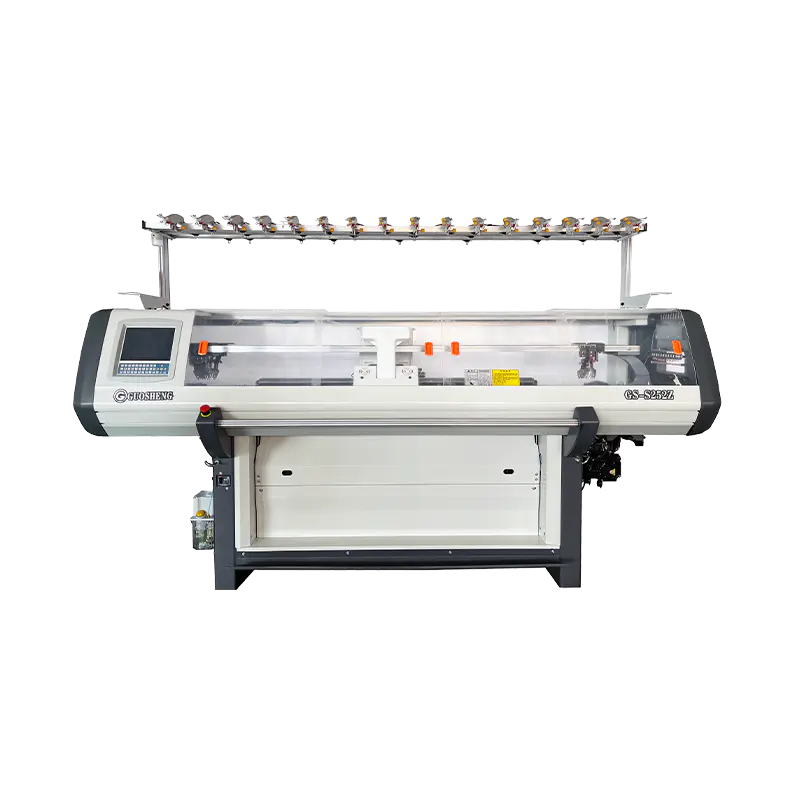

Ready to Begin?
Product Categories
- Sweater Knitting Machine (Economic SE)
- Sweater Knitting Machine (Full Function S)
- Collar Knitting Machine (Economic CE)(Fabric)
- Collar Knitting Machine (Full-Function C)
- Blanket Knitting Machine(Fabric)
- Shoe Upper Knitting Machine
- Ready To Wear Sweater Knitting Machine
- Ready To Wear Glove Knitting Machine
- Ready To Wear Hat Knitting Machine
- Knee Pad Knitting Machine
- Metal Mesh Knitting Machine
Contact Information
-
 Email: gs@guoshengchina.cn
-
 Phone: +86-0512-52690511
-
 Address: No. 18, Hupu Pujiang Road, Bixi New District, Changshu City, Jiangsu Province, China
QR Code
