


 English
 Español
 русский
 عربى
 中文简体
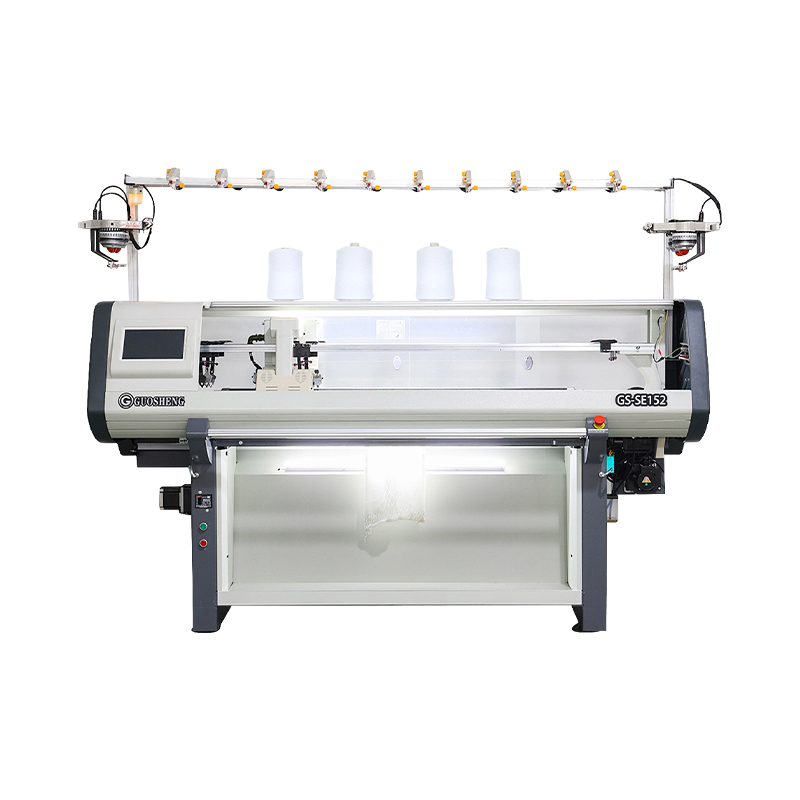
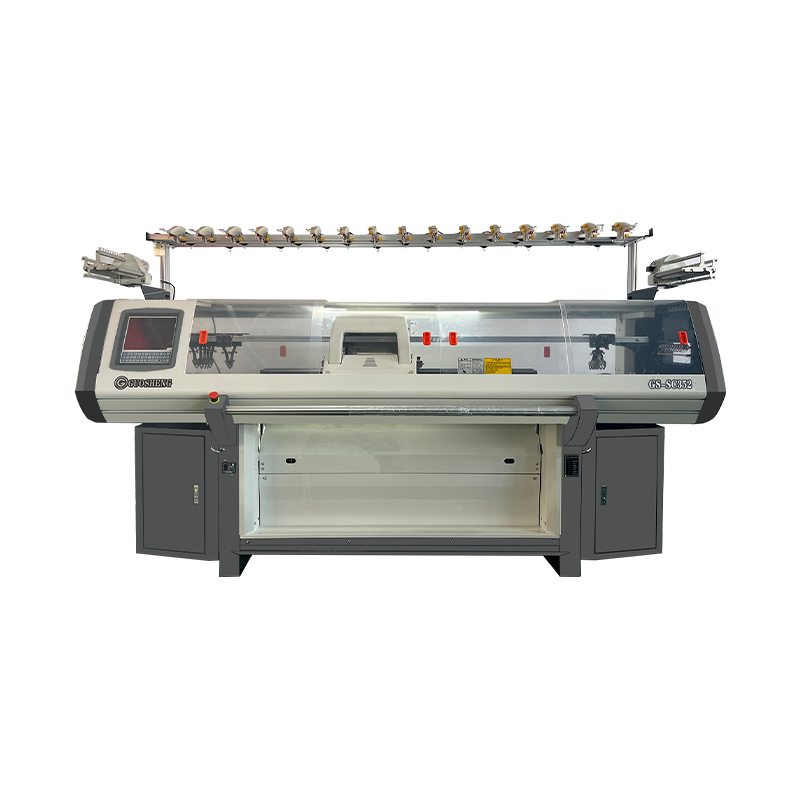
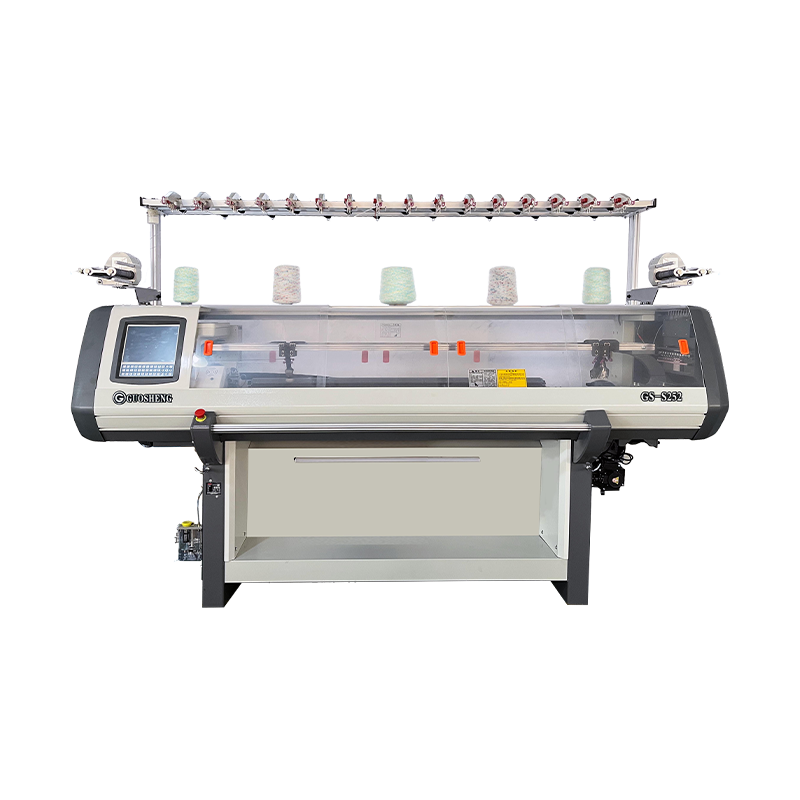
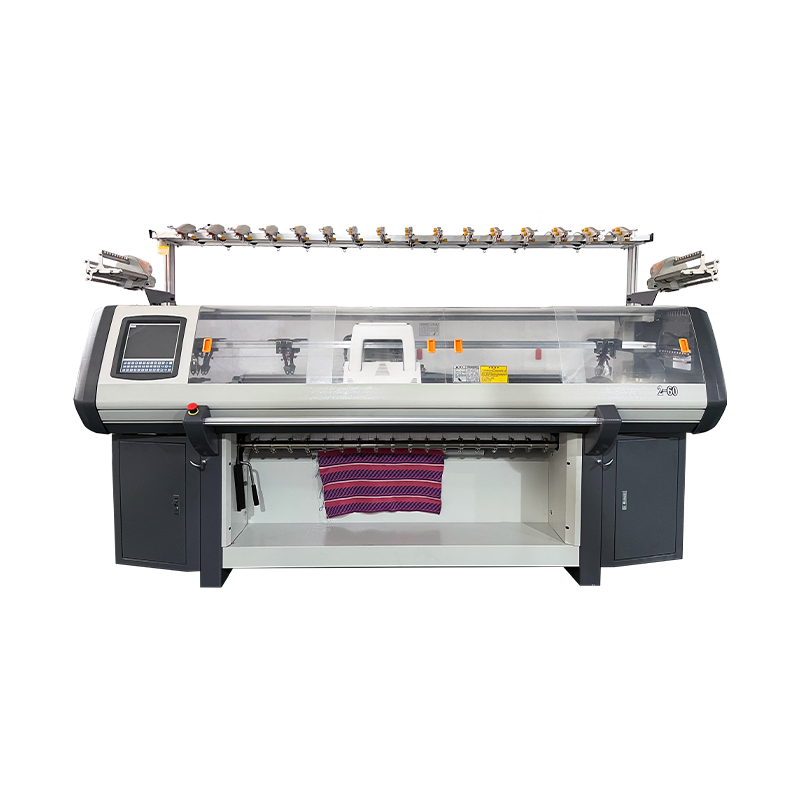

Lin Yuxi — International Product Sales Manager
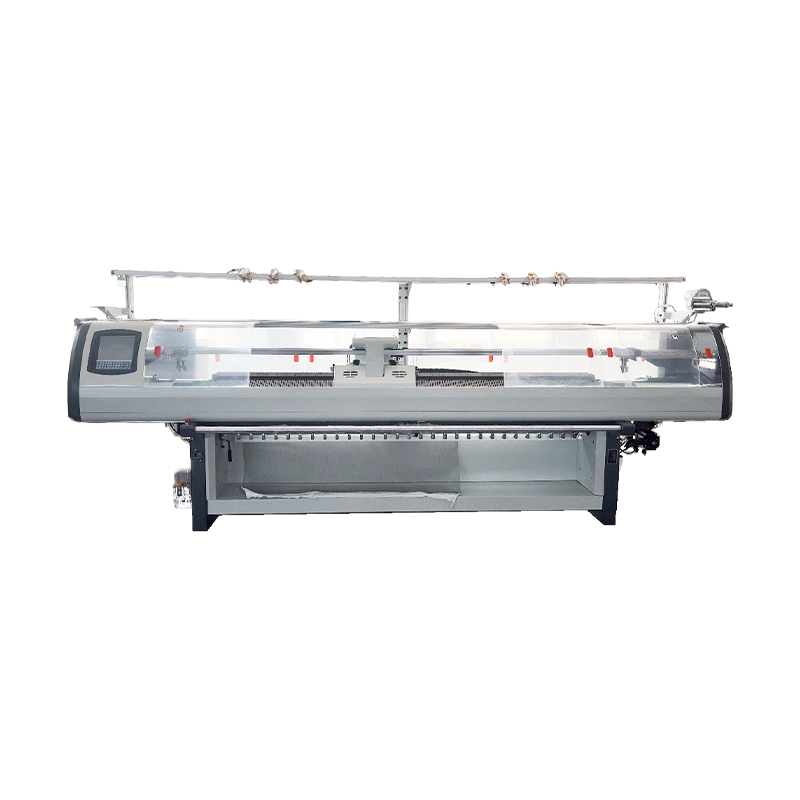
GS-CE340 40-Inch Economic Three-System Collar Knitting Machine: A Practical Guide to High-Efficiency Jacquard Collar Production
Date:Nov 19, 2026
Content
- 1 1. The Changing Requirements of Collar Knitting Production
- 2 2. Product Positioning and Main Technical Characteristics
- 3 3. Three-System Single-Carriage Architecture
- 4 4. Three-Color Jacquard Capability
- 5 5. Variable Stitch Density for Higher Product Value
- 6 6. Computerized Multi-Stage Needle Selection
- 7 7. High-Precision Insert Needle Bed
- 8 8. Upper-Lower Composite Take-Down System
- 9 9. Small-Head Fully Motorized Cam System
- 10 10. Control System, Data Management, and Protection
- 11 11. Manufacturing Strengths Behind the Machine
- 12 12. Advantages Compared with Simpler Competitor Equipment
- 12.1 12.1 Compared with single-system collar machines
- 12.2 12.2 Compared with basic two-system machines
- 12.3 12.3 Compared with traditional high-low needle machines
- 12.4 12.4 Compared with machines lacking variable stitch control
- 12.5 12.5 Compared with machines using basic take-down systems
- 12.6 12.6 Compared with high-cost full-specification systems
- 13 13. Production Applications
- 14 14. Recommended Production Workflow
- 15 15. Maintenance and Operational Reliability
- 16 16. Business Value for Knitwear Factories
- 17 17. Purchasing Considerations
- 18 18. Frequently Asked Questions
- 18.1 Q1: What type of machine is the GS-CE340?
- 18.2 Q2: What is the main advantage of the three-system configuration?
- 18.3 Q3: Can the machine produce three-color jacquard collars?
- 18.4 Q4: Which knitting functions are available?
- 18.5 Q5: What gauges are available?
- 18.6 Q6: How does variable stitch density improve collar production?
- 18.7 Q7: How is needle selection controlled?
- 18.8 Q8: What is the function of the composite traction system?
- 18.9 Q9: What information can be stored in the control system?
- 18.10 Q10: Does the machine provide automatic protection functions?
- 18.11 Q11: What power supply does the machine use?
- 18.12 Q12: Is the GS-CE340 suitable for small and medium-sized collar factories?
- 18.13 Q13: Can the machine be used for both standard and premium collars?
- 18.14 Q14: What should operators monitor during production?
- 19 19. Conclusion
- 20 References
- 21 Product: GS-CE340 40-Inch Economic Three System Collar Knitting Machine
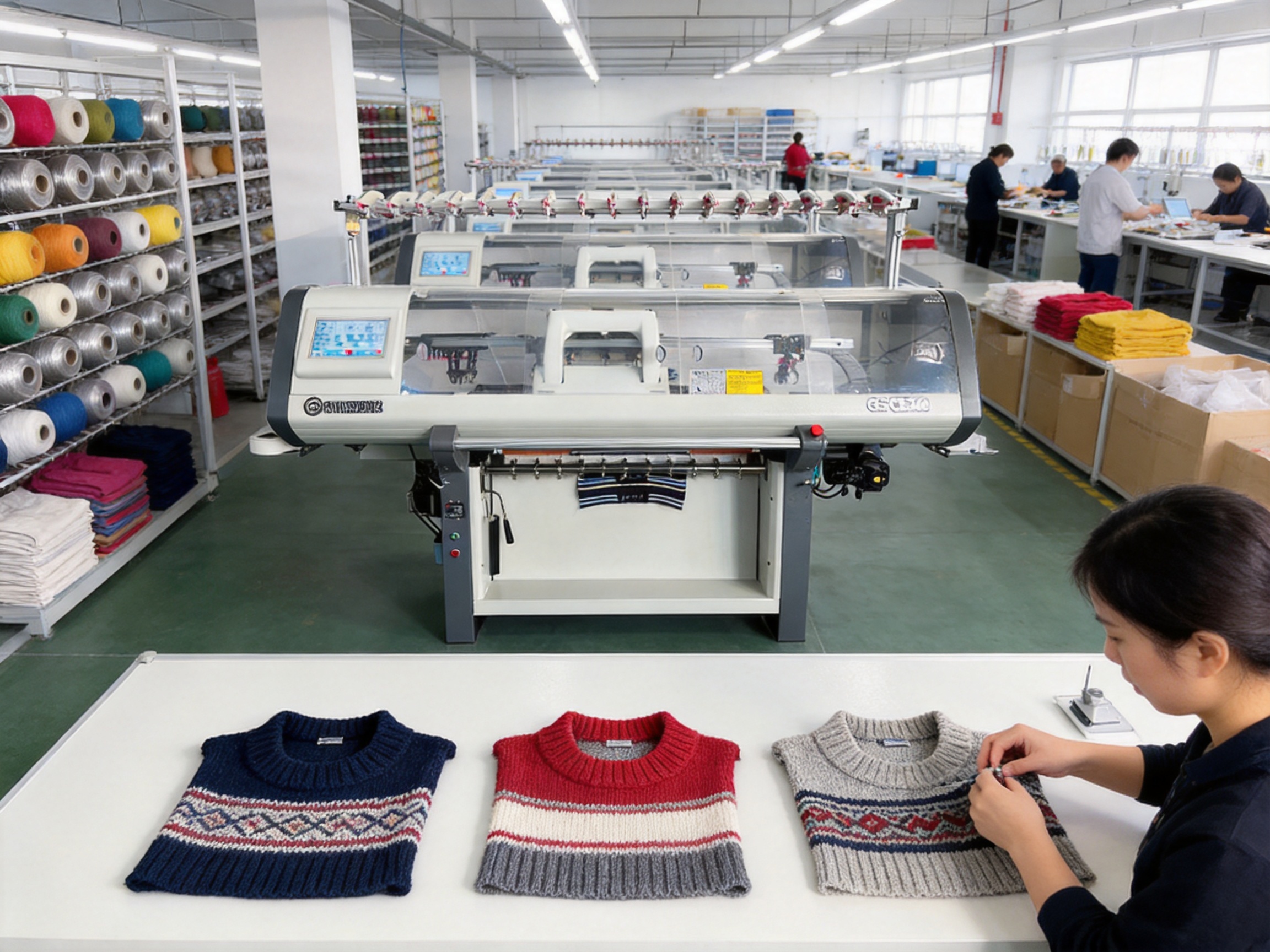
In modern knitwear manufacturing, collars are no longer treated as simple supporting components. They contribute directly to garment identity, comfort, visual balance, and perceived product value. A carefully designed collar can turn an ordinary sweater into a premium fashion product, while an unstable or poorly finished collar can reduce the quality impression of the entire garment. As brands increasingly request multi-color patterns, variable textures, accurate dimensions, and dependable delivery, collar manufacturers need equipment that combines productivity with design flexibility.
The GS-CE340 40-Inch Economic Three-System Collar Knitting Machine is designed for this production environment. It brings a three-system knitting configuration, three-color jacquard capability, computerized needle selection, variable stitch density, and composite take-down control into an economical collar machine platform. Its design addresses the needs of factories that want to move beyond basic single-color or limited-pattern collar production without immediately investing in a full-featured high-cost machine.
With a 40-inch knitting width, gauges from 12G to 20G, a maximum knitting speed of 1.5 meters per second, and support for flat, transfer, tuck, and jacquard functions, the machine is suitable for a broad range of knitted collar applications. It is particularly relevant to knitwear trim factories, sweater manufacturers, fashion garment suppliers, and production facilities seeking more advanced pattern capability with controlled equipment investment.
1. The Changing Requirements of Collar Knitting Production
Collar production has become increasingly demanding because the collar must satisfy several requirements at the same time. It must maintain a stable shape, provide suitable elasticity, match the body fabric, and meet the visual expectations of the garment designer. In addition, the collar may include stripes, geometric motifs, color blocks, raised textures, or jacquard structures that require accurate yarn and needle control.
Traditional collar production methods often rely on relatively simple mechanical structures. These systems may be adequate for standard ribbed collars, but their limitations become apparent when a manufacturer needs multi-color patterns, frequent style changes, or different density effects within one component. Mechanical high-low needle systems can also require repeated adjustment, and pattern consistency may be affected by wear, operator intervention, or variations in machine setup.
Production managers therefore look for equipment that can improve output without sacrificing quality. A machine must be productive enough for continuous manufacturing, flexible enough for changing orders, and stable enough to reduce stoppages. It should also provide an accessible control interface so that operators can adjust production parameters without complicated manual procedures.
The GS-CE340 responds to these requirements through a combination of three-system operation, computerized needle selection, motorized control, and integrated protection functions. Instead of focusing on one isolated performance feature, its design brings together the main functions that influence collar production efficiency: carriage productivity, pattern control, stitch adjustment, yarn changing, fabric take-down, and machine monitoring.
2. Product Positioning and Main Technical Characteristics
The GS-CE340 belongs to the economic three-system collar knitting machine category. Its economic positioning does not mean that it is limited to basic knitting. Rather, the machine is structured to provide a practical balance between advanced capability and investment cost. It is intended for factories that need more than a single-system or basic two-system collar machine but may not require every feature of a premium full-function model.
The machine adopts an economic three-system, single-carriage architecture. Three knitting systems are integrated into one carriage, allowing more knitting actions to be completed during each carriage pass. This structure supports higher operational efficiency than simpler configurations and provides the foundation for three-color jacquard production.
Its nominal knitting width is 40 inches, making it suitable for the production of collar fabrics and related narrow-width knitted components. The available gauges include 12G, 14G, 16G, 18G, and 20G. This range allows the machine to serve different yarn types, fabric appearances, and product specifications, from relatively substantial structures to finer collar constructions.
| Item | Specification | Production Significance |
|---|---|---|
| Model | GS-CE340 | Three-system economic collar knitting platform |
| Knitting system | Economic three-system, single carriage | Improves carriage productivity and supports multi-color jacquard work |
| Knitting width | 40 inches | Suitable for collar fabrics and related knitted components |
| Available gauges | 12G, 14G, 16G, 18G, 20G | Supports a broad range of fabric weights and textures |
| Maximum knitting speed | 1.5 meters per second | Supports efficient production under suitable operating conditions |
| Knitting functions | Flat, transfer, tuck, and jacquard | Expands product variety and design flexibility |
| Yarn carrier system | 2 × 8 yarn carriers on each side of four guide rails | Supports yarn changes at any needle position |
| Stitch density | Motor controlled, 0–650 range with selectable subdivision levels | Enables precise density adjustment and structural variation |
| Take-down roller | 128-section tension control, adjustable from 0 to 100 | Helps maintain stable fabric pulling and dimensions |
| Control system | LCD display, USB input, 256 MB memory, multilingual interface | Simplifies programming, storage, and production monitoring |
| Power supply | 220 V, single phase | Suitable for facilities using standard single-phase power |
These specifications should be evaluated as an integrated system. The three-system carriage provides productivity, while the yarn carrier arrangement supports color flexibility. The stitch density and take-down systems influence fabric appearance and dimensional stability. The computerized control system coordinates these functions and makes operating parameters available for adjustment during production.
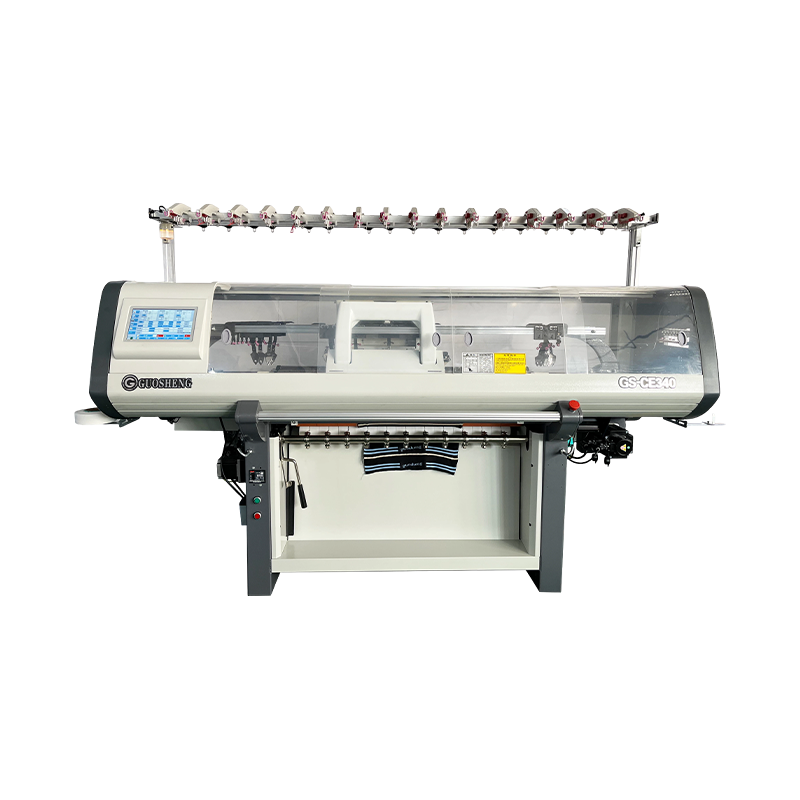
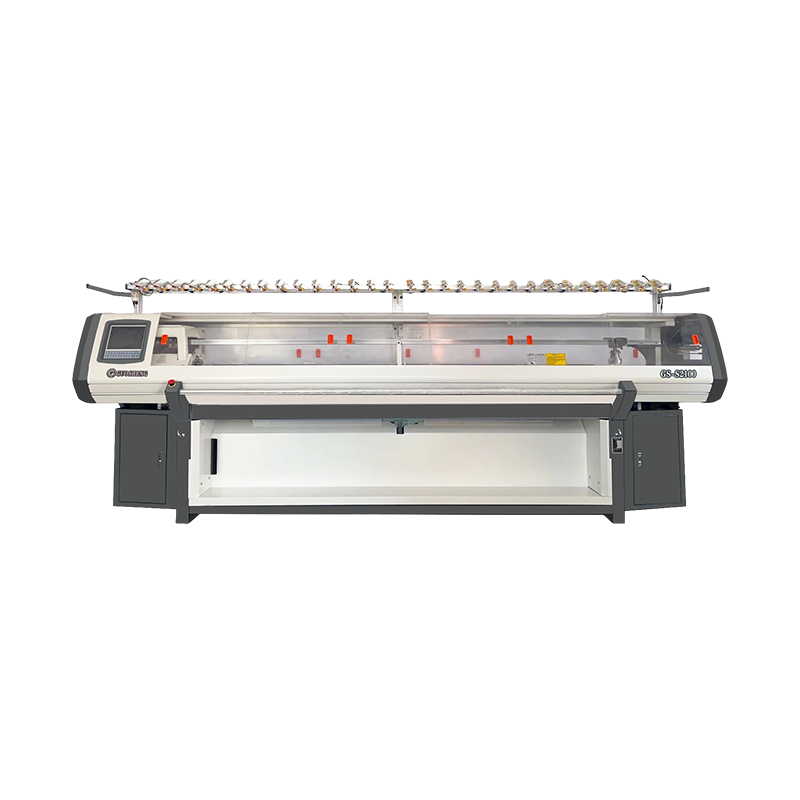
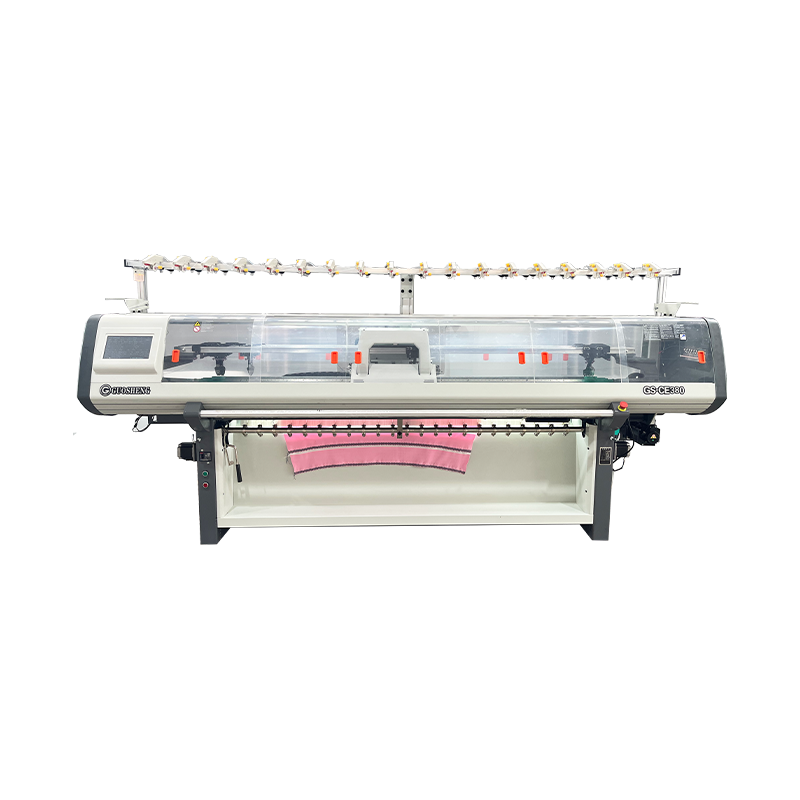
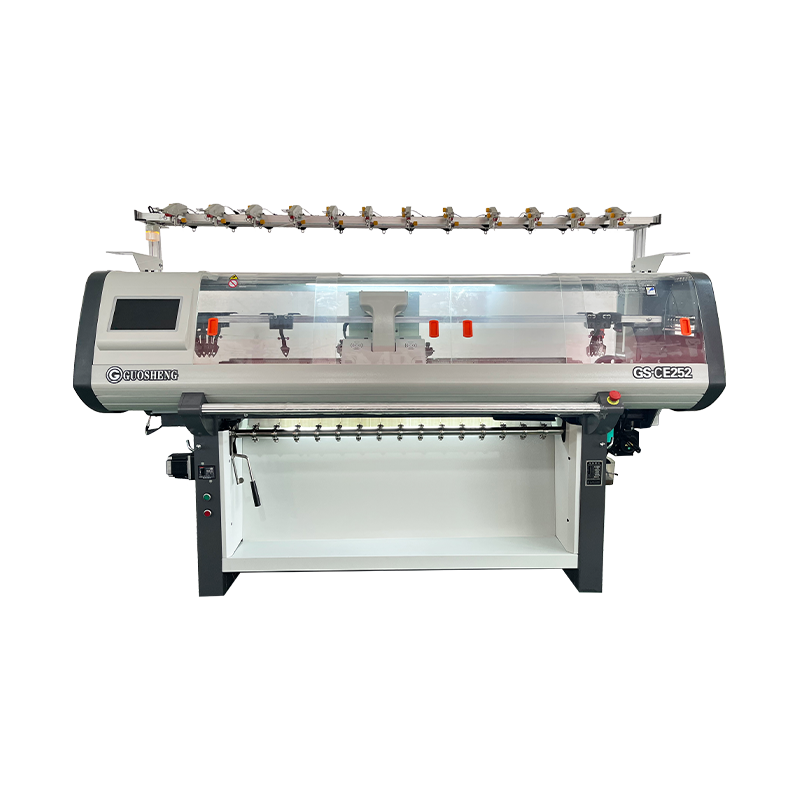
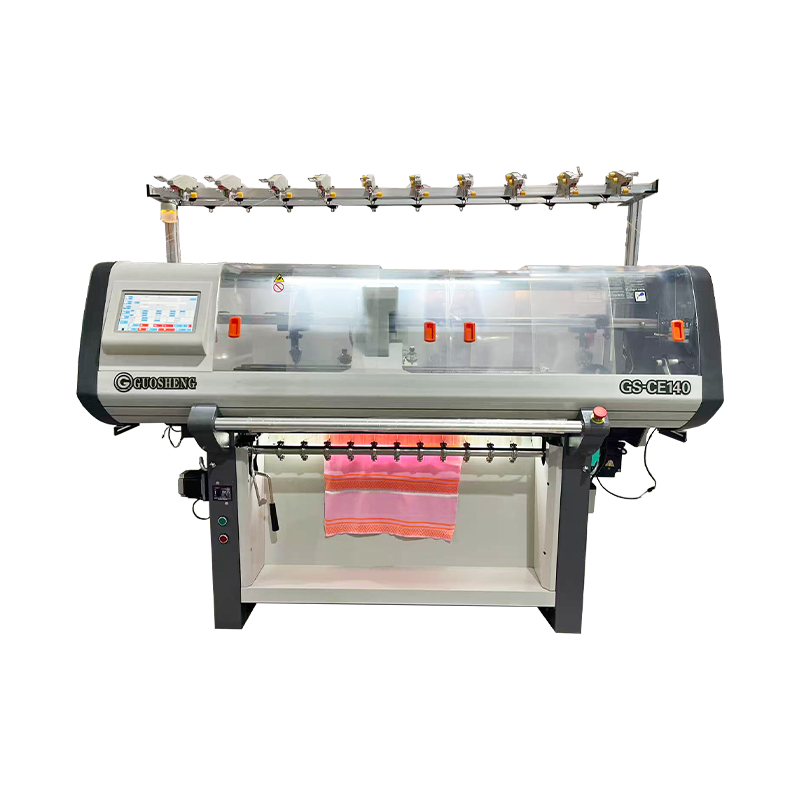
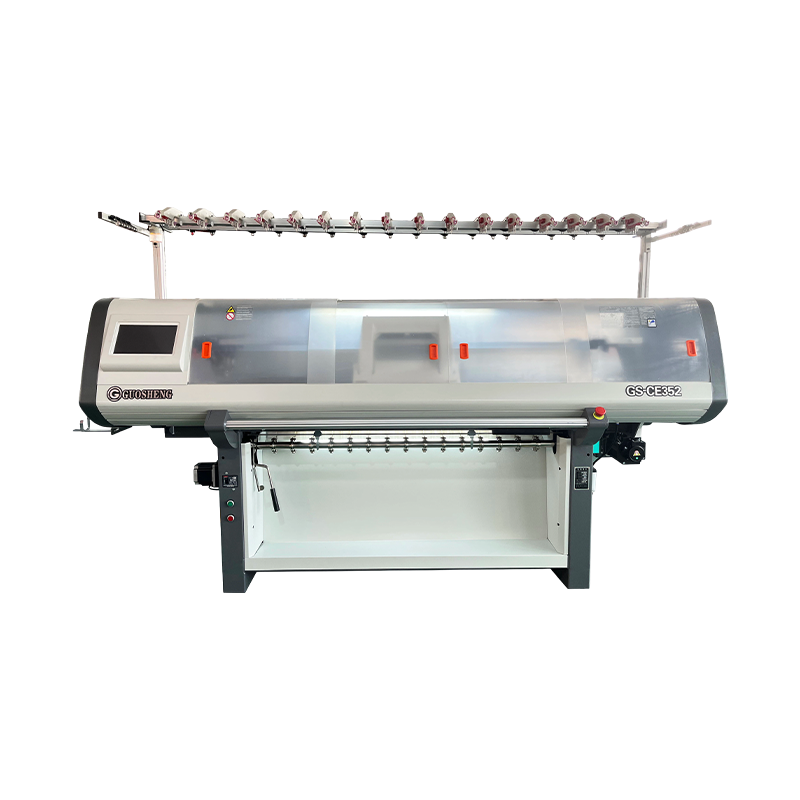
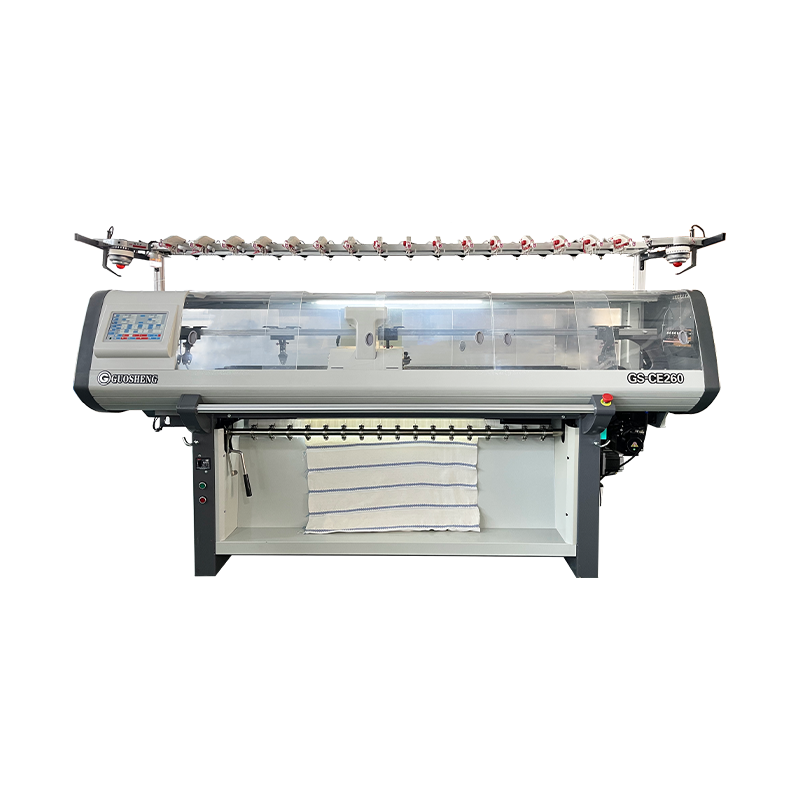
GS-CE340 40-Inch Economic Three System Collar Knitting Machine
3. Three-System Single-Carriage Architecture
The central advantage of the GS-CE340 is its economic three-system, single-carriage configuration. A knitting system can be understood as a functional group that performs specific needle and yarn actions during carriage movement. By combining three systems in one carriage, the machine can complete more knitting operations per pass than a simpler configuration.
This arrangement can improve effective productivity in several ways. More operations may be completed during each movement of the carriage, reducing unnecessary repetition. Pattern construction can become more efficient, especially when the design uses several color or structural instructions. The machine can also provide a better foundation for producing collar styles that would require more passes on a lower-system machine.
The three-system architecture is especially important for three-color jacquard production. A collar design may use three different yarn colors within the same pattern area. With appropriate programming and yarn carrier positioning, the machine can manage these color changes as part of the knitting sequence. This expands the range of visual effects available to product designers and allows factories to respond to fashion orders that require more complex color expression.
Compared with single-system equipment, the GS-CE340 can offer a more efficient production route for multi-step patterns. Compared with some basic two-system machines, it provides an additional system for coordinating pattern and structure operations. The advantage is not limited to maximum speed; it also concerns how much useful knitting work can be achieved during each carriage cycle.
Maximum speed is specified at 1.5 meters per second. Actual production speed should be selected according to gauge, yarn characteristics, pattern complexity, stitch density, fabric tension, and operator settings. A responsible production strategy does not use maximum speed for every order. Instead, the three-system structure gives the factory more available capacity, allowing the operator to select a stable speed that matches the product.
For factories producing repeated orders, the three-system arrangement may also help reduce cycle time and improve machine utilization. For factories producing varied designs, it can reduce the number of separate operations required for more complex collars. This combination of productivity and design capability is one of the machine's principal advantages over simpler economic collar knitting equipment.
4. Three-Color Jacquard Capability
Jacquard knitting enables different needles to participate in different ways so that color and structure can be arranged according to a programmed design. In collar production, jacquard capability can be used for stripes, repeated motifs, branding patterns, geometric designs, decorative bands, and color-rich fashion effects.
The GS-CE340 is designed to support three-color jacquard knitting. This is a meaningful improvement over machines limited to single-color work or simpler two-color effects. Three-color construction provides more opportunities for visual contrast, intermediate color relationships, and coordinated garment design. It can help manufacturers create collars that are visually connected to body panels, sleeves, cuffs, or fashion accessories.
The machine's 2 × 8 yarn carrier configuration is arranged on both sides of four guide rails. The carriers can shift at any needle position, which provides flexibility for yarn changes throughout the knitting width. This is important for jacquard work because a color transition may need to occur at a specific location rather than only at a fixed mechanical point.
Flexible yarn carrier movement can also support more efficient style changes. When a factory receives orders for multiple patterns, the ability to position carriers at different needle locations allows the production team to adapt the knitting sequence through programming instead of relying solely on extensive mechanical rearrangement.
Three-color jacquard capability increases product differentiation. A factory making only basic plain collars may compete mainly on price and delivery. A factory capable of stable multi-color jacquard production can offer more design value. It may be able to serve fashion brands, sportswear producers, uniform suppliers, and garment manufacturers seeking distinctive trim components.
However, jacquard quality depends on more than the number of yarn carriers. Needle selection, yarn tension, stitch density, take-down force, carriage timing, and program accuracy all influence the finished pattern. The GS-CE340 combines these systems so that the three-color function is supported by the rest of the machine rather than treated as an isolated feature.
5. Variable Stitch Density for Higher Product Value
Fixed stitch density is sufficient for many conventional collars, but it limits the ability to create changing surface effects. Variable stitch density allows the operator or program to alter stitch length during knitting. This can create differences in compactness, softness, thickness, surface relief, and visual depth within one collar structure.
The GS-CE340 uses a stepping motor to control stitch density. The system provides selectable levels through subdivision technology across a stated range of 0 to 650. The control resolution gives the operator greater ability to fine-tune the relationship between yarn, needle movement, and fabric structure.
Variable density can be used to create gradual transitions or defined structural zones. For example, a collar may require a firmer edge, a softer central section, or a decorative area with a denser appearance. A manufacturer may also combine different stitch settings with jacquard color changes to produce a fabric that has both visual contrast and textural variation.
This function can increase the perceived value of a collar without requiring a proportional increase in material consumption or additional production stages. A product with layered texture and controlled density may be positioned as a premium trim component, even when it is produced on an economically positioned machine.
Variable stitch density is also useful for product development. Designers can test different structures and quickly compare the effects of tighter or looser knitting. Production teams can adjust settings to suit different yarn compositions and thicknesses. This flexibility helps reduce the need to use separate specialized machines for every fabric effect.
It is important to distinguish density adjustment from uncontrolled looseness. The purpose of the system is not simply to make fabric tighter or looser, but to provide repeatable control. When the stitch system, take-down roller, and programmed instructions are properly coordinated, the resulting fabric can maintain more consistent dimensions from piece to piece.
6. Computerized Multi-Stage Needle Selection
The GS-CE340 uses a computer-controlled electromagnetic and motorized needle selection system. This design replaces the traditional high-low needle approach with electronically managed multi-stage selection. The system determines which needles participate in specific knitting actions according to the programmed design.
Computerized selection offers several benefits. It can improve pattern accuracy, reduce dependence on mechanical needle arrangements, and make design changes easier to manage. Instead of physically changing a large number of mechanical settings for every new pattern, the operator can load or edit a program through the machine's control system.
Multi-stage control is valuable because collar structures often combine several actions. A needle may need to knit, transfer, tuck, or participate in a jacquard sequence. The machine supports flat, transfer, tuck, and jacquard functions, allowing factories to move between basic rib structures and more advanced decorative constructions.
Traditional high-low mechanisms can be vulnerable to mechanical wear, adjustment errors, and pattern inconsistencies. An electronically controlled approach can reduce these sources of variation when the machine is correctly maintained and programmed. It also supports more repeatable production between batches, which is important when a garment style must be delivered over an extended period.
Computerized selection does not eliminate the need for technical skill. Operators still need to understand yarn behavior, pattern programming, fabric tension, and machine maintenance. However, it moves much of the design control into a more flexible and monitorable digital environment. This makes it easier to save, recall, revise, and standardize production settings.
The control system includes an LCD screen, USB input, and 256 MB of memory. A large number of design files can be stored, allowing production teams to maintain a library of collar patterns and machine programs. The monitoring menu displays operating information and permits parameters to be adjusted while the machine is running, subject to appropriate production procedures.
7. High-Precision Insert Needle Bed
The needle bed is a foundational component of any knitting machine. It determines the positioning and movement environment for the needles and directly affects the regularity of the knitted fabric. In collar production, the needle bed must support precise stitch formation over long operating periods while resisting wear from continuous movement.
The GS-CE340 uses a high-precision insert needle bed with insert needles and notched sinkers. The specified characteristics include high hardness, accurate precision, and tight density. These features are intended to provide a stable knitting surface and consistent needle operation during three-system production.
A precise needle bed helps maintain a flat and uniform fabric surface. This is particularly important for jacquard collars, where small differences in needle movement can become visible as pattern distortion, uneven loops, or irregular texture. A stable needle bed also supports the repeatability required for volume orders.
Wear resistance is equally important. A machine may be capable of excellent performance when new, but long-term value depends on how well the critical working components maintain their accuracy. A durable needle bed can reduce the frequency of replacement and help control maintenance costs associated with wear-related defects.
The insert needle design also supports practical service and component management. When maintenance is required, technicians can focus on the relevant needle or sinker area rather than treating the entire knitting surface as a single undifferentiated part. Proper cleaning, lubrication, inspection, and replacement procedures remain essential for maintaining the intended performance.
The combination of precision machining and carefully selected working components reflects an important aspect of modern knitting equipment manufacturing: performance is built into the mechanical foundation as well as the electronic control system. Advanced software cannot compensate for an unstable needle bed, so mechanical precision remains central to the product's value.
8. Upper-Lower Composite Take-Down System
Fabric take-down is the process of drawing the knitted material away from the needle area at a controlled rate. If the pulling force is uneven, the fabric may curl, twist, stretch irregularly, or vary in width. Such defects are especially problematic in collars because the component must match the garment body and maintain a consistent finished shape.
The GS-CE340 uses an upper-lower composite traction system. The upper and lower traction components work together to distribute pulling force across the 40-inch knitting width. This arrangement is designed to provide smoother tension and reduce the risk of edge curling, twisting, and dimensional variation.
The high-position roller increases overall traction force, while the thickened lower roller reinforces the pulling effect. The roller cover uses a wear-resistant formulation intended to support long-term operation. Together, these elements provide a more stable interface between the machine and the knitted fabric.
The take-down roller is controlled by programmed instructions through a stepping motor. It provides 128 selectable tension levels across an adjustable range of 0 to 100. This gives operators a practical way to match pulling force to different yarn weights, elasticities, stitch densities, and collar constructions.
Take-down adjustment is particularly important when combining variable stitch density with jacquard. A denser area may require different pulling behavior from a looser area. A multi-color pattern may also respond differently to tension than a plain structure. The ability to adjust traction through programmed control helps the production team stabilize these differences.
Consistent take-down supports both appearance and assembly. A collar that maintains its intended dimensions is easier to attach to the garment body. It can reduce rework, simplify sewing alignment, and improve the uniformity of finished garments. In this sense, the take-down system affects downstream production as well as the knitting process itself.
9. Small-Head Fully Motorized Cam System
The machine is equipped with a compact small-head fully motorized cam system. Cam mechanisms control important knitting actions, and their accuracy influences the timing and movement of needles and related components. A motorized design allows the machine to manage cam actuation through controlled electronic instructions.
The compact head contributes to a more concentrated and responsive operating structure. The fully motorized configuration is designed for rapid response and accurate action under continuous three-system operation. It can reduce the need for frequent manual mechanical adjustment during normal production and support better continuity across extended shifts.
Motorized cam control is especially useful when the machine must move between different knitting functions. Flat, transfer, tuck, and jacquard operations may require different action sequences. Electronic control allows these sequences to be coordinated more precisely with needle selection and yarn carrier movement.
As with all precision machine systems, performance depends on correct programming, maintenance, and operating conditions. The motorized cam system should be inspected according to the manufacturer's maintenance requirements, and operators should respond promptly to alarms or abnormal sounds. The benefit of motorization is maximized when mechanical cleanliness and electronic monitoring are maintained together.
10. Control System, Data Management, and Protection
A modern knitting machine must do more than move needles. It must provide operators with usable information, store design data, support parameter adjustment, and protect the machine from conditions that could cause damage or defective fabric. The GS-CE340 integrates these functions through an LCD-based control system with USB input and 256 MB of memory.
The LCD interface displays operating parameters and monitoring information. Operators can review the machine status and adjust relevant settings while the machine is running. This can be useful during trial production, when the team needs to fine-tune stitch density, take-down force, or other parameters according to the behavior of the yarn and fabric.
USB input simplifies the transfer of design files. A factory can organize its production library by customer, style, gauge, yarn type, or order number. Saving programs in a structured way can improve repeatability and reduce the time needed to recreate a previous production setup.
The control system supports multiple languages, including English and Chinese. A multilingual interface can be valuable for international customers and mixed-language production teams. Clear menu organization also helps reduce training time when new operators learn the machine.
The protection system is designed to issue alarms and stop the machine when abnormal conditions are detected. The listed protection functions cover yarn breakage, float yarn, rewinding faults, end of knitting, racking failure, needle breakage or collision, safety door events, and programming errors. Automatic stopping can prevent a small problem from developing into a larger mechanical failure or a long section of defective fabric.
Power-off memory provides an additional operational safeguard. The machine operates on 220 V single-phase power and can memorize production information when power is interrupted. This helps protect design and production data against unexpected shutdowns and supports a more orderly restart procedure.
Protection functions are not a substitute for operator attention, but they provide an important additional layer of risk control. In a production environment, the ability to detect and stop abnormal conditions can reduce waste, protect key components, and improve overall equipment reliability.
11. Manufacturing Strengths Behind the Machine
The performance of the GS-CE340 is linked to the manufacturing capabilities of Guosheng Wonderful Intelligent Technology (Changshu) Co., Ltd. The company is based in Changshu, Jiangsu Province, an important textile machinery manufacturing area in China. Its location provides access to a mature industrial ecosystem, technical resources, component suppliers, and manufacturing experience connected with the textile equipment sector.
The company focuses on the research, development, manufacturing, and global supply of computerized knitting machinery. Its product portfolio includes computerized flat knitting machines, collar knitting machines, and flyknit shoe upper knitting machines. This product range gives the company experience across several related knitting applications rather than limiting its expertise to one narrow product category.
Experience across different machine types can support cross-functional engineering knowledge. Control systems, needle selection, servo drive technology, yarn handling, and fabric take-down principles are relevant to multiple knitting applications. Lessons learned in one product area can help inform improvements in another, while the company can provide equipment solutions for customers with several types of knitting production.
The GS-CE340 reflects a manufacturing approach that combines mechanical accuracy with computerized control. Precision components such as needle beds, sinkers, rollers, cams, and guide systems must be produced and assembled with controlled tolerances. Electronic components must then coordinate these mechanical systems through software, sensors, motors, and programmed instructions.
Product development for a machine of this type requires attention to the complete production process. It is not sufficient to increase speed if fabric take-down becomes unstable. It is not sufficient to add color capability if the yarn carriers cannot move accurately. It is not sufficient to provide digital programming if the needle bed cannot maintain precision. The value of the machine comes from how these functions work together.
The company states that it continuously optimizes machine structure, control performance, and knitting capabilities. This focus is relevant to factories that expect equipment to remain useful as product requirements change. A machine with flexible programming and adjustable knitting functions can often support more product variations over its service life than a machine designed for only one fixed production method.
Manufacturing strength also includes the ability to understand practical customer requirements. Textile factories need more than isolated technical specifications. They need reliable operation, manageable maintenance, accessible controls, usable design storage, and support for stable production. By focusing on production conditions rather than only laboratory performance, the manufacturer can make the machine more suitable for real factory environments.
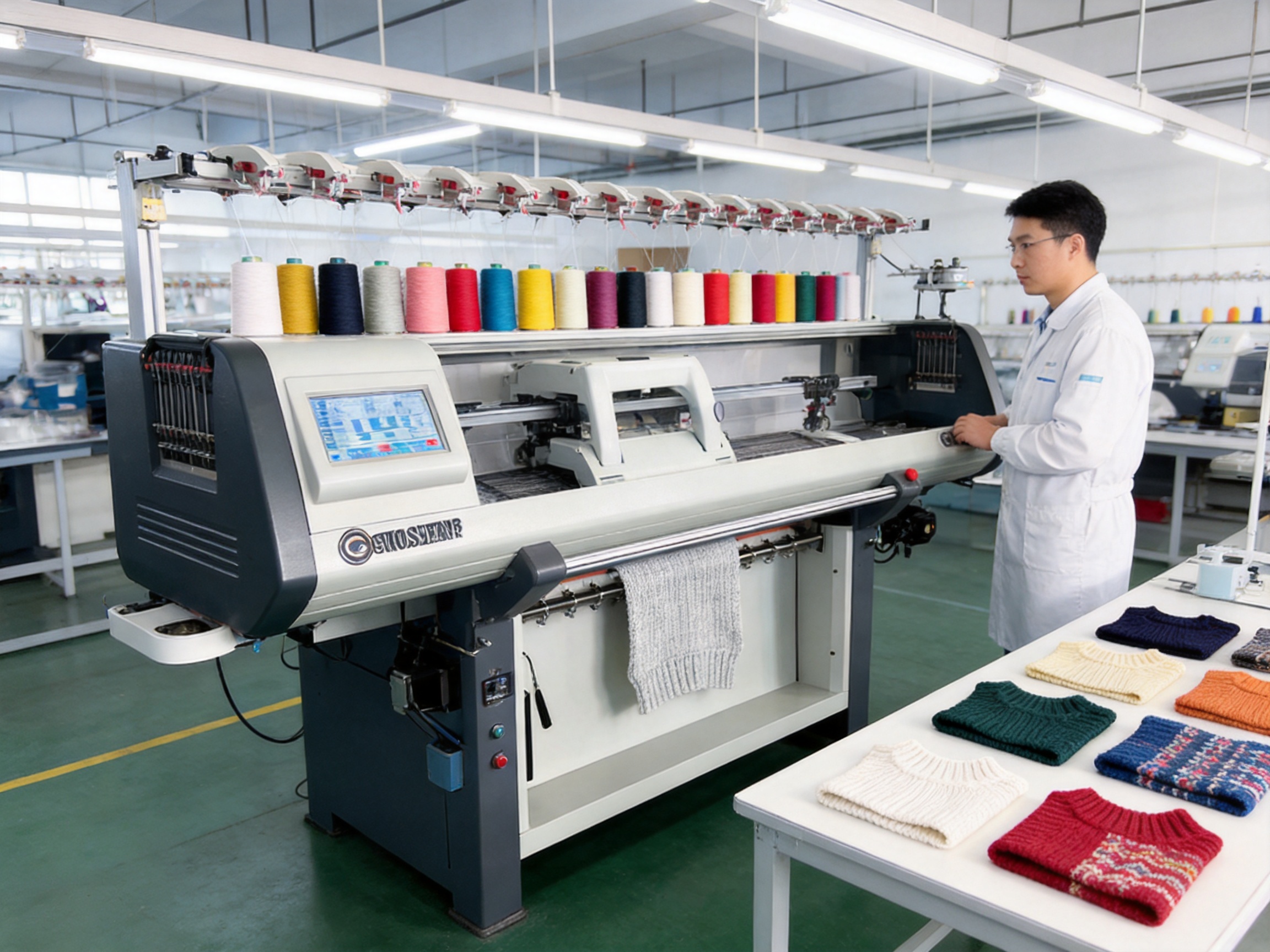
12. Advantages Compared with Simpler Competitor Equipment
The GS-CE340 should be compared with competing machines according to the specific production requirements of a factory. Its advantages are most evident when the customer needs three-system productivity, three-color jacquard capability, variable stitch density, and computerized pattern control in one economic platform.
12.1 Compared with single-system collar machines
Single-system machines may be suitable for basic collars and smaller production volumes, but they generally require more carriage passes to complete multi-step designs. The GS-CE340's three-system architecture can improve efficiency by completing more actions per pass. It also provides a stronger foundation for complex jacquard and structural combinations.
For factories moving from basic products to more design-oriented collars, the difference can be significant. A three-system machine may reduce the production time required for certain patterns and enable the factory to accept orders that would be impractical on a single-system platform.
12.2 Compared with basic two-system machines
Two-system machines can provide a useful balance of cost and productivity, but the third system of the GS-CE340 creates additional flexibility for pattern and structure coordination. The machine's three-color jacquard capability further distinguishes it from equipment restricted to simpler color arrangements.
The practical advantage is strongest when a factory produces multi-color patterns, variable textures, or designs requiring several types of needle action. Rather than adding separate production stages, the machine can manage more of the work within one programmed knitting process.
12.3 Compared with traditional high-low needle machines
Traditional high-low needle methods may require more manual mechanical adjustment and can be affected by mechanical wear or setup variation. The GS-CE340 uses computer-controlled multi-stage needle selection, which supports more flexible design changes and more repeatable pattern control.
Digital programming can also improve production organization. A factory can store designs, recall previous settings, and adjust parameters through the control interface. This is particularly helpful for customers who receive frequent style changes or repeat orders with different color and structural requirements.
12.4 Compared with machines lacking variable stitch control
Machines with fixed stitch density may produce consistent basic fabrics, but they provide fewer options for creating layered surfaces and density transitions. The GS-CE340 allows stitch density to be adjusted during the knitting process, creating more opportunities for premium product development.
This can help a factory compete on design value rather than only on unit price. A collar with controlled structural variation may support higher-value garment programs and provide a visible reason for customers to choose the manufacturer.
12.5 Compared with machines using basic take-down systems
Uneven traction can cause distortion, especially across a wider knitting area or when working with elastic yarns. The upper-lower composite traction system of the GS-CE340 provides a more comprehensive approach to fabric pulling. Its programmable tension levels allow settings to be adapted to different materials and structures.
Stable take-down can reduce downstream fitting and sewing problems. It also supports more consistent collar dimensions, which is essential when the component must be attached to garment panels produced in separate operations.
12.6 Compared with high-cost full-specification systems
The GS-CE340 is not positioned as the most feature-intensive machine for every possible knitting application. Its advantage is that it concentrates important high-value functions in an economic three-system platform. Factories can obtain three-color jacquard, computerized selection, variable stitch density, and advanced traction control without necessarily purchasing a machine designed for requirements beyond their current business.
This balance can improve capital efficiency. A factory can invest in capabilities that directly support its collar product range instead of paying for unrelated functions. As production expands, the machine can continue to serve as a practical platform for a wide variety of collar designs.
13. Production Applications
The GS-CE340 is suitable for many types of knitted collar production. Plain ribbed collars can be produced when a simple and consistent structure is required. Transfer and tuck functions can add texture, elasticity, or decorative relief. Jacquard functions can support multi-color motifs and coordinated garment designs.
Potential product applications include sweater collars, fashion knitwear trims, sportswear collars, children's garment collars, uniform components, striped rib structures, decorative neckbands, and other knitted narrow-width components. The actual application should be determined by yarn specifications, gauge, pattern requirements, and the dimensional standards of the customer.
The machine's range of gauges allows the factory to consider both medium and finer knitted structures. A 12G setting may be appropriate for a relatively substantial collar appearance, while finer gauges such as 18G or 20G may be used for lighter and more delicate constructions. The correct choice depends on yarn count, fiber composition, desired handle, elasticity, and garment design.
Three-color jacquard expands the range of potential customers. Fashion brands may require decorative color combinations, sportswear producers may request team or collection colors, and uniform manufacturers may need repeatable institutional patterns. The ability to store design files also supports production of multiple customer styles on the same machine.
For factories producing both standard and premium collars, the machine can be used as a flexible production platform. Basic orders may use simpler programs and stable density settings, while higher-value orders can combine jacquard, tuck, transfer, and variable density functions.
14. Recommended Production Workflow
A disciplined workflow helps manufacturers obtain the best results from the machine. Production should begin with a review of the order requirements, including finished dimensions, yarn type, number of colors, structure, elasticity, and expected appearance. The appropriate gauge and initial machine parameters can then be selected.
The design file should be prepared and transferred through the USB input. Before full production, the operator should verify needle selection, yarn carrier positions, stitch density, take-down settings, and pattern repeat. A sample or short trial section should be examined for color accuracy, surface regularity, width, elasticity, and edge behavior.
During trial production, speed should be selected according to the complexity of the design and the behavior of the yarn. A simple structure may permit a higher speed, while a dense jacquard pattern or elastic yarn may require a more controlled setting. The maximum speed of 1.5 meters per second is an upper specification, not a universal requirement for every product.
Once the sample meets the required standard, the settings should be documented and saved. A production record may include the design file name, gauge, yarn details, stitch settings, take-down level, speed, and any special operating notes. This record helps improve repeatability when the order is repeated.
During continuous production, operators should monitor the LCD display and respond to alarms promptly. Yarn breakage, float yarn, rewinding faults, racking problems, needle issues, and programming errors should be investigated before restarting. Regular inspection helps prevent the accumulation of defects and protects the machine from avoidable damage.
After production, the collar fabric should be inspected for dimensions, pattern registration, color transition, surface flatness, edge condition, and elasticity. Feedback from inspection can be used to adjust the program for the next batch. This continuous improvement process is especially useful when a factory is developing new jacquard or variable-density products.
15. Maintenance and Operational Reliability
Reliable knitting performance depends on regular maintenance. The needle bed, sinkers, cams, yarn carriers, guide rails, rollers, drive system, and sensors should be inspected according to the recommended service schedule. Dust, lint, and yarn residue should be removed from areas where they could interfere with movement or detection.
The needle bed requires particular attention because its precision directly affects fabric quality. Needles and sinkers should be checked for damage, wear, or unusual movement. If a needle collision or abnormal noise occurs, the machine should be stopped and inspected before production continues.
Yarn carriers and guide rails should move smoothly through their operating range. Accumulated lint or misalignment can affect yarn changes and lead to jacquard irregularities. The upper and lower traction rollers should also be kept clean and checked for surface wear so that fabric tension remains stable.
Electronic protection functions should be tested as part of routine maintenance. Alarms and safety door systems need to operate correctly, and stored design files should be backed up through appropriate factory procedures. Power-off memory reduces risk during interruptions, but good data management remains important.
Operator training is another part of reliability. Staff should understand the machine's interface, alarm messages, emergency procedures, pattern loading process, and basic parameter relationships. Trained operators can identify problems earlier and make adjustments more systematically.
16. Business Value for Knitwear Factories
Investing in a collar knitting machine should be evaluated through both technical and commercial factors. The GS-CE340 can create value by expanding the product range, improving production efficiency, and supporting better consistency. Its three-color jacquard capability may enable a factory to accept more design-oriented orders, while variable stitch density can support premium product positioning.
Higher productivity does not automatically mean higher profit. The machine creates the greatest business value when its capabilities are connected to market demand. Factories should identify customers who need multi-color collars, textured trims, short style runs, or repeatable custom designs. The machine can then be used to build a product portfolio around those requirements.
The economic three-system positioning may also support a more controlled investment strategy. A factory can obtain meaningful upgrades over basic equipment while managing capital expenditure. If the machine replaces several simpler production stages or reduces dependence on manual pattern adjustments, the total production process may become more efficient.
Consistency is another source of commercial value. Customers expect collars from the same order to match one another and to fit the garment body correctly. Computerized pattern storage, programmable stitch density, controlled take-down, and precision needle selection all contribute to repeatability.
The machine can also support quicker sampling. Fashion customers often require prototypes before placing larger orders. The ability to save and modify designs, change color arrangements, and adjust structural parameters can help a factory respond more quickly during product development.
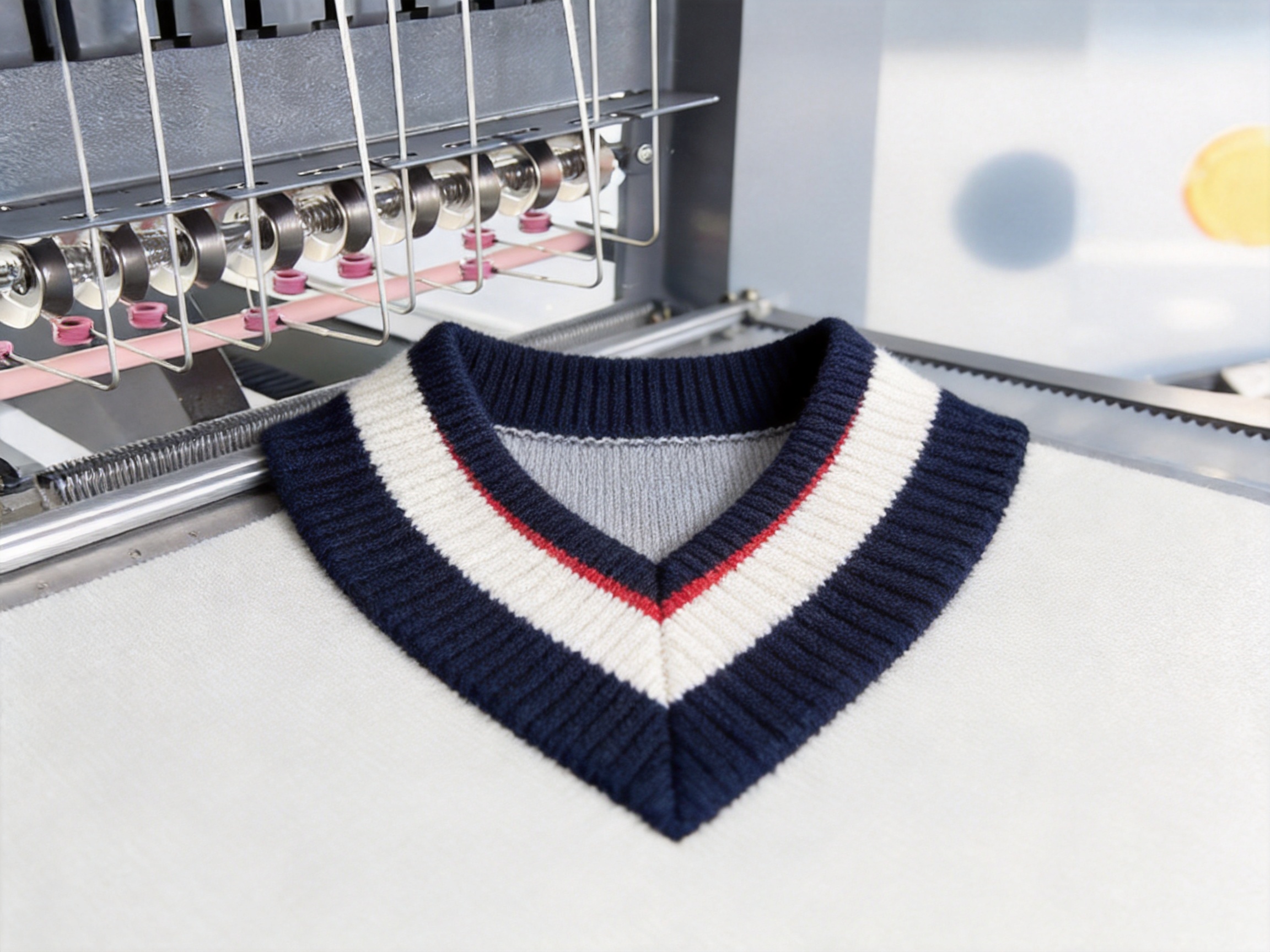
17. Purchasing Considerations
Before purchasing the GS-CE340, a factory should evaluate the types of collars it intends to produce. Important questions include the required gauge, yarn range, number of colors, pattern complexity, expected daily output, finished width, and acceptable level of automation.
Sample testing is recommended when working with unfamiliar yarns or demanding structures. A test should examine not only whether the machine can knit the design, but also whether the finished collar meets the customer's requirements for hand feel, elasticity, color clarity, dimensions, and sewing performance.
The factory should also assess installation space, power supply, operator availability, maintenance resources, and spare component planning. The machine uses 220 V single-phase power, but the production facility should confirm that its electrical installation is suitable and stable.
Training and after-sales support should be considered as part of the purchase decision. A technically advanced machine delivers better value when operators can use the available functions correctly and technicians can maintain the equipment efficiently. Buyers should establish a clear plan for installation, commissioning, design preparation, routine service, and troubleshooting.
The machine's economic classification makes it attractive for factories seeking a balance between function and investment, but the correct selection still depends on production goals. A manufacturer producing only one simple collar style may not need all of its advanced features. A manufacturer seeking multi-color, textured, and design-rich collar products may find that the machine's combined functions provide a strong fit.
18. Frequently Asked Questions
Q1: What type of machine is the GS-CE340?
The GS-CE340 is a 40-inch economic three-system collar knitting machine with a single carriage. It is designed for producing knitted collars and related narrow-width components with flat, transfer, tuck, and jacquard functions.
Q2: What is the main advantage of the three-system configuration?
The three-system configuration allows more knitting actions to be completed during each carriage pass than simpler single-system or lower-system machines. It also supports three-color jacquard production and can improve efficiency for complex collar designs.
Q3: Can the machine produce three-color jacquard collars?
Yes. The machine is designed for three-color jacquard knitting. Its 2 × 8 yarn carrier arrangement on four guide rails supports yarn changes at any needle position, allowing complex multi-color patterns to be programmed and produced.
Q4: Which knitting functions are available?
The GS-CE340 supports flat, transfer, tuck, and jacquard knitting functions. These functions allow the factory to produce basic ribbed collars as well as collars with textured and multi-color structures.
Q5: What gauges are available?
The listed gauges are 12G, 14G, 16G, 18G, and 20G. The appropriate gauge depends on yarn specifications, desired fabric weight, surface appearance, elasticity, and garment requirements.
Q6: How does variable stitch density improve collar production?
Variable stitch density allows stitch length to be adjusted during the knitting process. This can create density gradients, structural transitions, layered surfaces, and differentiated fabric effects within one collar piece.
Q7: How is needle selection controlled?
Needle selection is controlled by a computer-driven electromagnetic and motorized selection system. The multi-stage approach replaces the traditional high-low needle method and supports more flexible and repeatable pattern control.
Q8: What is the function of the composite traction system?
The upper-lower composite traction system applies controlled pulling force across the fabric width. It is designed to reduce edge curling, twisting, and dimensional variation while supporting stable collar dimensions.
Q9: What information can be stored in the control system?
The control system includes USB input and 256 MB of memory for storing design files. Production teams can maintain multiple collar programs and recall them for repeat orders or style variations.
Q10: Does the machine provide automatic protection functions?
Yes. The protection system can alarm and stop the machine when it detects conditions such as yarn breakage, float yarn, rewinding faults, end of knitting, racking failure, needle problems, safety door events, or programming errors.
Q11: What power supply does the machine use?
The machine operates on 220 V single-phase power and includes a power-off memory function to help preserve production data during unexpected interruptions.
Q12: Is the GS-CE340 suitable for small and medium-sized collar factories?
Its economic three-system positioning makes it suitable for factories seeking more advanced productivity and design capability without immediately investing in a full-specification premium machine. Suitability should be confirmed according to the factory's order volume, product range, and technical resources.
Yes. Standard collars can be produced with simpler programs, while premium products can combine three-color jacquard, variable stitch density, transfer, and tuck functions. This flexibility allows one machine platform to support different market segments.
Q14: What should operators monitor during production?
Operators should monitor yarn supply, yarn carrier movement, pattern accuracy, fabric tension, stitch density, take-down behavior, machine alarms, and the general condition of the knitted fabric. Any abnormal alarm or sound should be investigated promptly.
19. Conclusion
The GS-CE340 40-Inch Economic Three-System Collar Knitting Machine is designed for manufacturers that want to move beyond basic collar production while maintaining practical control over equipment investment. Its combination of three-system single-carriage operation, three-color jacquard capability, variable stitch density, computerized multi-stage needle selection, precision needle bed construction, and upper-lower composite traction gives it a strong position within the economic collar machine category.
Its main competitive advantage is the integration of multiple valuable functions into one production platform. The machine is not limited to increasing speed. It also improves design flexibility, supports richer color expression, provides more control over fabric structure, and helps stabilize dimensions during production.
The manufacturing strength behind the machine is based on the combination of mechanical precision, motorized action, computerized control, and practical textile engineering. Through its broader portfolio of computerized knitting equipment, the manufacturer applies experience from sweater, collar, and footwear-related knitting applications to the development of reliable industrial solutions.
For factories producing fashion collars, sportswear trims, multi-color knitwear components, and structured rib products, the GS-CE340 can provide a balanced route toward higher productivity and greater product value. Its capabilities are most effectively realized when supported by appropriate yarn selection, careful programming, operator training, preventive maintenance, and systematic quality inspection.
As the knitwear market continues to demand faster response, more distinctive patterns, and consistent quality, an economic machine with advanced three-system and computerized functions can become an important part of a factory's production strategy. The GS-CE340 offers that combination in a 40-inch collar knitting platform designed for flexible, repeatable, and commercially valuable production.
References
1. Product technical information for the GS-CE340 40-Inch Economic Three-System Collar Knitting Machine.
2. Manufacturer-provided specifications for computerized collar knitting equipment, including gauge, knitting width, speed, needle selection, yarn carrier, take-down, control, and protection systems.
3. Technical principles of flat knitting, transfer knitting, tuck knitting, and jacquard knitting in industrial textile production.
4. General engineering principles for stitch density control, computerized needle selection, servo drive systems, and knitted fabric take-down.
5. Manufacturing information concerning computerized flat knitting machines, collar knitting machines, and flyknit shoe upper knitting machines.
6. General quality-control practices for knitted collar dimensions, pattern consistency, fabric tension, elasticity, and production repeatability.
Product: GS-CE340 40-Inch Economic Three System Collar Knitting Machine

Ready to Begin?
Product Categories
- Sweater Knitting Machine (Economic SE)
- Sweater Knitting Machine (Full Function S)
- Collar Knitting Machine (Economic CE)(Fabric)
- Collar Knitting Machine (Full-Function C)
- Blanket Knitting Machine(Fabric)
- Shoe Upper Knitting Machine
- Ready To Wear Sweater Knitting Machine
- Ready To Wear Glove Knitting Machine
- Ready To Wear Hat Knitting Machine
- Knee Pad Knitting Machine
- Metal Mesh Knitting Machine
Contact Information
-
 Email: gs@guoshengchina.cn
-
 Phone: +86-0512-52690511
-
 Address: No. 18, Hupu Pujiang Road, Bixi New District, Changshu City, Jiangsu Province, China
QR Code
