


 English
 Español
 русский
 عربى
 中文简体

Zhao Yutong — After-Sales Service Manager
36-Inch Double-System Ready-to-Wear Glove Knitting Machine: A Complete Guide to Seamless 3D Glove Production
Date:Oct 18, 2026
Content
- 1 Introduction
- 2 Product Positioning and Manufacturing Purpose
- 3 Three-Dimensional Integral Forming Technology
- 4 Double-System, Single-Carriage Architecture
- 5 Motorized Cam Technology for Controlled Forming
- 6 Variable Stitch Density for Functional Glove Zones
- 7 Sinker Assistance and Fabric Formation
- 8 Gauge Options and Product Versatility
- 9 Yarn Carrier Configuration and Color Capability
- 10 Knitting Functions and Design Flexibility
- 11 Precision Take-Down and Tension Management
- 12 Racking, Drive System, and Mechanical Stability
- 13 Computerized Control and Operator Convenience
- 14 Protection and Fault Monitoring
- 15 Automatic Oil Supply and Maintenance Benefits
- 16 Advantages Over Conventional Glove Production Methods
- 17 Advantages Over Less Specialized Equipment
- 18 Manufacturing Strengths of Guosheng Wonderful Intelligent Technology
- 19 Production Workflow for a Ready-to-Wear Glove
- 20 Application Areas
- 21 Operational Recommendations for Best Results
- 22 Technical Specification Summary
- 23 Economic Value for Manufacturers
- 24 Q&A
- 24.1 What type of product is the machine designed to produce?
- 24.2 What does three-dimensional integral forming mean?
- 24.3 How does the double-system configuration improve production?
- 24.4 Why is the motorized cam important?
- 24.5 Can the machine produce gloves with different fabric densities?
- 24.6 What are the available gauge options?
- 24.7 Can the machine knit multi-color glove designs?
- 24.8 How does the scissor-and-clamp system reduce waste?
- 24.9 Does the machine require post-knitting finishing?
- 24.10 How does automatic oil supply benefit production?
- 24.11 What protection functions are included?
- 24.12 What type of control interface does the machine use?
- 24.13 What power supply is required?
- 24.14 Who can benefit most from this machine?
- 25 Conclusion
- 26 References
- 27 Product: GS-G236 36-Inch Double System Ready-to-Wear Glove Knitting Machine
Introduction
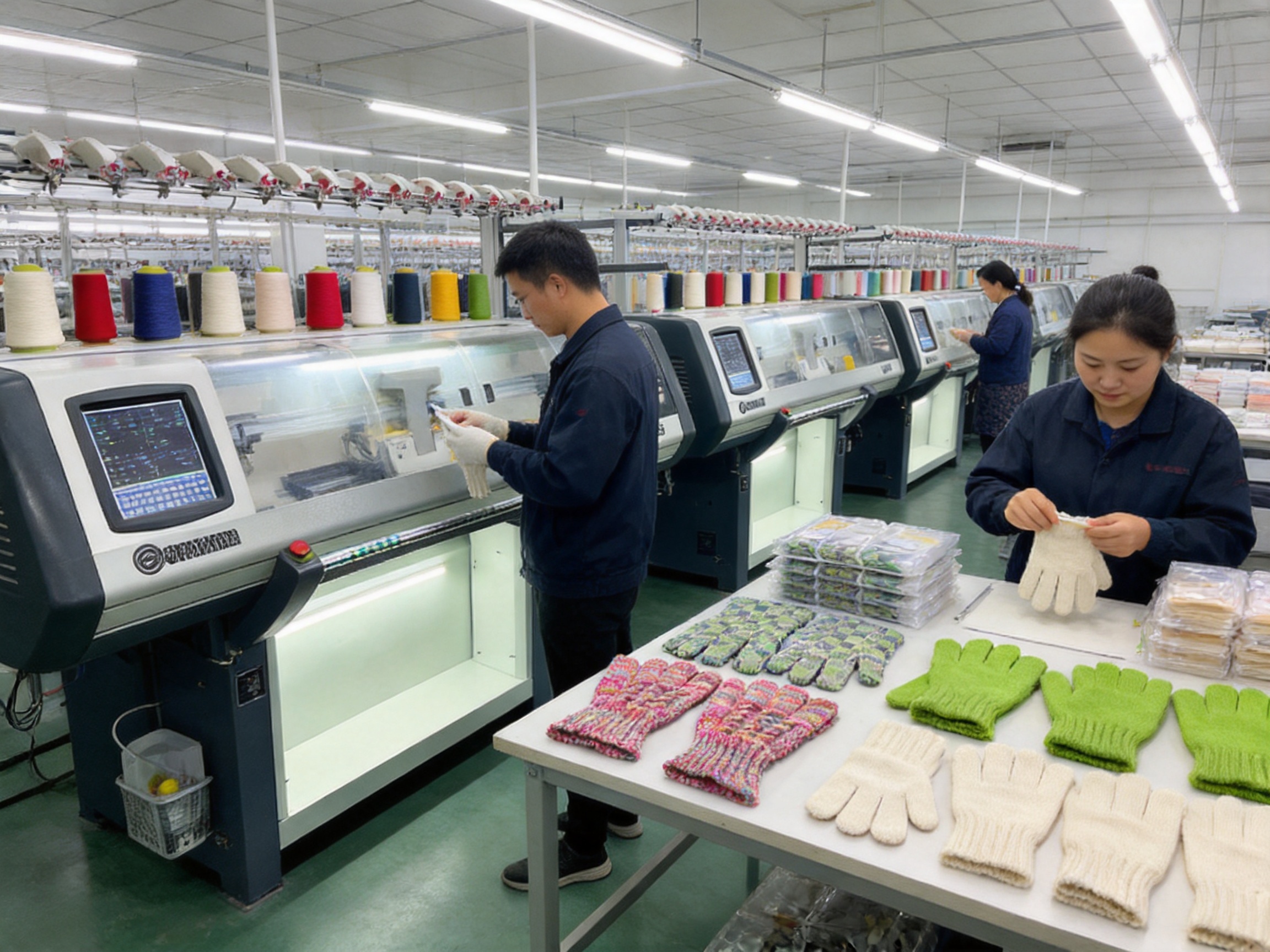
The development of ready-to-wear glove manufacturing has created new requirements for knitting machinery. Modern glove producers are expected to deliver products that are comfortable, durable, attractive, consistent, and economical to manufacture. At the same time, manufacturers must reduce labor-intensive finishing operations, control material consumption, respond quickly to customized orders, and maintain stable production over long operating periods. The GS-G236 36-Inch Double-System Ready-to-Wear Glove Knitting Machine is designed to address these requirements through integrated three-dimensional forming, computerized control, and a production structure developed specifically for complete glove knitting.
As a core model in the Full-Function G series, the machine combines a double-system, single-carriage configuration with precision needle selection, variable stitch density, a motorized cam system, sinker assistance, automatic lubrication, programmable yarn handling, and comprehensive machine protection. Its purpose is not simply to knit glove fabric. It is engineered to produce an entire glove in a continuous knitting process, from the fingertips through the finger transitions, palm, and wrist opening.
This integrated approach distinguishes the machine from conventional production methods in which individual glove components are knitted separately and later joined by sewing. By reducing or eliminating post-knitting sewing, the machine can help manufacturers lower labor requirements, shorten production cycles, improve product uniformity, and create a smoother finished article. These advantages are particularly valuable for safety gloves, sports gloves, fashion gloves, work gloves, and other functional knitted products.
The 36-inch working width, six available gauge options, two knitting systems, and flexible yarn arrangement allow the machine to serve a broad range of glove applications. Its control platform also enables operators to adjust production parameters while the machine is running, store numerous design files, and manage complex structures such as transfer, tuck, miss, jacquard, intarsia, and needle transfer patterns.
Product Positioning and Manufacturing Purpose
The GS-G236 is positioned as a professional machine for manufacturers moving toward ready-to-wear and three-dimensionally formed glove production. Its design reflects a clear shift in the textile industry: customers increasingly expect gloves to be delivered as finished or nearly finished products, while manufacturers seek to reduce manual intervention after knitting.
Traditional glove manufacturing often involves multiple stages. Yarn is first knitted into separate panels or tubular sections. These components are then cut, aligned, sewn, trimmed, inspected, and sometimes subjected to additional shaping or finishing. Every additional step introduces cost and potential variation. Sewing lines may become uncomfortable during wear, seam positions can affect flexibility, and inconsistent stitching may reduce product durability.
The GS-G236 addresses these limitations by integrating the principal forming operations into one computerized knitting process. The machine is capable of controlling finger formation, transitions between fingers, palm shaping, and wrist construction through programmed knitting instructions. The result is a glove with continuous knitted connectivity and fewer structural interruptions.
For manufacturers, this production concept provides several important benefits. It can reduce dependence on sewing operators, simplify production planning, decrease the number of workstations, and reduce the time between knitting and final inspection. It also helps create a more repeatable manufacturing process because the shape of the glove is determined by digital programming and machine settings rather than by numerous manual assembly operations.
Three-Dimensional Integral Forming Technology
The most important feature of the machine is its 3D integral forming capability. This technology enables the glove to be knitted as one connected product rather than as a group of separately manufactured pieces. The knitting sequence can progress from the fingertip of one finger through its transition area and into the palm, while other fingers are formed according to the programmed design.
Three-dimensional glove knitting is more demanding than the production of flat panels. The machine must coordinate needle selection, stitch transfer, yarn feeding, carriage movement, stitch density, take-down tension, and forming actions in a precise sequence. Small errors in timing or tension can influence finger length, fingertip shape, finger spacing, palm width, wrist elasticity, and overall comfort.
The GS-G236 is designed to coordinate these operations through a computerized control system and a double-system knitting architecture. This allows the machine to manage complicated knitting instructions while maintaining the structural continuity required for a complete glove. The result is a smoother transition between glove zones and a reduction in the seam-related issues associated with conventional construction.
Integral forming also supports improved wearer comfort. The absence of conventional sewn seams can reduce pressure points and friction, particularly around the fingers and palm. This can be beneficial in sports gloves, work gloves, protective gloves, and close-fitting fashion products where flexibility and tactile comfort are important.
Durability is another potential advantage. A glove assembled through sewing contains connection points that may be exposed to repeated bending, stretching, washing, and abrasion. A continuously knitted structure distributes stress through the fabric more evenly. Although the final performance depends on yarn type, stitch structure, finishing, and intended use, integral forming provides a strong foundation for durable glove construction.
From a design perspective, three-dimensional forming also permits manufacturers to develop differentiated products. Gloves may be programmed with customized finger lengths, shaped palms, varied densities, reinforced zones, color arrangements, or functional structures. This flexibility supports both standardized large-volume products and smaller, more specialized orders.
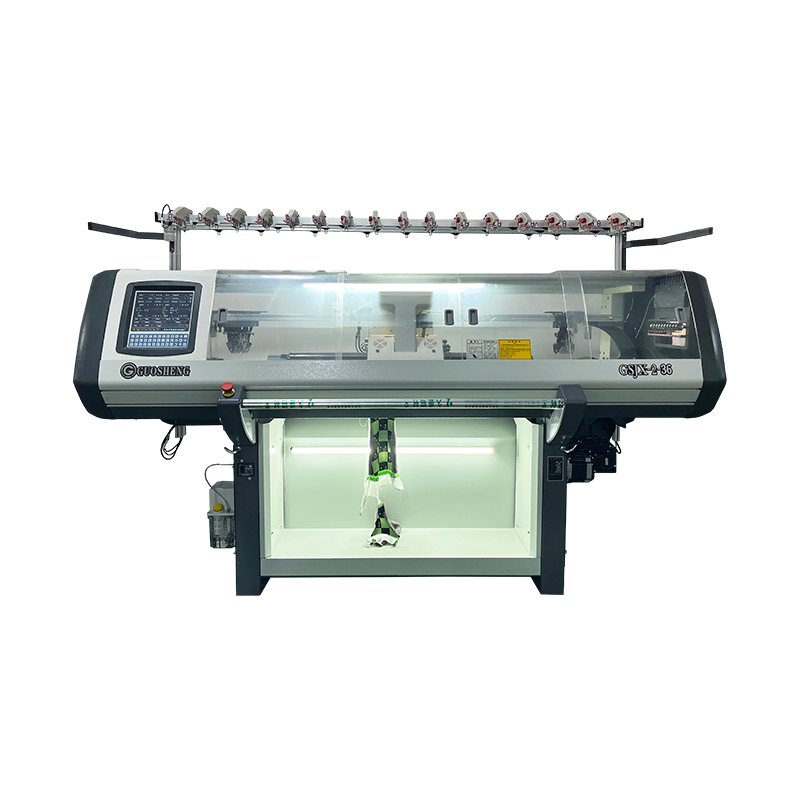
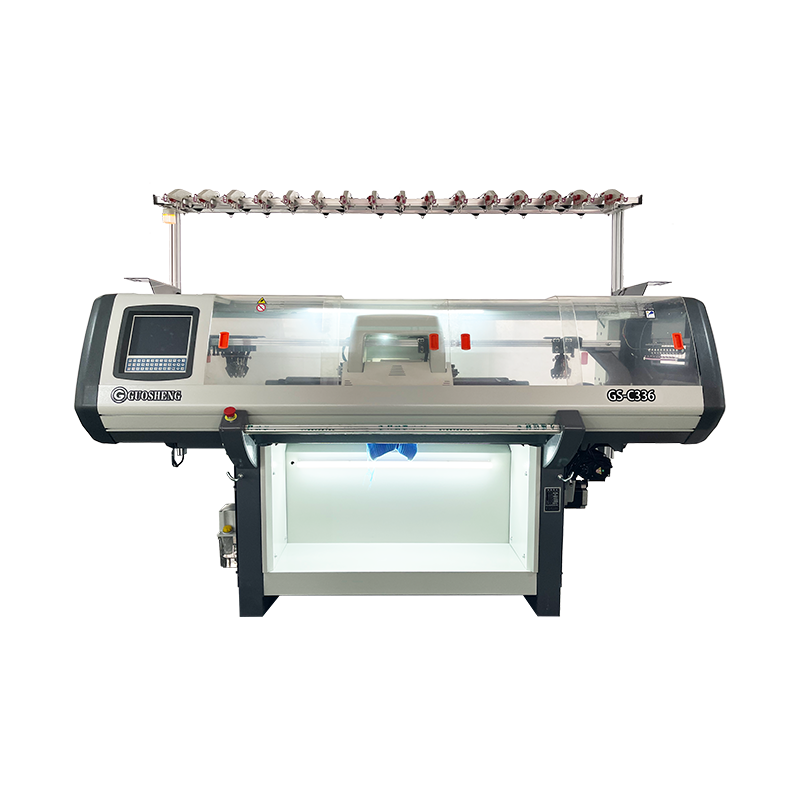
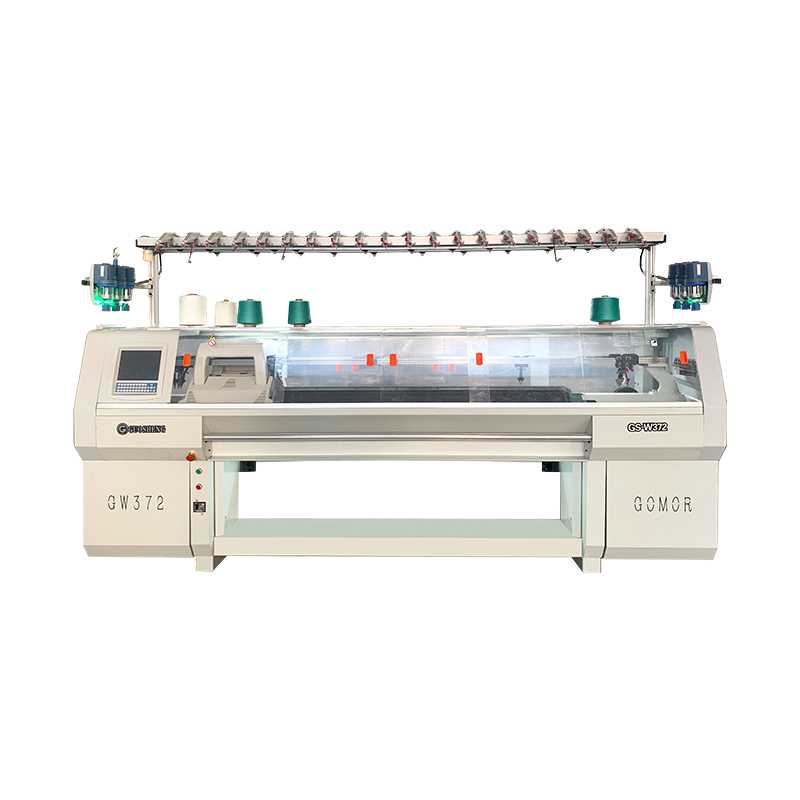
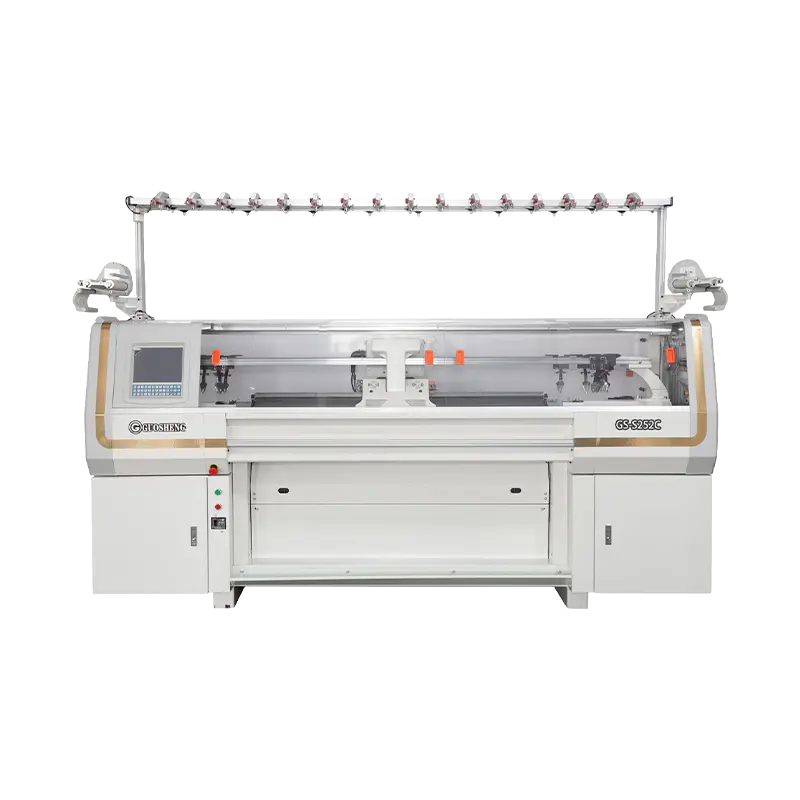
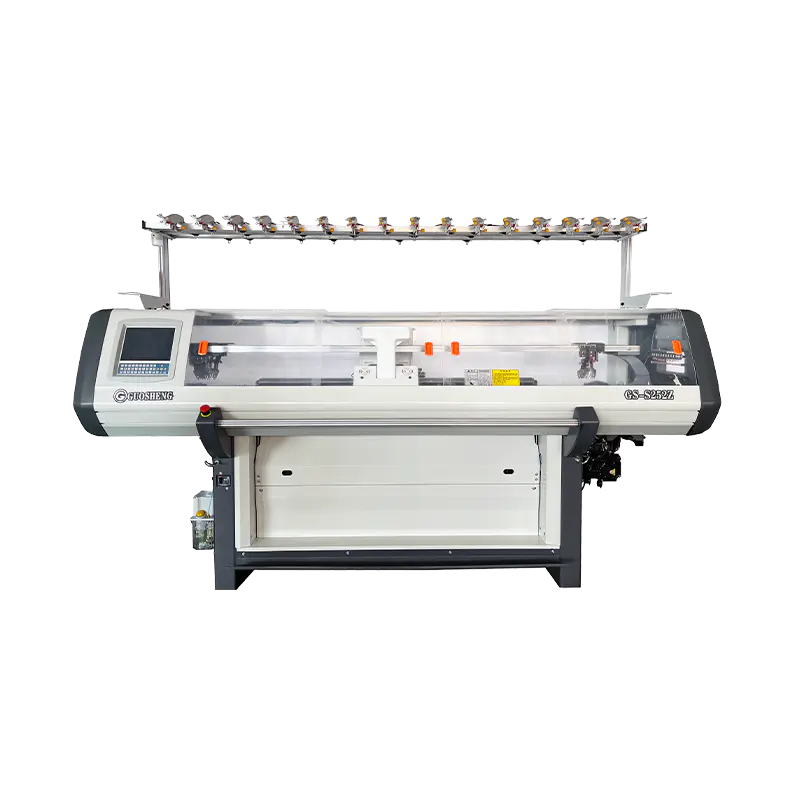
GS-G236 36-Inch Double System Ready-to-Wear Glove Knitting Machine
Double-System, Single-Carriage Architecture
The double-system, single-carriage architecture is the principal production foundation of the machine. A double-system arrangement enables more knitting actions during each carriage pass than a comparable single-system configuration. This can improve production efficiency, especially when the programmed glove design contains frequent changes in stitch structure, forming actions, or needle selection.
Glove knitting involves a dense sequence of operations. Finger sections are narrow, transition areas require controlled shaping, and the machine must repeatedly change the active needle range. A machine intended for integral glove production must therefore balance speed with precision. Excessive speed without accurate control can cause dropped stitches, uneven finger shapes, yarn instability, or dimensional variation.
The GS-G236 is specified with a maximum knitting speed of 1.5 meters per second. This speed rating provides a useful production basis for manufacturers that need to fulfill medium- and large-volume orders. More importantly, the double-system configuration can shorten the knitting cycle by allowing more actions to be completed within a single carriage movement, subject to the design, yarn, gauge, and operating conditions.
Compared with single-system equipment, a double-system machine may provide a stronger balance between output and functional capability. It can support productive operation without requiring the operator to sacrifice complex patterning or three-dimensional shaping. This is particularly valuable for factories that produce multiple glove categories rather than a single basic style.
The single-carriage design also contributes to a coordinated mechanical layout. The carriage controls the movement and knitting actions across the working width, while the computerized system manages stitch instructions, needle selection, and auxiliary functions. A well-coordinated carriage structure can support stable operation and simplify the relationship between machine settings and programmed designs.
Motorized Cam Technology for Controlled Forming
The machine uses a 5.2-inch fully motorized cam system. In computerized flat knitting equipment, the cam system is responsible for controlling key knitting actions, including the movement of needles and the formation of different stitch types. A fully motorized system allows cam actions to be controlled electronically and adjusted rapidly according to the programmed knitting sequence.
This capability is particularly important in ready-to-wear glove production because the machine must repeatedly shift between different operating conditions. A fingertip may require a narrow active needle range and a specific stitch density. A finger transition may require transfer or shaping actions. The palm may need a broader knitting area, while the wrist may require an elastic or structurally different construction.
Motorized cam control helps coordinate these changes with greater precision than a system that relies primarily on fixed mechanical arrangements. The operator can use programmed instructions to define how the needles should behave in different sections of the glove. This reduces the need for frequent manual mechanical adjustments and supports faster product changeovers.
The compact cam structure also contributes to responsive operation. Rapid and accurate cam movement is useful when a design contains frequent transitions between knit, tuck, miss, transfer, and other functions. By matching cam movement to the design instructions, the machine can support more consistent stitch formation and reduce the risk of defects caused by delayed or inconsistent mechanical action.
For manufacturers, the practical result is improved repeatability. When a design file is reused, the machine can reproduce the same cam instructions under equivalent operating conditions. This supports batch consistency and makes it easier to establish standardized production procedures for frequently ordered glove styles.
Variable Stitch Density for Functional Glove Zones
Gloves are not uniform products. Different areas of the glove perform different functions and may require different fabric characteristics. Fingertips may need compact, wear-resistant structures. The palm may require a balance between durability, flexibility, and breathability. The wrist may need elasticity and controlled recovery. A single fixed stitch density cannot always deliver the best performance in every area.
The GS-G236 includes variable stitch density control, allowing the stitch length and fabric density to be adjusted according to the programmed section of the glove. This makes it possible to produce different fabric characteristics within one integral product without changing machines or stopping the production process for manual intervention.
A tighter stitch arrangement can help create a denser fabric in areas where abrasion resistance, protection, or close fit is important. A more open or flexible arrangement can be used where comfort, ventilation, stretch, or hand movement is more important. The correct settings depend on the yarn, gauge, glove purpose, and desired performance, but the machine provides the control range needed to explore these options.
According to the supplied specifications, stitch density is controlled by a stepping motor with 128 or 32 adjustable levels, depending on the control setting, across a range of 0 to 650. This level of adjustment gives operators a detailed method for tuning the fabric. It also enables manufacturers to create more refined product specifications rather than relying on broad mechanical adjustments.
Variable density is valuable for product development as well as mass production. A factory can test different density combinations for the fingertip, finger body, palm, and wrist, then save the most successful configuration as a repeatable production program. This supports continuous improvement and allows the manufacturer to respond to customer requirements more precisely.
Sinker Assistance and Fabric Formation
The sinker assist system provides additional support during the knitting process. Sinkers help hold, guide, and control the knitted fabric as stitches are formed. In three-dimensional glove production, this function is especially important because the machine must manage narrow finger sections, curved transition zones, and changing fabric geometry.
Finger roots and joint areas can be challenging because the active knitting width changes rapidly. The fabric must be held in a stable position while needles form new stitches, transfer loops, or carry out shaping operations. If fabric control is insufficient, the result may be uneven surfaces, inconsistent dimensions, or distortions around the finger transitions.
By assisting yarn and fabric control, the sinker system supports more even formation and improved structural uniformity. It helps the machine maintain the fabric position during critical forming actions, which contributes to the consistency of finger shape and palm construction.
The system is also relevant to production stability. Stable fabric control can reduce the possibility of irregular loops, fabric deformation, and interruptions caused by poor material handling. This is useful when producing long batches in which small inconsistencies could otherwise accumulate across a large quantity of gloves.
When combined with motorized cam control and variable stitch density, sinker assistance gives the machine a more complete forming capability. The cam system controls the knitting action, the stitch-density function manages fabric compactness, and the sinker system helps maintain fabric position and formation quality.
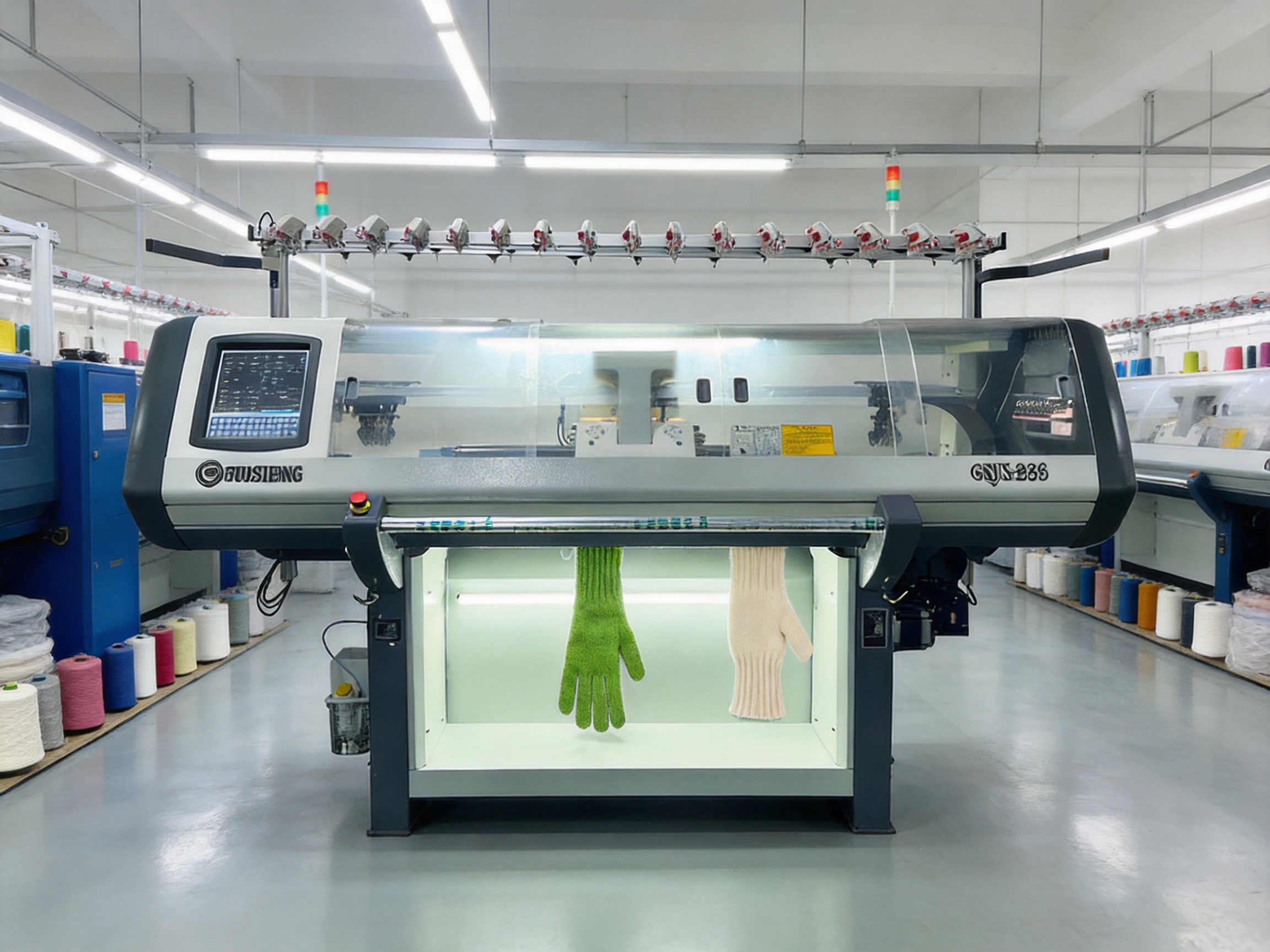
Gauge Options and Product Versatility
The machine is available in six gauge options: 3-5-7G, 7G, 9G, 10G, 12G, and 14G. Gauge selection influences the fineness, texture, density, and application range of the finished glove. A lower gauge is generally associated with heavier or more substantial knitted structures, while higher gauges can support finer and lighter products.
The broad gauge range allows one machine platform to serve diverse market segments. Heavy-gauge configurations may be suitable for chunky winter gloves, substantial work gloves, or products requiring a thicker visual appearance. Medium gauges can be used for general-purpose work, sports, and casual gloves. Fine gauges may be appropriate for lightweight fashion gloves, liner gloves, precision-use products, or close-fitting accessories.
Gauge choice must be considered together with yarn count, fiber composition, stitch density, and desired stretch. A machine’s flexibility is most useful when operators understand how these factors interact. The GS-G236 provides the mechanical and electronic foundation for this experimentation while allowing manufacturers to maintain a consistent production platform across several product categories.
The 36-inch knitting width is tailored to glove production requirements. It provides sufficient working space for the machine’s knitting operations and yarn-carrier arrangement while remaining focused on a specialized product category. A dedicated width can help manufacturers optimize machine layout, programming, and production planning for glove manufacturing.
Yarn Carrier Configuration and Color Capability
The yarn system includes 16 yarn carriers on each side of four guide rails. The carriers can shift to any needle position, providing flexibility for color changes, yarn selection, and patterned knitting. This arrangement supports the production of multi-color gloves and designs that require different yarns within the same knitting program.
Color flexibility is important in the glove market. Manufacturers may need to produce corporate colors, team designs, fashion combinations, high-visibility sections, contrast cuffs, decorative patterns, or functional color zoning. A flexible yarn-carrier system can reduce the restrictions associated with fixed yarn positions and allow more freedom in design programming.
The machine supports structures including jacquard and intarsia. Jacquard techniques can create repeated or integrated color patterns, while intarsia can be used for localized color areas with reduced unnecessary yarn float. These capabilities are useful for branding, decoration, visual differentiation, and performance-oriented color placement.
The left and right scissor-and-clamp assemblies can be programmed to operate synchronously or independently. This provides greater control over yarn ends and yarn changes. By coordinating the cutting and clamping sequence with the knitting program, the machine can minimize unnecessary yarn waste and improve the cleanliness of the finished product.
Reduced yarn waste has both economic and environmental value. Yarn represents a major material cost in glove production, especially when using specialized fibers, blended yarns, elastic yarns, or multiple colors. Efficient yarn handling helps reduce discarded material and can improve the overall utilization rate of purchased yarn.
Knitting Functions and Design Flexibility
The machine supports transfer, tuck, miss, jacquard, intarsia, and needle transfer functions. Each function contributes to a different aspect of glove design and fabric engineering.
Transfer functions can be used to move loops between needles and support shaping, structural transitions, decorative effects, or localized construction details. Tuck stitches can add thickness, texture, stretch, or visual relief. Miss stitches can create controlled floats or modify the fabric structure according to the design objective.
Jacquard and intarsia functions expand the machine’s color and pattern capabilities. Needle transfer functions are particularly relevant to forming operations because they can help shape narrow sections and manage transitions between different parts of the glove.
These functions allow manufacturers to move beyond plain knitted gloves. They can develop products with reinforced fingertips, textured palm zones, decorative motifs, color-blocked designs, contrast cuffs, and other differentiated features. The same machine can therefore support basic production programs and more advanced value-added products.
Design flexibility also improves responsiveness to customer orders. When a buyer requests a new color combination or a revised surface structure, the manufacturer may be able to modify the digital program rather than redesigning a large amount of mechanical tooling. This can shorten development time and reduce the cost of trial production.
Precision Take-Down and Tension Management
Take-down control is essential for stable flat knitting. The take-down roller determines how the knitted fabric is drawn away from the needles. If the pulling force is too high, the fabric may stretch excessively or cause stitch formation problems. If it is too low, the fabric may accumulate, distort, or interfere with the knitting process.
The GS-G236 uses a programmed take-down roller controlled by a stepping motor. The system provides 128 selectable tension levels within an adjustment range of 0 to 100. This enables operators to adapt the take-down force to different yarns, gauges, stitch structures, and glove sections.
Different areas of a glove may require different take-down conditions. A narrow fingertip, a transition area, a broad palm, and an elastic wrist may respond differently to the same pulling force. Programmable take-down control allows the machine to compensate for these differences and maintain better fabric stability throughout the knitting cycle.
Consistent tension management contributes to dimensional accuracy. It helps control the length and width of knitted sections, supports more uniform loop formation, and reduces variation between gloves in the same batch. For ready-to-wear products, repeatable dimensions are important because the gloves must fit the intended size range and maintain a consistent appearance.
Racking, Drive System, and Mechanical Stability
Racking is controlled by a computer and supported by an AC servo system. The supplied specifications identify a two-inch racking range with fine adjustment capability. Racking allows the machine to shift the relative position of the needle bed or knitting elements, supporting shaping, transfer operations, and structural design requirements.
Accurate racking is important in glove manufacturing because small positional changes can affect finger alignment, stitch transfer, and the relationship between different fabric sections. Computerized control helps ensure that racking instructions are executed consistently according to the design program.
The drive system uses synchronous belt transmission and AC servo control. Synchronous belts provide coordinated movement with reduced slip, while servo motors support precise speed and position control. Together, these features contribute to smooth operation, stable carriage movement, and accurate execution of programmed knitting actions.
A stable drive system also helps reduce mechanical vibration and irregular movement. Smooth operation is particularly valuable when the machine works at higher speeds or performs frequent changes in knitting direction and structure. Reduced mechanical instability can support better stitch quality and longer service life for key components.
Computerized Control and Operator Convenience
The machine is equipped with an LCD control interface and USB input. Its 256MB system memory can store a large number of design files, allowing manufacturers to maintain a library of glove programs and retrieve them when required.
Digital storage supports efficient production organization. Frequently used designs can be saved with clear program names or identification numbers, reducing the time required to set up repeat orders. A stored design can also serve as a reference for future production, helping operators maintain consistency across different batches.
The monitoring menu displays operating parameters and enables adjustments while the machine is running. This is useful when operators need to fine-tune stitch density, take-down tension, speed, or other production conditions in response to yarn behavior or fabric formation.
Real-time adjustment can reduce unnecessary machine stops. Instead of stopping production for every minor correction, the operator may be able to modify the relevant parameter during operation, provided that the adjustment is appropriate for the design and machine condition. This contributes to higher equipment utilization and more responsive production management.
The visual design system is intended to be easy to understand and upgrade. A clear interface reduces the learning burden for operators and helps production teams manage complex programs more effectively. Support for Chinese, English, and other language versions also makes the system suitable for international manufacturing environments.
For factories with multiple machines or multiple shifts, standardized digital control can help improve training and operating consistency. Operators can follow established procedures, use saved parameter sets, and monitor the same categories of information across production runs.
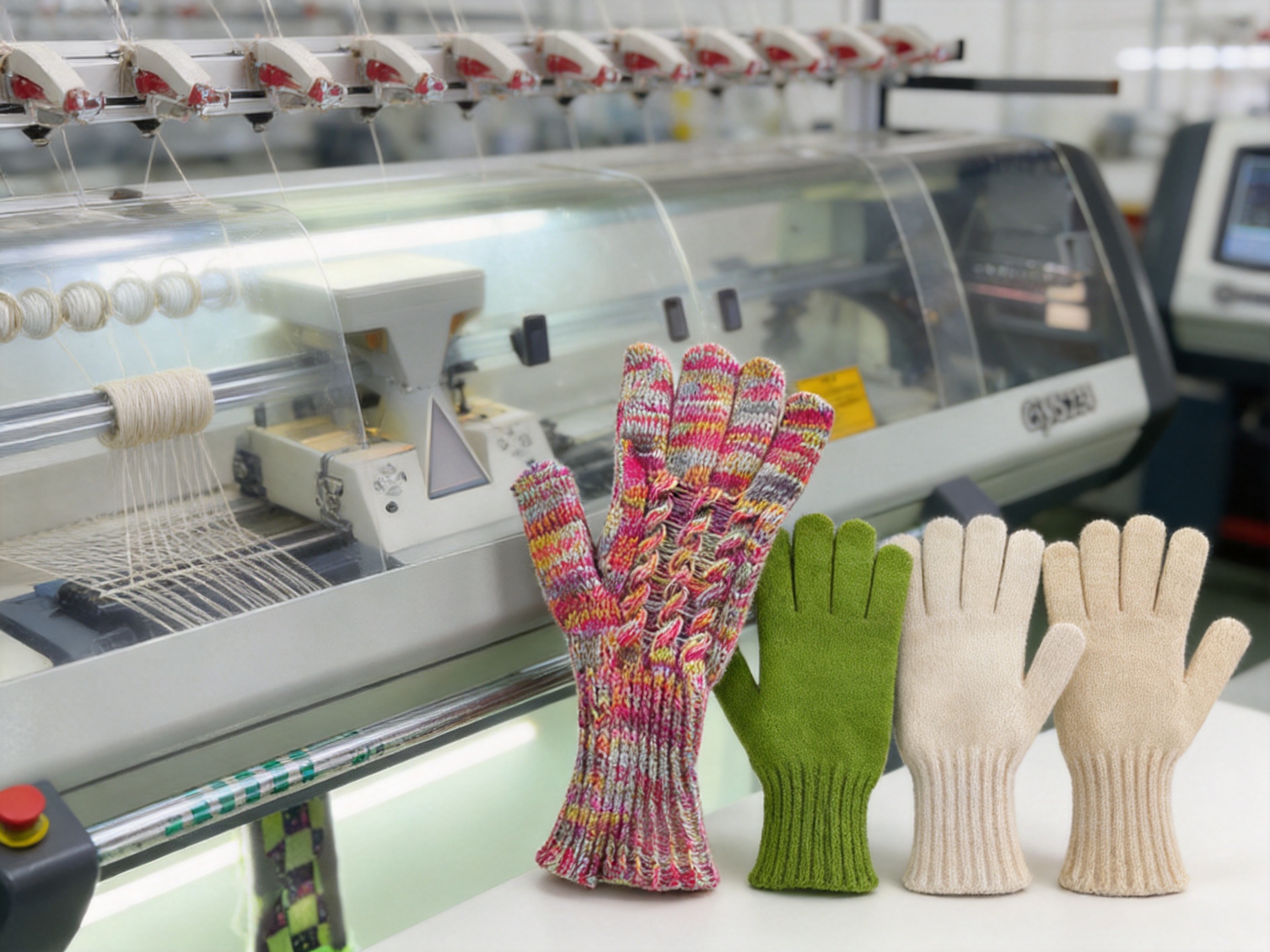
Protection and Fault Monitoring
Automated protection is essential for a high-speed computerized knitting machine. The GS-G236 is designed to issue alarms and stop operation when it detects conditions such as yarn breakage, floating yarn, rewinding faults, racking problems, needle collision, safety-door events, programming errors, and other abnormal situations.
Early detection helps prevent a minor problem from becoming a major production defect. For example, continued operation after a yarn break could create a damaged section of fabric or cause the machine to knit without the intended yarn. A response to needle collision can help limit damage to needles, cams, and related components. Detection of a safety-door event protects personnel by preventing operation under an unsafe condition.
Protection systems also support quality control. Automatic monitoring reduces the time during which a machine may operate outside its intended conditions. This can lower the number of defective gloves requiring repair or rejection and help operators identify the cause of an interruption more quickly.
The power-off memory function preserves production data in the event of an unexpected interruption. This is useful when power instability or accidental shutdown occurs. Protecting the active program and machine information can reduce recovery time and help prevent the loss of production settings.
Protection features do not replace regular maintenance or operator attention. Instead, they form an additional layer of security within the production process. Correct lubrication, needle inspection, cleaning, yarn preparation, software management, and operator training remain necessary for reliable long-term operation.
Automatic Oil Supply and Maintenance Benefits
The integrated automatic oil supply system continuously lubricates the needles and relevant moving components. Lubrication reduces friction and helps limit wear during extended operation. This is particularly important for glove production because narrow finger sections and complex forming sequences may require frequent needle movement and precise mechanical response.
Regular and controlled oil supply can extend the service life of needles and associated drive components. It may also reduce the frequency of maintenance-related stops, helping factories keep machines available for longer production periods.
Automatic lubrication contributes to consistency as well. Manual lubrication can vary according to the operator, shift, or maintenance schedule. An integrated system provides a more uniform supply, subject to proper adjustment and routine inspection. This supports stable mechanical operation and reduces the risk of insufficient lubrication.
Maintenance teams should still inspect the oil system, clean relevant areas, check oil levels or supply conditions, and follow the manufacturer’s recommended service procedures. Automatic supply is a productivity feature, not a substitute for preventive maintenance.
Advantages Over Conventional Glove Production Methods
The most direct advantage of the machine over conventional glove production is the reduction of sewing and assembly work. A traditional process may require operators to align and join multiple knitted parts. The integral forming approach moves much of this work into the knitting program, which can reduce labor requirements and shorten the route from yarn to finished glove.
A second advantage is improved structural continuity. Seamless or near-seamless construction can create a smoother interior surface and reduce areas where thread or stitching may cause discomfort. It can also improve the visual quality of the glove by removing visible joining lines from key areas.
A third advantage is manufacturing consistency. Computer-controlled knitting, programmable density, computerized racking, servo drive, and automatic monitoring help reduce reliance on manual judgment. While operator skill remains important, the machine creates a more repeatable foundation for production.
A fourth advantage is design flexibility. The combination of multiple gauges, several knitting functions, 16 yarn carriers on each side of four guide rails, variable density, and programmable scissor-and-clamp operation provides a broader design platform than basic glove knitting equipment.
A fifth advantage is resource efficiency. Reduced sewing labor, programmable yarn handling, minimized yarn waste, automatic lubrication, and digital design storage can all contribute to lower operating costs when the machine is correctly configured and maintained.
Compared with a single-system machine, the double-system configuration can offer higher knitting efficiency for complex glove programs. Compared with equipment relying heavily on manual adjustments, the motorized cam and computerized control system can provide faster response and more repeatable operating conditions. These advantages are especially meaningful for manufacturers that need both productivity and product differentiation.
Advantages Over Less Specialized Equipment
General-purpose flat knitting machines may be capable of producing selected glove components, but specialized ready-to-wear glove production requires more than basic fabric knitting. The GS-G236 integrates functions intended for the complete glove production sequence, including three-dimensional forming, narrow-section management, variable density, yarn control, and programmable take-down.
A machine with a broad product focus may require additional devices, manual adaptations, or secondary operations to produce a complete glove. Each adaptation can add complexity and increase the risk of inconsistent results. The dedicated configuration of the GS-G236 gives glove manufacturers a more direct route from design programming to finished product.
The machine’s six gauge options also provide an advantage for producers serving different market segments. Instead of maintaining separate equipment for every glove category, a manufacturer may be able to use one platform with the appropriate gauge and yarn configuration for multiple products.
Its 16-carrier arrangement on both sides of four guide rails supports more flexible yarn management than a simpler arrangement. This is valuable for designs involving multiple colors, intarsia sections, decorative patterns, or functional yarn changes.
Manufacturing Strengths of Guosheng Wonderful Intelligent Technology
Guosheng Wonderful Intelligent Technology (Changshu) Co., Ltd. is a specialized manufacturer focused on the research, development, production, and global supply of computerized knitting machinery. Its location in Changshu, Jiangsu Province, places the company within an important Chinese textile machinery manufacturing region with access to engineering resources, component suppliers, production knowledge, and an established industrial ecosystem.
The company’s product portfolio includes computerized flat knitting machines, collar knitting machines, flyknit shoe upper knitting machines, and equipment for other knitted textile applications. This broad product experience is relevant to the development of a specialized glove machine because it combines knowledge of computerized control, needle selection, yarn feeding, fabric formation, servo drive systems, and textile production requirements.
Advanced machinery manufacturing is not limited to assembling mechanical parts. It requires coordination among structural design, precision machining, control software, electronic systems, motion control, quality testing, and after-sales technical support. A manufacturer with experience across several categories of computerized knitting equipment can apply this knowledge to the design of a more integrated glove production platform.
The company’s stated focus on mechanical precision and intelligent control aligns with the requirements of ready-to-wear glove production. Stable machine operation, accurate knitting functions, flexible programming, and consistent output are all essential when a machine must create a complete three-dimensional product in one continuous process.
Global supply experience also supports the needs of international customers. Export-oriented textile manufacturers typically require multilingual control interfaces, standardized technical documentation, reliable packaging, installation guidance, spare-parts support, and communication across different operating environments. These factors are important when purchasing specialized machinery for long-term production use.
The company’s engineering approach emphasizes practical production requirements. This includes the ability to manage different yarns, product specifications, stitch structures, production speeds, maintenance conditions, and factory workflows. Such a practical orientation helps ensure that machine development is connected to the daily needs of glove manufacturers rather than limited to theoretical performance.
Production Workflow for a Ready-to-Wear Glove
A typical production workflow begins with yarn preparation. The manufacturer selects yarn according to the intended glove function, gauge, color, strength, elasticity, softness, and finishing requirements. Yarn must be correctly conditioned and installed so that feeding remains stable throughout the knitting process.
The next stage is digital design preparation. The glove dimensions, finger lengths, palm shape, wrist construction, stitch structures, color arrangement, stitch density, and take-down settings are programmed into the control system. The design may include transfer, tuck, miss, jacquard, intarsia, or needle transfer operations.
Before full production, the operator checks the machine condition, needle arrangement, yarn carriers, oil supply, safety devices, and selected gauge. A trial glove or sample section can be knitted to verify dimensions, density, yarn behavior, and forming quality.
During production, the carriage executes the programmed knitting sequence. The machine forms the fingers and transition zones, controls stitch density, manages yarn changes, adjusts take-down tension, and uses sinker assistance to maintain fabric stability. The computerized system monitors the operation and responds to abnormal conditions when detected.
After knitting, the glove may require limited finishing depending on the yarn, product type, and customer specification. Possible steps can include washing, heat setting, trimming of controlled yarn ends, coating, printing, inspection, packing, or performance testing. Because the glove is integrally formed, the amount of assembly work is reduced compared with a conventional multi-piece process.
Quality inspection should verify glove dimensions, finger alignment, stitch consistency, surface appearance, color accuracy, wrist construction, and the absence of defects. Manufacturers may also test tensile performance, abrasion resistance, elasticity, comfort, or protective characteristics according to the intended market.
Application Areas
The machine can support the production of work and safety gloves where durability, fit, and repeatable sizing are important. Different gauges and stitch-density programs can be selected to create heavier or lighter structures, while specific zones may be reinforced through density or stitch design.
Sports gloves can benefit from seamless shaping and flexible construction. Athletes often require gloves that allow hand movement without bulky seams. Variable density can be used to balance comfort, breathability, and wear resistance in areas exposed to repeated movement.
Fashion gloves can use jacquard, intarsia, color changes, and varied textures to create distinctive visual effects. The broad yarn-carrier arrangement provides options for multi-color designs and seasonal collections.
Functional gloves can be engineered with different properties in the fingertips, palm, and wrist. Depending on the yarn and structure, manufacturers may develop gloves for thermal comfort, lightweight protection, grip-related applications, or specialized work environments.
The machine may also be suitable for customized or private-label production. Digital design storage and flexible programming allow manufacturers to maintain several customer-specific patterns and produce smaller batches without extensive mechanical reconfiguration.
Operational Recommendations for Best Results
To obtain stable results, manufacturers should match the gauge, yarn, stitch density, and machine speed to the intended product. A fine gauge does not automatically produce a better glove, and a higher speed does not always provide the lowest production cost. The correct combination depends on product specifications and the behavior of the selected yarn.
Operators should begin new designs with controlled sample production. Finger length, palm width, wrist recovery, stitch density, and fabric appearance should be checked before starting a large batch. Small adjustments to take-down tension or stitch density can have a significant effect on final dimensions.
Needles, sinkers, yarn carriers, cams, guide rails, and take-down components should be inspected regularly. Damaged or worn components can affect stitch formation and lead to repeated defects. Preventive replacement is often more economical than allowing a worn component to cause extensive production losses.
Yarn should be stored in a clean and stable environment. Dust, excessive moisture, poor winding, inconsistent tension, and damaged packages can all affect machine performance. Good yarn preparation is an important part of achieving the performance expected from computerized equipment.
Operators should also use the machine’s alarm and monitoring functions effectively. An alarm should be investigated rather than simply reset. Recording the cause of interruptions can help production managers identify recurring problems related to yarn, programming, maintenance, or operating procedures.
Technical Specification Summary
| Product | 36-inch double-system ready-to-wear glove knitting machine |
| Model designation | GS-G236; the supplied technical table also identifies the model as GS-S236 |
| Gauge options | 3-5-7G, 7G, 9G, 10G, 12G, and 14G |
| Knitting system | Two systems, single carriage |
| Knitting width | 36 inches |
| Maximum knitting speed | 1.5 meters per second |
| Primary forming capability | Three-dimensional integral glove forming |
| Cam system | 5.2-inch fully motorized cam |
| Knitting functions | Transfer, tuck, miss, jacquard, intarsia, and needle transfer |
| Stitch-density control | Stepping-motor controlled; 128 or 32 selectable levels; adjustment range 0-650 |
| Take-down control | Stepping-motor controlled; 128 selectable levels; adjustment range 0-100 |
| Racking | Computer controlled, with servo operation and approximately two-inch range |
| Drive system | Synchronous belt drive with AC servo system |
| Yarn carriers | 16 carriers on each side of four guide rails |
| Scissor and clamp | Left and right units programmable for synchronized or independent operation |
| Control interface | LCD display with USB input and multilingual support |
| Memory | 256MB design storage |
| Protection functions | Monitoring for yarn breakage, floating yarn, rewinding faults, racking faults, needle collision, safety events, and programming errors |
| Lubrication | Automatic oil supply system |
| Power supply | 220V, single-phase, with power-off memory function |
Economic Value for Manufacturers
The economic value of a glove knitting machine should be assessed across the entire production process rather than only by its purchase price. A machine that reduces sewing labor, lowers material waste, improves repeatability, and supports a broader product range may generate greater long-term value than equipment with a lower initial cost but more extensive manual requirements.
The GS-G236 can help reduce labor associated with post-knitting assembly because the glove is formed as an integrated product. The exact labor saving depends on the previous production method, product design, local wage conditions, and factory organization, but the reduction of manual sewing operations can simplify workforce planning.
Higher production efficiency can also improve machine utilization. The double-system arrangement and maximum speed of 1.5 meters per second provide a foundation for increased output, while digital programming reduces the time required to repeat established designs.
Material savings may result from the programmable scissor-and-clamp system and more accurate yarn control. In high-volume production, small reductions in yarn waste can accumulate into meaningful financial savings.
Product quality has economic value as well. More consistent dimensions and fewer seam-related defects can reduce returns, rework, and customer complaints. A smooth, comfortable, well-formed glove may also command a stronger position in competitive markets.
Q&A
What type of product is the machine designed to produce?
The machine is designed for ready-to-wear knitted gloves produced through three-dimensional integral forming. It can support work gloves, sports gloves, fashion gloves, safety gloves, and other functional glove products, depending on the selected gauge, yarn, design, and finishing requirements.
What does three-dimensional integral forming mean?
Three-dimensional integral forming means that the glove is knitted as one connected structure, including the fingers, finger transitions, palm, and wrist opening. This reduces or eliminates the need to sew separately knitted components together.
How does the double-system configuration improve production?
A double-system configuration allows more knitting actions to be completed during each carriage pass than a single-system arrangement. This can shorten the knitting cycle and improve productivity, especially for complex glove designs with frequent forming and stitch changes.
Why is the motorized cam important?
The 5.2-inch fully motorized cam provides electronically controlled needle and knitting actions. It supports rapid, precise changes between different knitting operations and helps maintain accurate forming in fingertips, finger joints, palms, and wrist areas.
Can the machine produce gloves with different fabric densities?
Yes. The variable stitch density function allows different sections of the same glove to be knitted at different densities. This can help manufacturers create denser fingertips, flexible palms, elastic wrists, or other function-specific zones.
What are the available gauge options?
The available options are 3-5-7G, 7G, 9G, 10G, 12G, and 14G. These gauges cover a range from heavier knitted structures to finer, lighter glove fabrics.
Can the machine knit multi-color glove designs?
Yes. The machine has 16 yarn carriers on each side of four guide rails and supports jacquard and intarsia functions. These features provide flexibility for multi-color patterns, contrast areas, decorative designs, and functional color placement.
How does the scissor-and-clamp system reduce waste?
The left and right scissor-and-clamp units can be programmed to work together or independently. Coordinated yarn cutting and clamping can reduce unnecessary yarn tails and improve yarn utilization during color and carrier changes.
Does the machine require post-knitting finishing?
The integral forming process reduces sewing and assembly operations, but the exact finishing requirements depend on the yarn, product design, customer specification, and end use. Washing, setting, trimming, coating, inspection, or packing may still be required for certain products.
How does automatic oil supply benefit production?
Automatic oil supply provides regular lubrication to needles and related moving components. This helps reduce friction and wear, supports stable long-term operation, and may reduce maintenance-related interruptions when the system is correctly maintained.
What protection functions are included?
The machine can monitor conditions including yarn breakage, floating yarn, rewinding faults, racking problems, needle collision, safety-door events, and programming errors. It can issue an alarm and stop operation when an abnormal condition is detected.
What type of control interface does the machine use?
The machine uses an LCD interface with USB input, 256MB memory, multilingual support, and a monitoring menu. Operating parameters can be displayed and adjusted while the machine is running, subject to the requirements of the design and operating condition.
What power supply is required?
The supplied specification identifies a 220-volt, single-phase power supply. The machine also includes a power-off memory function to help protect production data during unexpected interruptions.
Who can benefit most from this machine?
Glove manufacturers seeking to reduce sewing operations, increase production efficiency, improve three-dimensional shaping, develop multi-style products, or move toward digitally controlled ready-to-wear manufacturing can benefit from the machine.
Conclusion
The GS-G236 36-inch double-system ready-to-wear glove knitting machine is designed for a production environment in which efficiency, comfort, precision, flexibility, and product consistency are equally important. Its three-dimensional integral forming capability provides the central advantage: a complete glove can be knitted with continuous structural connectivity from fingertip to wrist, reducing the dependence on traditional sewing and assembly.
The machine’s double-system, single-carriage architecture supports productive operation, while the 5.2-inch fully motorized cam provides accurate control of complex forming actions. Variable stitch density allows manufacturers to engineer different fabric characteristics within one glove. Sinker assistance improves fabric control in difficult forming zones, and programmable take-down, racking, yarn carriers, and scissor-and-clamp functions contribute to a more comprehensive production platform.
Its six gauge options and broad range of knitting functions allow the machine to serve multiple glove markets. Computerized control, design storage, multilingual operation, automatic lubrication, and fault protection further support practical factory use. Together, these functions provide a specialized solution for manufacturers that want to improve productivity while developing higher-value seamless or integrally formed glove products.
Backed by the engineering and manufacturing experience of Guosheng Wonderful Intelligent Technology (Changshu) Co., Ltd., the machine reflects the continuing development of intelligent textile machinery. Its value lies not only in knitting speed, but in the integration of forming technology, motion control, fabric engineering, yarn management, and production protection within one dedicated glove manufacturing system.
References
1. Product technical materials for the GS-G236 36-inch double-system ready-to-wear glove knitting machine.
2. Supplied machine specifications covering gauge, knitting width, speed, knitting functions, drive system, control system, protection system, and power requirements.
3. Technical descriptions of three-dimensional integral forming and computerized flat knitting processes.
4. General principles of knitted glove construction, stitch density control, take-down tension, yarn management, and fabric formation.
5. Manufacturing information concerning Guosheng Wonderful Intelligent Technology (Changshu) Co., Ltd. and its computerized knitting machinery portfolio.
Product: GS-G236 36-Inch Double System Ready-to-Wear Glove Knitting Machine

Ready to Begin?
Product Categories
- Sweater Knitting Machine (Economic SE)
- Sweater Knitting Machine (Full Function S)
- Collar Knitting Machine (Economic CE)(Fabric)
- Collar Knitting Machine (Full-Function C)
- Blanket Knitting Machine(Fabric)
- Shoe Upper Knitting Machine
- Ready To Wear Sweater Knitting Machine
- Ready To Wear Glove Knitting Machine
- Ready To Wear Hat Knitting Machine
- Knee Pad Knitting Machine
- Metal Mesh Knitting Machine
Contact Information
-
 Email: gs@guoshengchina.cn
-
 Phone: +86-0512-52690511
-
 Address: No. 18, Hupu Pujiang Road, Bixi New District, Changshu City, Jiangsu Province, China
QR Code
