


 English
 Español
 русский
 عربى
 中文简体

Zhao Yutong — After-Sales Service Manager
GS-M2100 3G 100-Inch Double-System Metal Mesh Knitting Machine: Precision Manufacturing for Industrial Specialty Fabrics
Date:Oct 24, 2026
Content
- 1 1. The Industrial Challenge of Metal Mesh Knitting
- 2 2. Wide-Format Production with a Double-System Configuration
- 3 3. Four Core Advantages for Specialty-Material Knitting
- 4 4. Advanced Drive and Motion-Control Architecture
- 5 5. Broad Knitting Functions for Industrial Fabric Development
- 6 6. Precision Stitch and Take-Down Management
- 7 7. Computerized Control for Repeatable Production
- 8 8. Automatic Protection and Operational Safety
- 9 9. Advantages Compared with More General-Purpose Equipment
- 10 10. Manufacturing Strengths Behind the Equipment
- 11 11. Applications for the GS-M2100
- 12 12. Recommended Production Workflow
- 13 13. Maintenance and Operator Considerations
- 14 14. Quality Control for Industrial Mesh
- 15 15. Commercial Value for Manufacturers
- 16 16. Q&A
- 16.1 Q1: What materials is the GS-M2100 designed to knit?
- 16.2 Q2: What is the standard working width?
- 16.3 Q3: Why is automatic oil supply important for metal mesh production?
- 16.4 Q4: What gauge options are available?
- 16.5 Q5: Can the machine produce more than a simple uniform mesh?
- 16.6 Q6: How does the double-system single-carriage design benefit production?
- 16.7 Q7: What is the maximum knitting speed?
- 16.8 Q8: How is mesh aperture controlled?
- 16.9 Q9: What happens when the machine detects a problem?
- 16.10 Q10: Is the control system suitable for international factories?
- 16.11 Q11: What power supply does the machine use?
- 16.12 Q12: What should a buyer evaluate before ordering?
- 17 17. Conclusion
- 18 References
- 19 Product: GS-M2100 3G 100-Inch Double System Metal Mesh Knitting Machine
Metal mesh knitting is one of the most demanding branches of computerized flat knitting. Unlike conventional textile yarns, metal wire and other rigid specialty materials place exceptional stress on needles, cams, yarn carriers, take-down components, and drive systems. A machine designed for this work must do more than move a carriage across a needle bed. It must control material delivery, stitch formation, fabric tension, mesh aperture, machine protection, and production data with a high level of coordination.
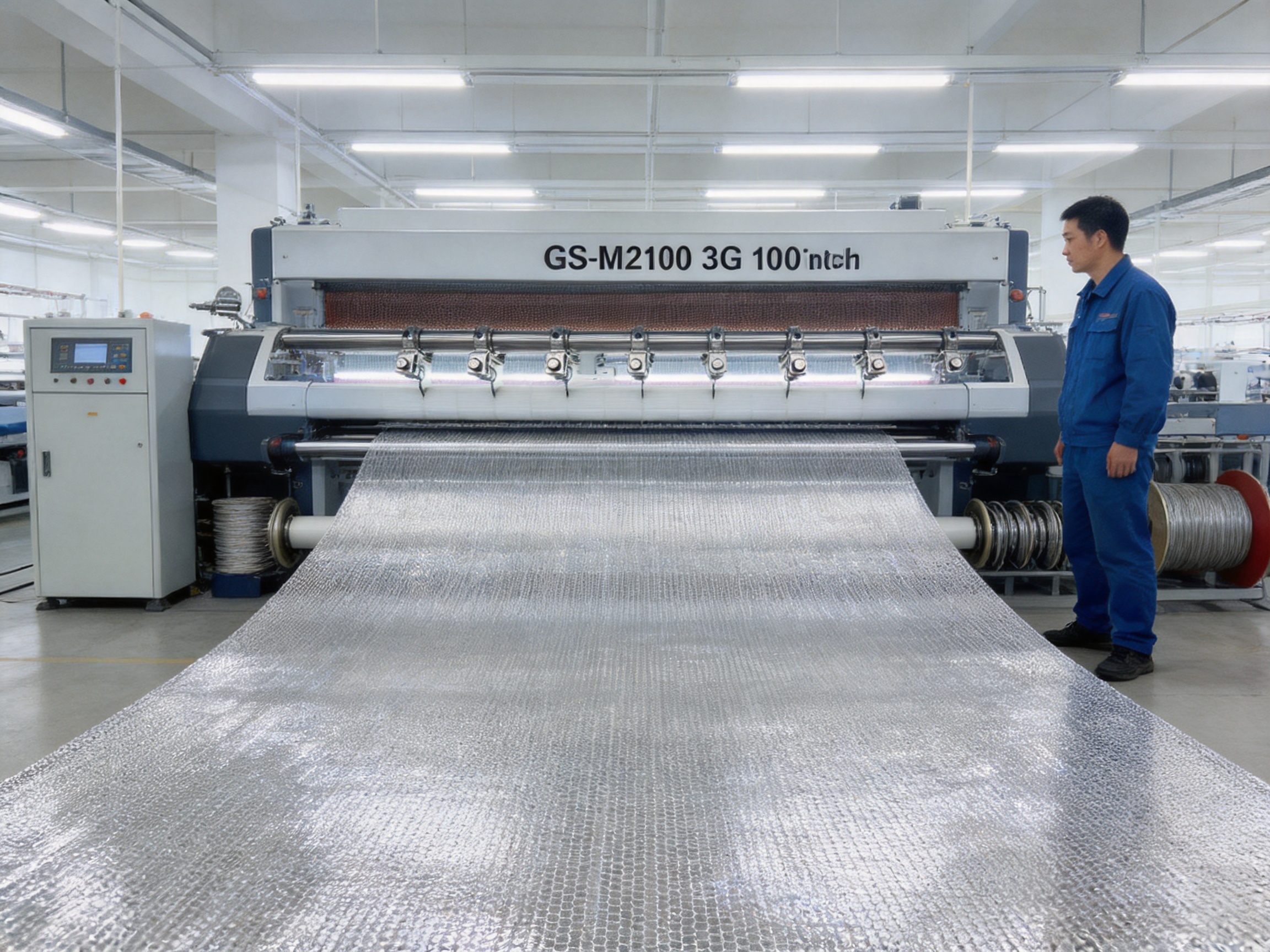
The GS-M2100 3G 100-Inch Double-System Metal Mesh Knitting Machine is engineered for this specialized production environment. It combines a wide 100-inch knitting width, a double-system single-carriage configuration, computerized control, motorized cam technology, automatic needle lubrication, specialized yarn feeding, variable stitch density, and a comprehensive protection system. The result is a production platform intended for metal mesh, filtration nets, protective fabrics, industrial screens, and other specialty textile structures.
While the standard model provides a 100-inch working width, 80-inch and 120-inch options are also available. This range allows manufacturers to select a configuration that aligns with product dimensions, factory layout, material requirements, and production planning. Gauge options of 3G, 3-5-7G, and 14G further extend the equipment’s application range, covering coarse industrial meshes as well as finer specialty fabrics.
Manufactured by Guosheng Wonderful Intelligent Technology (Changshu) Co., Ltd., the machine reflects the company’s focus on computerized knitting machinery, engineering development, and industrial textile applications. Its design is intended not merely to increase output, but to improve process stability when working with difficult materials that can accelerate wear and create production interruptions on ordinary knitting equipment.
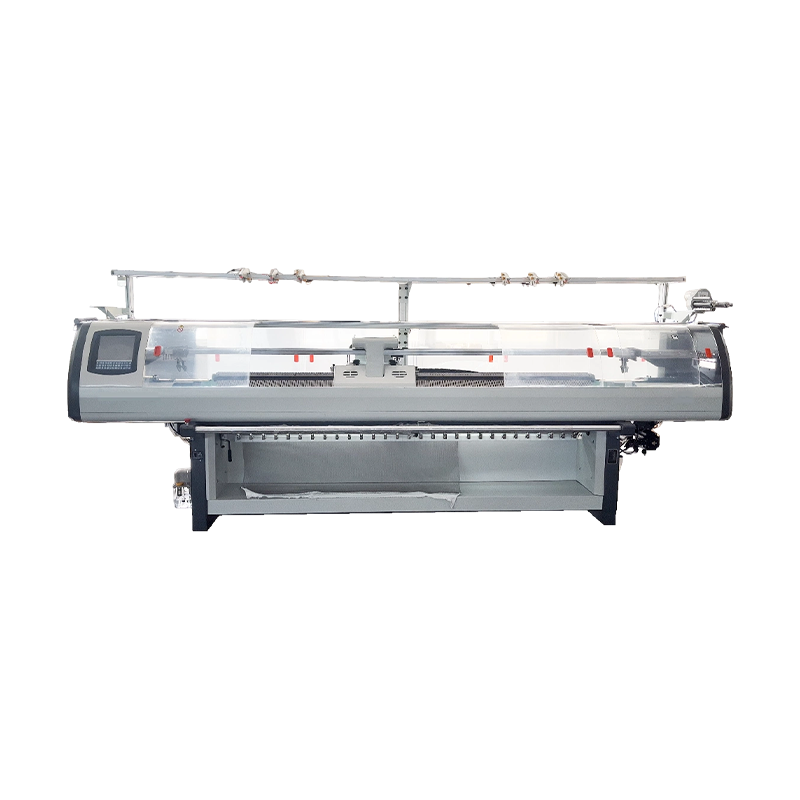
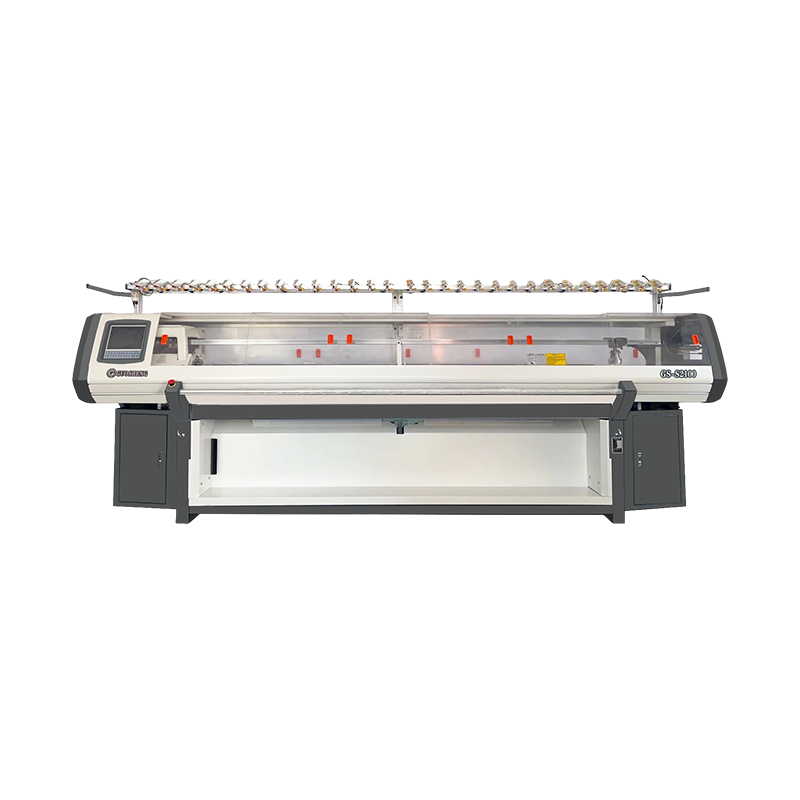
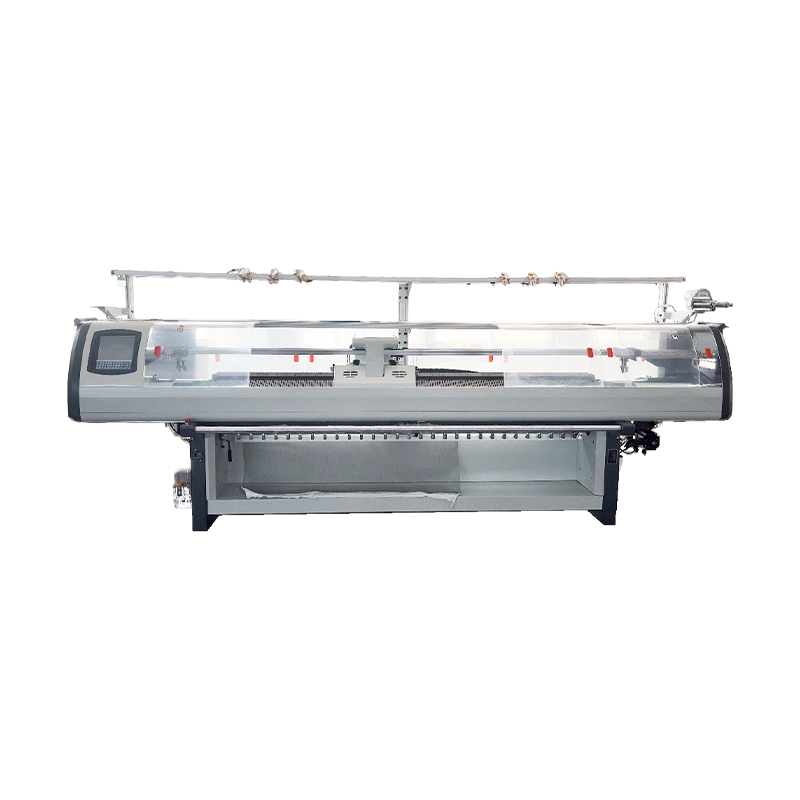
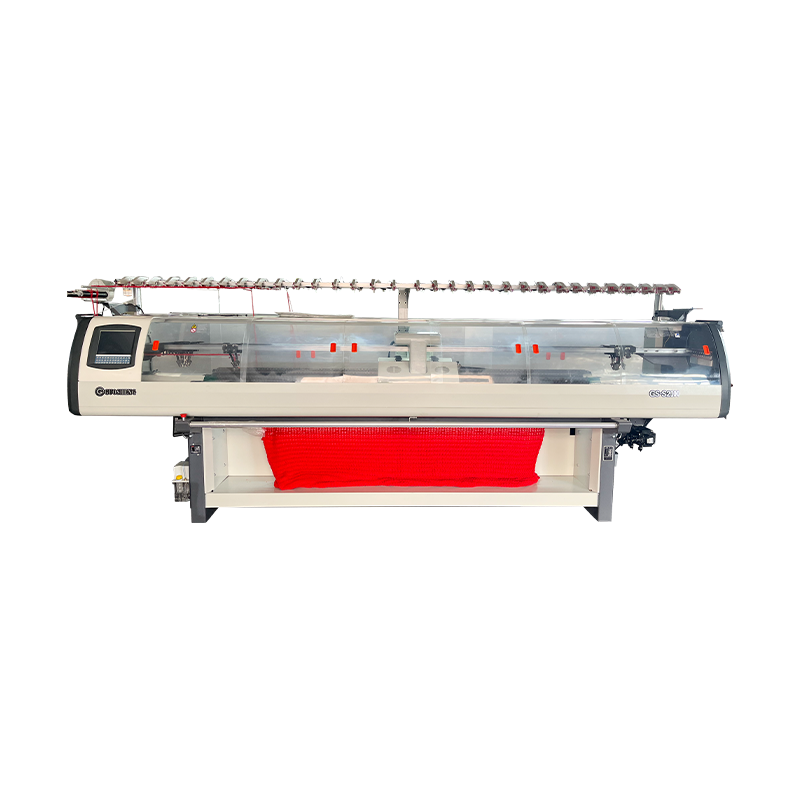
GS-M2100 3G 100-Inch Double System Metal Mesh Knitting Machine
1. The Industrial Challenge of Metal Mesh Knitting
Metal mesh production requires a different machine philosophy from ordinary sweater or garment knitting. In garment production, yarn is generally flexible, compressible, and relatively forgiving. Metal wire is more rigid, less tolerant of abrupt changes in direction, and more likely to create mechanical resistance during loop formation. If feeding is inconsistent or stitch control is inaccurate, the consequences may include broken wire, dropped stitches, irregular mesh openings, needle damage, fabric distortion, and extended downtime.
These challenges become more significant as the working width increases. A wide-format machine must maintain consistent behavior across the entire needle bed. Small differences in tension, lubrication, carriage movement, or take-down force can become visible as fabric defects when multiplied across a large production area.
Industrial users also require flexibility. A single production facility may need to manufacture protective mesh with relatively large openings, filtration material with finer apertures, decorative metal fabric, reinforcing structures, or specialty technical textiles made from combinations of metal wire and synthetic yarn. A machine that supports only one fixed stitch density or one narrow material range can limit commercial opportunities.
The GS-M2100 addresses these requirements through an integrated set of mechanical, electronic, and software functions. Its performance is based on coordinated systems rather than a single feature. The motorized cam system supports precise needle movement, the feeding system manages specialty materials, automatic oiling reduces friction-related wear, and the take-down roller helps maintain fabric tension during formation. Computerized stitch and pattern control then allows operators to adjust production parameters for different mesh specifications.
2. Wide-Format Production with a Double-System Configuration
The defining feature of the GS-M2100 is its 100-inch knitting width. This format is suitable for manufacturers producing broad industrial fabrics or seeking to reduce the number of joins and secondary operations required for large mesh products. The availability of 80-inch and 120-inch alternatives gives buyers additional flexibility when matching the machine to product width and factory capacity.
A wide needle bed can improve production efficiency when the finished fabric is itself wide. Instead of knitting several narrow sections and combining them later, operators can produce larger continuous surfaces. This can reduce handling, simplify downstream processing, and support more consistent product dimensions. For industrial users, those benefits may be especially valuable when fabric uniformity and repeatability are important.
The machine uses a double-system, single-carriage structure. In practical terms, the configuration provides two knitting systems within one carriage arrangement, supporting efficient movement and a broad range of knitting actions. The compact mini carriage is designed for rapid rotation and variable stitch gauge operation. This combination helps the machine manage complex knitting programs without requiring an unnecessarily large carriage structure.
Compared with a basic single-system machine, a double-system design can provide greater process flexibility and more efficient handling of suitable knitting sequences. It is particularly useful when a production program requires multiple operations, structural changes, or advanced pattern instructions. The value of the arrangement is not limited to speed; it also lies in the machine’s ability to support more sophisticated fabric construction within a controlled production cycle.
The maximum knitting speed is specified at 0.6 meters per second. For metal wire and specialty materials, maximum speed should be considered together with material behavior and fabric quality. Excessive speed can increase stress, vibration, and instability. The GS-M2100’s speed specification is positioned as a balance between productive operation and the precision required for mesh formation.
Width and Configuration Options
The standard 100-inch model is appropriate for broad industrial applications, while optional 80-inch and 120-inch versions allow production planning around different product sizes. This modular approach is advantageous for manufacturers that serve multiple markets or anticipate changes in product demand.
The 3G configuration is suitable for relatively coarse structures and larger mesh openings. The 3-5-7G option provides a broader gauge range for products that require different combinations of wire size, stitch structure, and density. The 14G option is intended for finer constructions and more closely spaced fabric structures. Actual results depend on wire properties, pattern design, operating conditions, and finishing requirements, but the range gives the machine a wider technical envelope than equipment limited to a single gauge.
3. Four Core Advantages for Specialty-Material Knitting
3.1 Fully Motorized Cam Control
The cam system is central to knitting performance because it controls the movement of needles during stitch formation. When a machine processes rigid wire, the cam mechanism must operate with accuracy while resisting increased mechanical stress. A poorly controlled or insufficiently robust cam system may produce inconsistent needle movement, premature wear, or unstable loop formation.
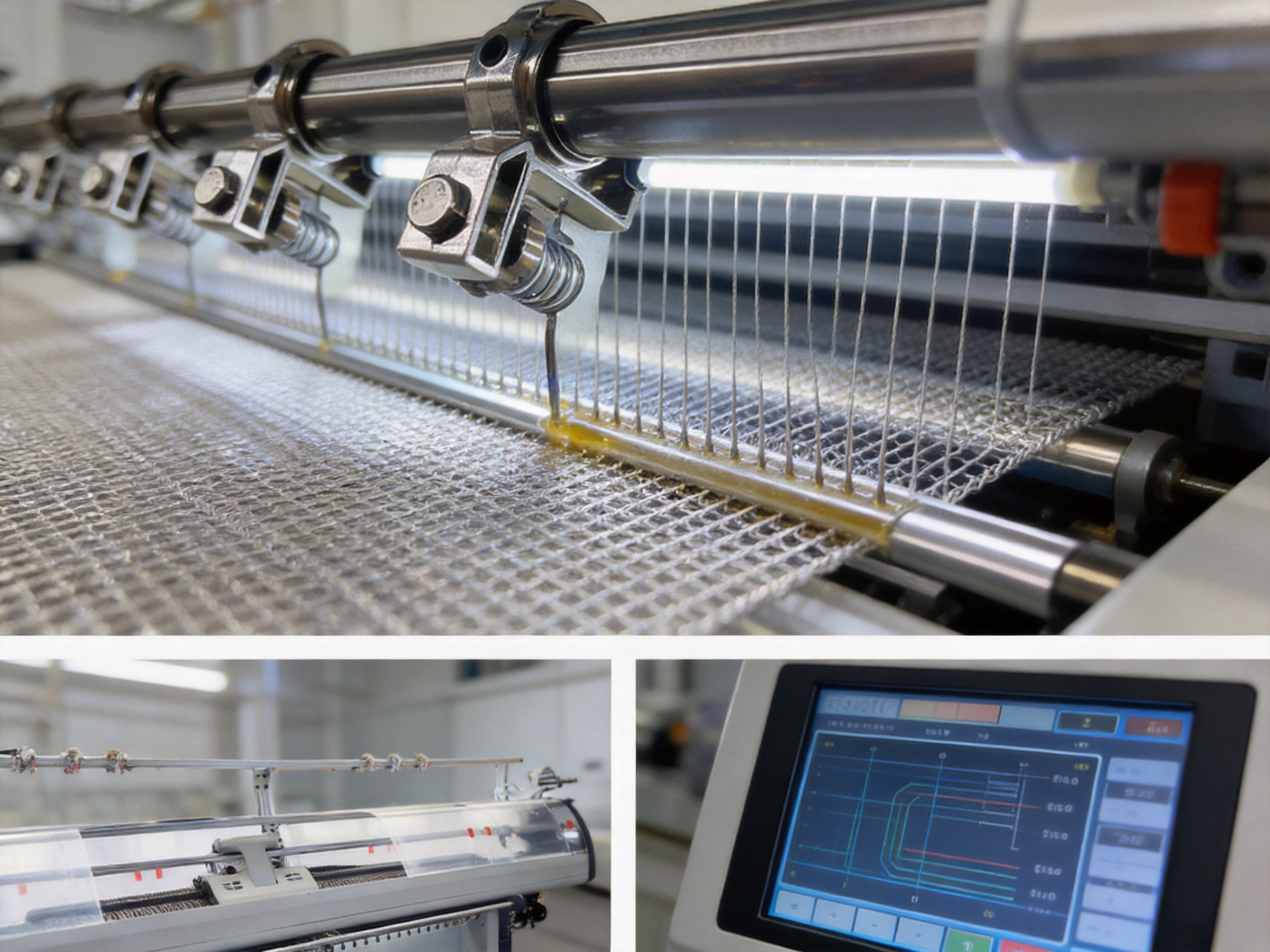
The GS-M2100 uses a fully motorized cam system. Motorized control supports precise operation and allows the machine to coordinate needle movement with programmed knitting instructions. This is important when producing mesh structures that require repeatable aperture sizes, consistent stitch formation, and controlled transitions between different operations.
The system is also designed for the mechanical demands associated with metal wire. By combining controlled movement with a structure intended for high-stress operation, the machine can support more reliable production than a general-purpose platform that has not been adapted for rigid materials. Consistency in cam movement can contribute to fewer irregular stitches and more stable operation over extended production cycles.
3.2 Automatic Oil Supply for Needle Protection
Metal wire can accelerate friction and wear at the needle interface. Needles must repeatedly interact with rigid material while moving through the knitting cycle, and insufficient lubrication can increase resistance, heat, surface damage, and the probability of component failure.
The GS-M2100 incorporates an automatic oil supply system that delivers continuous targeted lubrication to the knitting needles. Automatic lubrication reduces dependence on irregular manual application and helps maintain a more consistent lubrication condition during operation. It also supports preventive maintenance by reducing unnecessary friction before it becomes a serious production issue.
Longer needle service life can improve operating economics in several ways. It may reduce the frequency of replacement, limit unplanned stops, and help preserve stitch quality over longer production runs. For a wide-format industrial machine, these benefits are significant because a single needle-related issue can interrupt a large section of fabric or require additional inspection and repair.
3.3 Specialized Feeding, Traction, and Take-Down
Material feeding is especially important in metal mesh production. The wire must travel smoothly and consistently from the supply system into the knitting zone. Sudden resistance, uncontrolled slack, or excessive tension can cause breakage or irregular loop formation.
The GS-M2100 uses a specialized yarn feeding system designed around the characteristics of metal wire and specialty yarns. Its purpose is to provide smoother delivery throughout the knitting cycle. The machine also includes a purpose-built traction and take-down arrangement to maintain fabric tension from material feeding through cloth formation.
Consistent take-down is essential because the fabric must be pulled away from the knitting zone at a controlled rate. If the take-down force is too weak, the fabric may accumulate or distort. If it is too strong, the stitches may be stretched, the wire may experience excessive stress, or the mesh opening may change. Programmed take-down control allows operators to adapt tension to the requirements of different structures.
3.4 Variable Stitch Density
Industrial mesh products are defined partly by aperture size, thickness, density, and mechanical behavior. A machine that can vary stitch density offers manufacturers more control over these characteristics. The GS-M2100 supports variable stitch density so that mesh openings can be adjusted for different applications.
Large-opening structures may be required for protective screens, reinforcement, or safety applications. Finer openings may be needed for filtration, separation, or specialized industrial fabrics. The ability to change density within the machine’s operating range allows one equipment platform to support a wider product portfolio.
The stitch system is controlled by a stepping motor and provides 128 selectable levels, with subdivision technology supporting an adjustment range from 0 to 650. This fine adjustment capability helps operators make controlled changes rather than relying on coarse mechanical settings. It can also assist in maintaining more consistent results between production batches when the same program and material specification are repeated.
4. Advanced Drive and Motion-Control Architecture
Stable motion is fundamental to industrial knitting. Carriage movement, racking, needle selection, stitch adjustment, and take-down must work together without unnecessary vibration or abrupt changes. For rigid materials, smooth movement is particularly important because sudden acceleration or deceleration can transfer stress directly to the wire and needle system.
The GS-M2100 uses a synchronous belt drive combined with an AC servo system. Synchronous belt transmission supports accurate motion transfer while reducing the risk of slippage associated with less precise drive arrangements. The AC servo system provides responsive control of carriage movement and contributes to stable, low-vibration operation.
Low vibration can benefit both machine durability and fabric quality. Excessive vibration may influence needle engagement, material feeding, and the consistency of mesh formation. It can also increase noise and mechanical fatigue over time. By emphasizing controlled motion, the machine is designed to operate with a stable mechanical rhythm suitable for long production cycles.
The racking mechanism is driven by an AC servo motor and provides a range of up to two inches with fine-adjustment capability. Racking changes the relative position of the needle beds and is used to create or support different fabric structures. Accurate racking is essential when producing complex mesh patterns, shaping, or programmed structural transitions.
Computer-controlled racking allows the operator to define movement through the design program rather than relying only on manual adjustment. This improves repeatability when the same construction must be reproduced across multiple batches. It also supports more complex design possibilities for industrial fabrics that combine functional mesh zones with decorative or structural pattern elements.
5. Broad Knitting Functions for Industrial Fabric Development
Although the GS-M2100 is optimized for metal mesh, it is not restricted to one basic mesh formation. The machine supports transfer, tuck, miss, jacquard, intarsia, and visible or hidden shaping. These functions allow manufacturers to develop fabrics with differences in density, surface arrangement, structure, and appearance.
Transfer
Transfer operations move loops between needle positions and can be used to create structural changes, openings, relief effects, and shaped sections. In specialty fabric production, transfer may help connect different mesh zones or create engineered transitions in a technical textile.
Tuck
Tuck stitches retain existing loops while adding new material. They can increase thickness, modify surface structure, and introduce controlled variations in fabric density. When applied appropriately, tuck operations may support products that require reinforced sections or a specific combination of flexibility and coverage.
Miss
Miss operations allow the machine to bypass selected needles during a knitting sequence. This can create openings, alter pattern geometry, and contribute to lightweight or ventilated structures. For mesh products, miss programming may be useful when a designer needs controlled open areas rather than a uniform fabric field.
Jacquard and Intarsia
Jacquard and intarsia functions expand the machine’s ability to produce patterned or zoned materials. These techniques can be used for visual identification, functional differentiation, or the integration of multiple design areas into one fabric. In industrial markets, the design may be decorative, but it may also communicate product information or distinguish performance zones.
Visible and Hidden Shaping
Visible and hidden shaping functions support changes in fabric geometry and construction. They can be used for products that require shaped edges, dimensional transitions, or integrated structural features. This is valuable when a manufacturer wants to move beyond flat, uniform mesh and produce more specialized components.
The combination of these functions gives product developers more freedom. Instead of treating metal mesh as a simple repeating grid, they can explore engineered structures with varying apertures, reinforced areas, patterned sections, and shaped profiles. This may help manufacturers serve more demanding customers without investing in multiple narrowly specialized machines.
6. Precision Stitch and Take-Down Management
Mesh quality depends on the relationship between stitch formation and fabric removal. Even when the wire feed is stable, an unsuitable stitch setting or take-down force can change the final aperture size. For this reason, the GS-M2100 provides separate computerized control for stitch density and take-down roller operation.
The stitch density system uses a stepping motor with 128 selectable levels and subdivision technology. The adjustment range of 0 to 650 supports fine changes during program preparation and production optimization. Operators can use these settings to develop a target mesh specification and then save the selected values as part of the production program.
The take-down roller is also controlled by programmed instructions through a stepping motor. It provides 128 tension levels with an adjustable range from 0 to 100. This gives manufacturers a structured way to adapt fabric tension to different wire types, mesh openings, and fabric thicknesses.
Programmed take-down can reduce dependence on subjective manual adjustment. Operators still need to understand material behavior and evaluate the fabric, but the machine provides repeatable electronic settings that can be documented and recalled. This is useful for quality management, especially when several machines or shifts are involved in the same product order.
| Technical Item | GS-M2100 Specification | Production Significance |
| Standard knitting width | 100 inches | Supports broad industrial mesh and large-format fabric production |
| Optional knitting widths | 80 inches and 120 inches | Allows configuration according to product size and factory requirements |
| Gauge options | 3G, 3-5-7G, and 14G | Supports different wire diameters, densities, and fabric structures |
| Knitting system | Double system, single carriage | Provides flexible and efficient programmed knitting operations |
| Maximum knitting speed | 0.6 meters per second | Balances productivity with control of rigid specialty materials |
| Stitch density | 128 levels; subdivision adjustment from 0 to 650 | Enables fine control of mesh aperture and fabric density |
| Take-down control | 128 levels; adjustable range from 0 to 100 | Supports consistent fabric tension and dimensional stability |
| Drive system | Synchronous belt drive with AC servo system | Promotes accurate, smooth, and low-vibration movement |
| Racking range | Up to 2 inches | Supports complex structures and programmed shaping |
| Control interface | LCD screen with USB input | Facilitates program loading, monitoring, and parameter adjustment |
| Memory | 256MB | Stores a substantial library of design and production files |
| Power supply | 220V, single-phase | Suitable for compatible industrial electrical installations |
7. Computerized Control for Repeatable Production
A modern industrial knitting machine must provide more than mechanical capability. It must also help operators manage programs, settings, monitoring, and production changes. The GS-M2100 uses an LCD control panel with USB input and 256MB of system memory.
The USB interface enables operators to transfer design files and production programs efficiently. The memory capacity allows a large collection of patterns and operating files to remain available in the machine. This can reduce preparation time when a factory changes between product specifications or receives repeat orders from different customers.
The monitoring menu displays operating parameters and allows adjustments while the machine is running. Real-time access to machine conditions is useful during product development and production troubleshooting. An operator can review settings, observe the effect of an adjustment, and refine the process without relying entirely on mechanical intervention.
The visual design system is intended to be straightforward and easy to understand. This is important for factories with multiple operators, different levels of technical experience, or production teams working across shifts. Clear access to settings can shorten the learning curve and help improve consistency between users.
Multilingual support, including Chinese and English, supports international operation and communication. A control system that can be understood by local production staff is an important part of equipment usability, particularly when machines are installed in overseas factories or operated by multilingual teams.
The power-off memory function protects operational data at the moment of an unexpected interruption. While it does not eliminate the need for safe shutdown practices or electrical protection, it can help preserve important machine information and reduce the risk of losing production settings after a power failure.
8. Automatic Protection and Operational Safety
Industrial production efficiency depends heavily on preventing small problems from becoming major failures. The GS-M2100 includes an automatic protection system that monitors several operating conditions and triggers an alarm when an abnormality is detected.
Protection functions include monitoring for yarn or wire breakage, float yarn, rewinding, end of knitting, racking failure, needle breakage, and programming errors. The machine can stop automatically when a serious issue is identified. This protects the equipment, the material, and the fabric already in production.
Automatic stopping is particularly valuable in metal mesh knitting because continuing operation after a wire break or needle failure can enlarge the defect and increase repair time. Early detection may limit the affected area and make it easier for an operator to identify the cause.
The protection system also supports production supervision. Operators can respond to alarms rather than continuously watching every individual mechanical action. This does not replace regular inspection, cleaning, lubrication checks, or preventive maintenance, but it adds an important layer of operational security.
Safety door monitoring and other machine protection functions help reduce risks associated with access during operation. Proper training and factory safety procedures remain essential, but integrated monitoring can reinforce safe working practices and minimize the likelihood of operation under unsuitable conditions.
9. Advantages Compared with More General-Purpose Equipment
When evaluating metal mesh knitting equipment, manufacturers often compare a purpose-optimized machine with a general computerized flat knitting machine. The appropriate choice depends on product requirements, but several design characteristics give the GS-M2100 a strong position for specialty-material applications.
First, its design specifically addresses rigid materials. The fully motorized cam, automatic needle oiling, specialized feeding system, and controlled take-down are directly relevant to metal wire production. A general-purpose garment machine may offer advanced pattern functions, yet it may not provide the same combination of material-focused feeding, lubrication, and tension management.
Second, the machine provides a wide working format. A 100-inch bed, with 80-inch and 120-inch options, can be more suitable for large industrial fabric than narrow equipment designed primarily for apparel panels. Wider production can reduce the need for joining and can support a more efficient workflow for broad mesh products.
Third, the GS-M2100 combines specialty-material handling with broad design functions. Some industrial machines may be highly specialized but limited in pattern flexibility. This machine supports transfer, tuck, miss, jacquard, intarsia, shaping, racking, and variable stitch density. That combination gives product developers room to create different constructions on one platform.
Fourth, the machine emphasizes parameter repeatability. Computer-controlled stitch density, take-down tension, racking, needle selection, and design storage can help manufacturers reproduce approved specifications. Repeatability is particularly important in industrial supply chains, where customers may require the same mesh aperture and fabric behavior across multiple orders.
Fifth, its automatic protection functions can help control production loss. No machine can eliminate all wire breaks, needle issues, or programming mistakes, but early detection and automatic stopping may prevent defects from spreading and support faster intervention.
These advantages should be assessed alongside material trials, production targets, operator skills, maintenance practices, and factory conditions. Performance depends on the correct combination of gauge, wire type, pattern, stitch density, take-down force, and operating speed. Nevertheless, the machine’s architecture gives specialty-fabric manufacturers a strong starting point for developing stable production processes.
10. Manufacturing Strengths Behind the Equipment
The performance of a specialized knitting machine depends on how it is designed, assembled, tested, and supported. Guosheng Wonderful Intelligent Technology (Changshu) Co., Ltd. is based in Changshu, Jiangsu Province, a region known for textile machinery manufacturing and related industrial capabilities. This location provides access to an established supply chain, engineering resources, component manufacturing, and textile-industry knowledge.
The company focuses on research, development, manufacturing, and global supply of computerized knitting machinery. Its portfolio includes computerized flat knitting machines, collar knitting machines, and flyknit shoe upper knitting machines. This broader product experience is relevant because it exposes the manufacturer to different knitting structures, material behaviors, needle-selection requirements, and customer applications.
A manufacturing strength of a computerized knitting equipment supplier is the ability to integrate mechanical and electronic systems. The GS-M2100 requires accurate interaction between the needle bed, cam system, servo drive, racking mechanism, feeding components, take-down roller, sensors, control software, and operator interface. The machine’s value comes from the way these systems work together, not from any isolated component.
Engineering for metal mesh also requires an understanding of wear. Rigid wire can place more demanding conditions on needles and moving parts than ordinary textile yarn. The use of automatic oil supply, motorized cam operation, and specialized feeding demonstrates an approach centered on long-term process stability rather than only initial operating speed.
Manufacturing quality is also connected to configuration control. Machines supplied for different gauges and working widths must maintain reliable alignment, accurate component installation, and correct software settings. Consistent assembly and inspection procedures are therefore important for ensuring that the delivered machine matches the selected technical specification.
The company’s stated objective is to provide dependable technology solutions for textile manufacturers. Its approach combines machine structure, control performance, flexible knitting functions, production efficiency, and consistent quality. For industrial customers, this type of integrated focus can be more valuable than a machine marketed only on speed or a single headline feature.
Engineering for Long-Term Factory Use
Industrial knitting equipment is a capital investment. Buyers typically evaluate not only purchase price, but also machine availability, maintenance cost, operator training, spare-part requirements, energy use, product flexibility, and expected service life. A machine that is easy to adjust and protects key components may provide greater value over years of operation.
The GS-M2100’s automatic lubrication system can reduce manual maintenance pressure around needle lubrication. Its computerized parameter storage can reduce setup variation. Its automatic alarms can shorten response time during abnormal events. Its broad gauge and width options can allow the same equipment family to remain useful as product requirements change.
These features support a total-cost perspective. Lower defect rates, fewer unplanned stops, less frequent needle replacement, and faster changeovers can all contribute to better production economics. The actual result will depend on operating discipline, material quality, preventive maintenance, and the suitability of the machine configuration for the intended products.
11. Applications for the GS-M2100
The machine is intended for a wide range of metal mesh and industrial specialty textile applications. Protective mesh is one important area. Such fabrics may be used where ventilation, physical separation, reinforcement, or controlled openings are required. The ability to adjust density allows manufacturers to develop different levels of coverage and openness.
Filtration nets are another important application. Filtration products often require controlled apertures and consistent dimensions. The GS-M2100’s variable stitch density, fine stepping-motor adjustment, and programmed take-down control can support the development of mesh structures suited to different filtration concepts.
Industrial screening and separation fabrics may also benefit from the machine’s wide format and pattern flexibility. Depending on the material combination and product design, manufacturers can explore fabrics that combine open areas, reinforced sections, and structurally differentiated zones.
Decorative metal textiles and specialty design fabrics represent another possible field. Jacquard, intarsia, tuck, transfer, and shaping functions may be used to create visually distinctive surfaces or functional patterns. These products can serve interior, architectural, fashion, exhibition, or premium design markets when the selected wire and finishing process are suitable.
The machine may also support composite or hybrid structures involving metal wire and compatible specialty yarns. Such applications require careful trials because different materials may have different tension, friction, and recovery characteristics. The specialized feeding and take-down systems provide a foundation for experimenting with these combinations.
12. Recommended Production Workflow
A disciplined workflow helps manufacturers obtain the best results from a machine designed for demanding materials. The first stage is material evaluation. Wire diameter, surface finish, flexibility, tensile behavior, coating, and spool condition should be reviewed before production. Material irregularities can affect feeding and mesh uniformity even when the machine is correctly adjusted.
The second stage is gauge selection. Coarser gauges may be selected for larger wire or open industrial structures, while finer gauges may be more appropriate for smaller wire and tighter mesh. The correct choice should be based on product requirements and trial results rather than gauge alone.
The third stage is pattern preparation. Operators should define the desired stitch structure, aperture, width, racking movement, and functional operations in the design system. Transfer, tuck, miss, jacquard, intarsia, and shaping should be tested in controlled samples before full production.
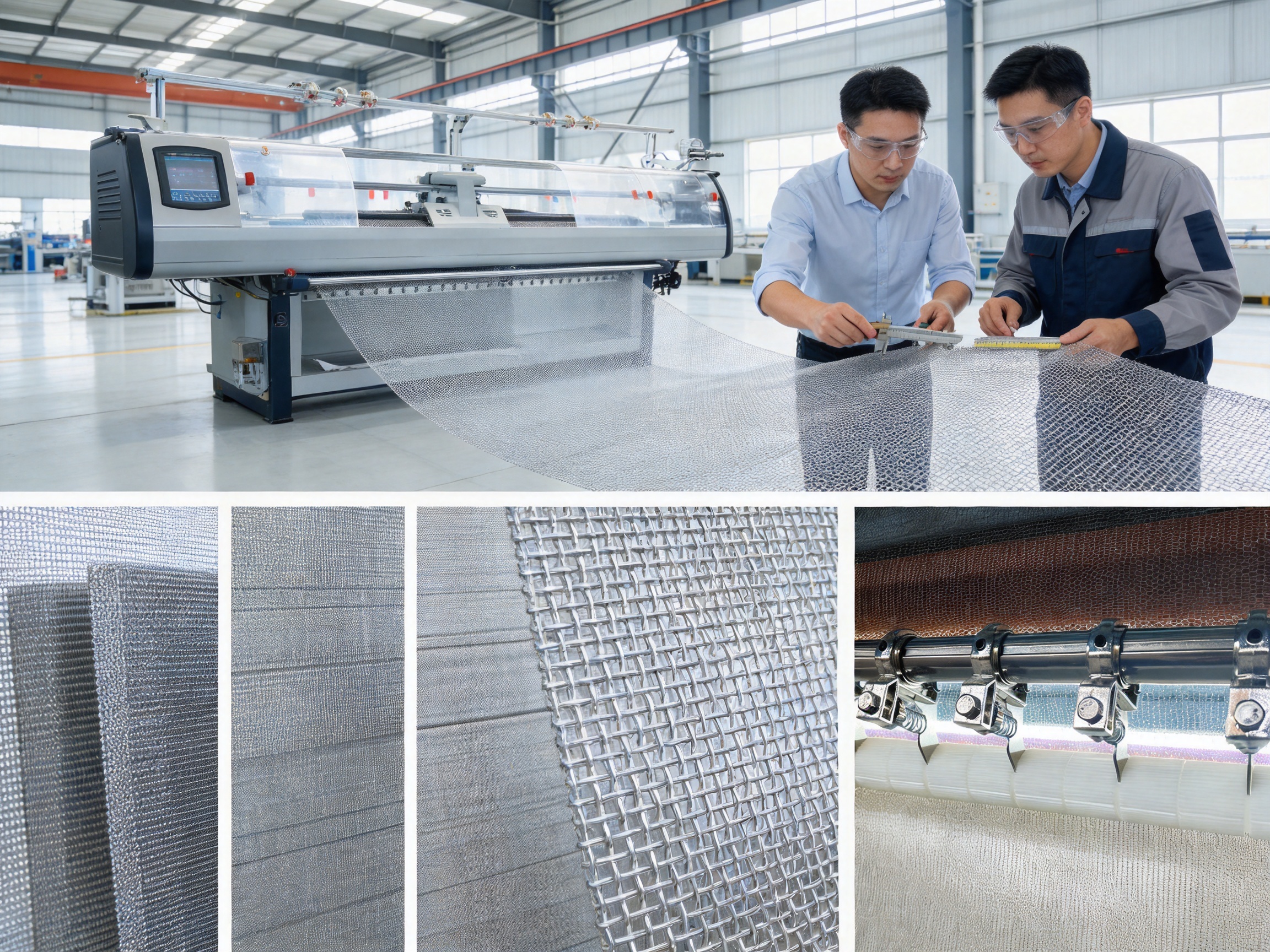
The fourth stage is stitch and take-down calibration. Stitch density and roller tension should be adjusted together because changing one can influence the other. A sample should be measured for mesh opening, width, thickness, flatness, and visual consistency. Once the target is reached, the settings should be documented and stored.
The fifth stage is speed optimization. The maximum rated speed is not automatically the ideal speed for every wire or product. Operators should identify a stable operating point that balances output with low breakage, accurate aperture formation, acceptable surface quality, and manageable machine stress.
The final stage is process monitoring. Operators should review alarms, inspect needles and wire paths, confirm lubrication, monitor take-down behavior, and check the fabric at regular intervals. A strong preventive maintenance routine helps preserve the advantages of the machine’s computerized and mechanical systems.
13. Maintenance and Operator Considerations
Although the GS-M2100 includes automatic lubrication and protection features, routine maintenance remains essential. Needles, yarn carriers, wire guides, take-down surfaces, sensors, belts, and electrical connections should be inspected according to the manufacturer’s maintenance schedule and factory conditions.
Operators should keep the knitting zone clean because metal particles, dust, and fragments from damaged wire can affect needle movement or sensor performance. Spools should be mounted securely, and the wire path should be checked for sharp edges, uncontrolled drag, or obstruction.
Alarm information should be treated as a process signal rather than simply cleared. Repeated alarms may indicate a material problem, an incorrect stitch or take-down setting, a damaged needle, a feeding issue, or a mechanical alignment concern. Investigating the cause can prevent recurring defects and protect the equipment.
Training should cover both the control interface and the physical behavior of metal wire. Operators need to understand how changes in stitch density, take-down force, racking, speed, and feeding affect the finished fabric. A well-trained team can use the machine’s flexibility more effectively and make adjustments without creating unnecessary instability.
14. Quality Control for Industrial Mesh
Quality control should be based on measurable product characteristics. Mesh aperture is often a primary parameter, but it is not the only one. Manufacturers may also need to evaluate fabric width, thickness, weight, tensile performance, edge condition, flatness, wire continuity, visual defects, and dimensional stability after handling or finishing.
Because metal mesh can contain repetitive structures, a small setting error may appear across a large area. Sampling should therefore be performed at different positions across the width and at different stages of the production roll or panel. This helps identify local feeding issues, edge effects, or gradual changes in tension.
Digital production records can improve traceability. Program files, stitch settings, take-down levels, gauge, material batch, speed, alarm history, and inspection results can be recorded for each order. The GS-M2100’s memory and computerized interface support the storage and retrieval of relevant design and operating files.
Consistent documentation also helps when an approved product must be reproduced months later. Rather than relying solely on operator memory, the production team can retrieve the saved design and parameter information, confirm the material specification, and perform a short verification run before starting the full order.
15. Commercial Value for Manufacturers
The commercial value of the GS-M2100 lies in its ability to support both efficiency and product diversification. A wide-format double-system machine can serve established industrial mesh orders while also providing a platform for new product development. This may help manufacturers respond to customers who require different openings, widths, patterns, or specialty structures.
Flexible gauge options can reduce the need to purchase separate equipment for every product family. Variable density and programmable take-down provide additional control over product characteristics. Advanced knitting functions allow the same basic machine to address both functional and decorative applications.
Reliability is equally important. A production machine that frequently stops for needle replacement, feeding correction, or fabric repair can create hidden costs beyond the original equipment price. Automatic lubrication, protection monitoring, stable servo movement, and specialty feeding are intended to reduce those risks and support a more predictable production schedule.
For exporters and contract manufacturers, multilingual operation and stored design files can simplify collaboration between technical teams, production sites, and customers. The ability to maintain repeatable machine settings is particularly useful when a product specification must be transferred between operators or facilities.
16. Q&A
Q1: What materials is the GS-M2100 designed to knit?
The machine is specifically optimized for metal wire and industrial specialty materials. It can also work with suitable specialty yarns and hybrid material combinations, provided that the material properties are evaluated and the correct feeding, gauge, stitch, and take-down settings are selected.
Q2: What is the standard working width?
The standard knitting width is 100 inches. Optional configurations with 80-inch and 120-inch widths are available for manufacturers with different product dimensions or production planning requirements.
Q3: Why is automatic oil supply important for metal mesh production?
Rigid wire can increase friction and accelerate needle wear. The automatic oil supply system provides continuous targeted lubrication, helping reduce friction, support smoother needle movement, extend needle service life, and lower the risk of maintenance-related interruptions.
Q4: What gauge options are available?
The machine is available in 3G, 3-5-7G, and 14G configurations. These options support different wire diameters, mesh densities, fabric thicknesses, and product structures. The best gauge depends on the material and finished-fabric requirements.
Q5: Can the machine produce more than a simple uniform mesh?
Yes. It supports transfer, tuck, miss, jacquard, intarsia, visible shaping, hidden shaping, racking, and variable stitch density. These functions can be used to create different apertures, patterned areas, reinforced zones, and shaped structures.
Q6: How does the double-system single-carriage design benefit production?
The configuration provides two knitting systems within a single carriage arrangement. It supports efficient programmed operations and gives manufacturers greater flexibility for complex structures and production sequences than a basic single-system arrangement.
Q7: What is the maximum knitting speed?
The maximum specified knitting speed is 0.6 meters per second. The most suitable operating speed depends on the wire type, mesh design, gauge, stitch density, take-down setting, and desired quality level.
Q8: How is mesh aperture controlled?
Mesh aperture is influenced by stitch density, gauge, material properties, knitting structure, and take-down tension. The GS-M2100 provides computerized stitch density control with 128 levels and subdivision adjustment from 0 to 650, together with programmed take-down control offering 128 tension levels.
Q9: What happens when the machine detects a problem?
The automatic protection system can issue an alarm and stop the machine when it detects conditions such as wire or yarn breakage, float yarn, rewinding, end of knitting, racking failure, needle breakage, or programming errors. This helps limit damage and allows the operator to investigate the cause.
Q10: Is the control system suitable for international factories?
The machine uses an LCD control panel, USB input, 256MB memory, real-time parameter monitoring, and multilingual support including Chinese and English. These features are intended to simplify operation, design storage, and production management in international manufacturing environments.
Q11: What power supply does the machine use?
The specified power supply is 220V, single-phase. The installation should be checked by a qualified electrical professional to confirm compatibility with the factory’s power infrastructure and applicable safety requirements.
Q12: What should a buyer evaluate before ordering?
Buyers should evaluate the intended wire type, product width, target aperture, required gauge, production volume, pattern complexity, factory power supply, operator capability, maintenance resources, and after-sales support requirements. Sample trials are recommended for new or unusually demanding materials.
17. Conclusion
The GS-M2100 3G 100-Inch Double-System Metal Mesh Knitting Machine is designed for manufacturers that require more than conventional flat knitting performance. Its wide working width, double-system single-carriage structure, specialized metal-wire feeding, automatic needle lubrication, motorized cam system, variable stitch density, servo-controlled drive, programmed take-down, and comprehensive protection functions create an integrated platform for industrial specialty fabric production.
Its advantage over more general-purpose equipment is the way these functions are combined around the specific challenges of rigid materials. The machine supports the production of protective mesh, filtration nets, industrial screens, reinforced fabrics, decorative metal textiles, and other engineered structures. Gauge and width options allow manufacturers to configure the equipment according to their product strategy rather than forcing every application into one fixed format.
The machine’s computerized system further strengthens its production value. LCD operation, USB file input, 256MB memory, multilingual support, real-time parameter adjustment, and power-off memory help factories manage complex designs and repeatable production. Automatic protection and precise motion control contribute to a more stable operating environment, while automatic oil supply and specialty feeding address major sources of wear and material instability.
Behind the product is a manufacturing approach centered on computerized knitting technology, mechanical precision, intelligent control, application flexibility, and long-term industrial use. With its technical base in Changshu, Jiangsu Province, Guosheng Wonderful Intelligent Technology (Changshu) Co., Ltd. serves textile manufacturers seeking dependable equipment for garment, footwear, specialty yarn, and industrial fabric applications.
For businesses entering the metal mesh market or upgrading an existing production line, the GS-M2100 offers a combination of scale, control, material adaptability, and process protection. Its ultimate performance will depend on correct configuration, suitable materials, trained operators, and disciplined maintenance, but its engineering architecture provides a strong foundation for stable, repeatable, and diversified industrial mesh production.
References
1. GS-M2100 Product Technical Specification, computerized double-system metal mesh knitting machine documentation.
2. Industrial Flat Knitting Technology: Needle Selection, Stitch Formation, and Fabric Control, technical manufacturing reference.
3. Textile Machinery Maintenance Principles: Lubrication, Drive Systems, and Preventive Inspection, engineering reference.
4. Specialty Textile Manufacturing: Metal Wire, Filtration Fabrics, and Protective Mesh Applications, industry reference.
5. Computerized Knitting Machine Control Systems: Pattern Storage, Servo Motion, and Production Monitoring, technical reference.
6. Industrial Quality Management for Knitted Technical Textiles, manufacturing process reference.
Product: GS-M2100 3G 100-Inch Double System Metal Mesh Knitting Machine


Ready to Begin?
Product Categories
- Sweater Knitting Machine (Economic SE)
- Sweater Knitting Machine (Full Function S)
- Collar Knitting Machine (Economic CE)(Fabric)
- Collar Knitting Machine (Full-Function C)
- Blanket Knitting Machine(Fabric)
- Shoe Upper Knitting Machine
- Ready To Wear Sweater Knitting Machine
- Ready To Wear Glove Knitting Machine
- Ready To Wear Hat Knitting Machine
- Knee Pad Knitting Machine
- Metal Mesh Knitting Machine
Contact Information
-
 Email: gs@guoshengchina.cn
-
 Phone: +86-0512-52690511
-
 Address: No. 18, Hupu Pujiang Road, Bixi New District, Changshu City, Jiangsu Province, China
QR Code
